

If you qualify for Cost-Sharing Reductions, a Silver plan usually delivers the better deal, lower premium and lower costs when you actually see a doctor. If you don’t qualify but expect regular care, Gold tends to save you money overall once you add up the full year. Either way, the real answer comes down to your income and how often you expect to use your coverage, not which metal sounds shinier. Groups like Healthcare and researchers at Brookings back that up, and it’s the same math Sobal Nationwide Health walks clients through every day.
TL;DR:
- Silver plans often provide better value for Cost-Sharing Reduction-eligible households due to higher actuarial value and lower out-of-pocket costs after subsidies.
- Gold plans can be more cost-effective for frequent healthcare users or those with ongoing medical conditions even if their premiums are higher, provided the savings on deductibles and copays outweigh the extra monthly cost.
- Silver-loading can inflate Silver premiums in many markets, making some Gold plans cheaper after subsidies, so always compare net costs using the Marketplace’s estimated expenses rather than list prices.
- Income fluctuations and eligibility for CSRs significantly impact the best metal tier choice, with higher income often shifting the recommendation toward Gold once subsidies decline or disappear.
- Re-evaluating plan options annually is crucial, as premiums, subsidies, and provider networks change each year, potentially altering the optimal choice between Silver and Gold.
Table of Contents
- Silver vs Gold Plan Comparison at a Glance
- How Silver and Gold Differ: Actuarial Value, Premiums, and Out-of-Pocket Costs
- Why Silver Can Be the Smarter Choice for CSR-Eligible Buyers
- When Gold Is Usually Better: Frequent Care and Predictable Costs
- How to Compare Total Annual Cost Between Silver and Gold in 5 Steps
- Enrollment Checklist: What to Verify Before You Hit Enroll
- How Your Income Level Changes What You’ll Actually Pay
- What Is the ‘Gold Plan Loading’ Effect?
- What if Neither Silver nor Gold Fits Your Situation?
- When Do You Need to Enroll, and What Happens if You Miss It?
- Why You Should Re-Check Your Plan Every Single Year
- Sobal Health’s Take: Why This Decision Rarely Has One Right Answer
- How Sobal Health Can Help You Choose Between Silver and Gold
- Sources
- FAQ
Silver vs Gold Plan Comparison at a Glance
Think of actuarial value as a rough estimate of how much of your average yearly medical bill the insurance company covers versus what you pay yourself. Silver plans sit around 70%, while Gold plans cover closer to 80% of those costs in a typical year. That gap is the whole reason this decision matters.
Here’s how the two stack up on the basics:
- Actuarial value: Silver averages about 70%; Gold averages about 80%, meaning Gold picks up a bigger share of your medical bills in a typical year.
- Monthly premium: Silver usually costs less per month; Gold usually costs more, sometimes significantly more depending on your area.
- Deductibles and copays: Gold plans often carry lower deductibles, typically ranging from low to moderate amounts, compared to higher Silver deductibles.
- Subsidy caveat: Premium tax credits are calculated against a benchmark Silver plan, so in some counties, Gold ends up costing about the same as Silver after subsidies, or even less.
- Best fit: Silver tends to suit CSR-eligible shoppers and light users; Gold tends to suit people who see doctors often or manage a chronic condition.
None of this changes what’s actually covered. Every plan, regardless of metal, includes the same Essential Health Benefits.
How Silver and Gold Differ: Actuarial Value, Premiums, and Out-of-Pocket Costs
Actuarial value is the concept that drives everything else in this decision. It’s the percentage of total average costs, across a large pool of enrollees, that the plan pays instead of you. The Marketplace uses four tiers built around this number: Bronze at roughly 60%, Silver at roughly 70%, Gold at roughly 80%, and Platinum at roughly 90%.
Higher actuarial value means the insurance company absorbs more of the cost when you get care, which is why Gold plans generally come with lower deductibles and copays than Silver. You pay for that shift with a higher monthly premium. It’s a trade, not a bargain, you’re just choosing where to put your money: into the monthly bill or into the moment you need care.
A few terms worth pinning down. Your deductible is what you pay before the plan starts sharing costs. Copays are flat fees for specific services, like $30 for a primary care visit. Coinsurance is your percentage share after the deductible is met. Your out-of-pocket maximum, sometimes called MOOP, is your financial safety net for the year, the absolute cap on what you’ll pay no matter how bad things get. Gold plans typically hit that safety net with less spending than Silver does. One more thing worth knowing: Gold plans generally aren’t compatible with Health Savings Accounts, since HSA eligibility requires a qualifying high-deductible structure that Gold rarely meets.
Whichever tier you land on, the Essential Health Benefits stay identical across the board. Metal tier changes how you split the bill. It doesn’t change what’s covered.
Why Silver Can Be the Smarter Choice for CSR-Eligible Buyers
Here’s the part a lot of shoppers miss entirely: Silver is the only metal tier where Cost-Sharing Reductions apply, and CSRs can transform a standard 70% actuarial value plan into something that behaves more like Platinum.
If your household income falls between roughly 100% and 250% of the federal poverty level, you may qualify for enhanced Silver plans, sometimes labeled CSR94, CSR87, or CSR73 depending on your exact income band. A CSR plan with the highest level of reduction pushes actuarial value significantly higher, which can rival or beat Gold on out-of-pocket costs while keeping Silver’s typically lower premium. That’s the best of both worlds, if you qualify.
There’s a second layer here that surprises people: silver-loading. Because premium tax credits are calculated using the cost of the benchmark Silver plan in your area, and insurers in many states have folded the cost of CSRs into Silver premiums rather than spreading it across all tiers, benchmark Silver premiums run artificially high in a lot of markets. That inflates everyone’s tax credit, which sometimes makes Gold plans nearly free, or even cheaper than Silver, after subsidies are applied.
Pro Tip: Never dismiss Silver based on the sticker premium alone. Price a CSR-adjusted Silver plan against Gold using your actual subsidy first. The gap can shrink or flip entirely once the credit is applied.
When Gold Is Usually Better: Frequent Care and Predictable Costs
Gold tends to win for a specific kind of buyer: someone who knows they’ll be in the system a lot this year. That includes people managing a chronic condition like diabetes or heart disease, anyone expecting a pregnancy, and households juggling multiple regular prescriptions.
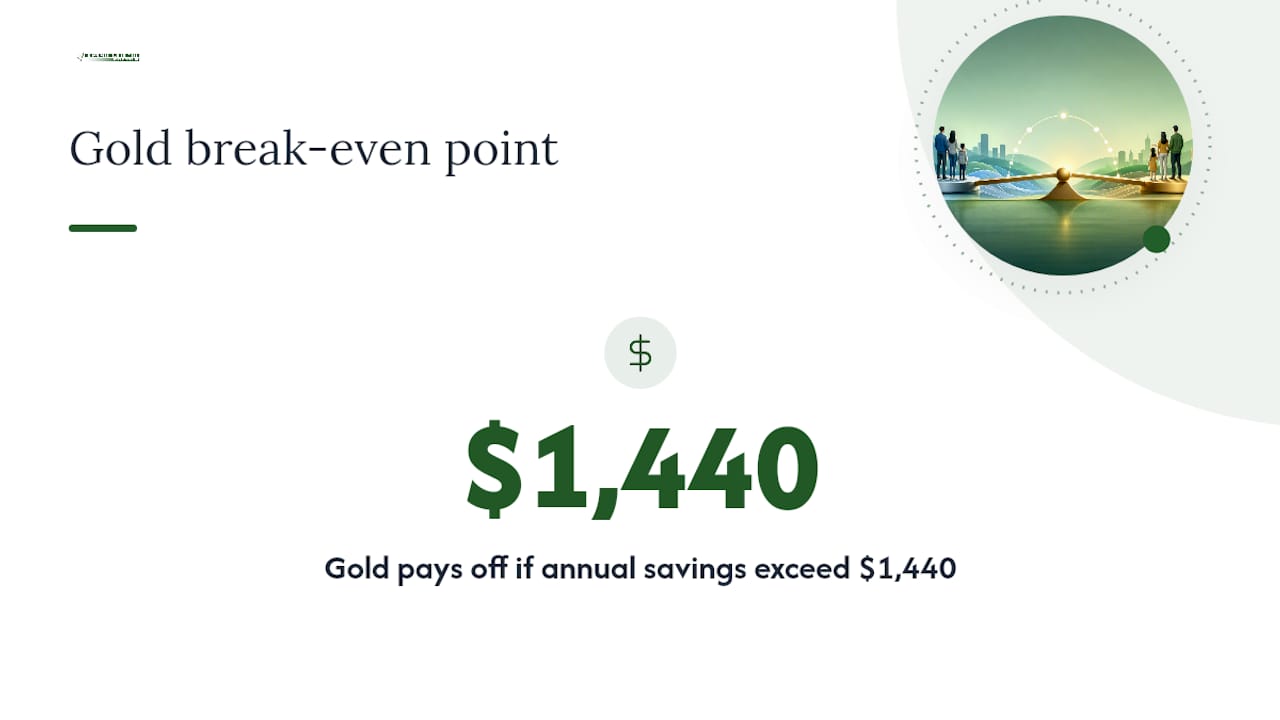
Here’s the break-even logic in plain terms. Say Gold costs $120 more per month than Silver, that’s $1,440 more per year in premium. If Gold’s lower deductible and copays save you more than $1,440 over twelve months of doctor visits, specialist consults, and prescription refills, Gold comes out ahead on total cost even though the monthly bill looks scarier. For someone who sees a specialist quarterly and fills three prescriptions a month, that math tips toward Gold fast.
Light users flip the equation. If you’re generally healthy and might visit a doctor once or twice a year, you’ll likely pay more in extra Gold premium than you’d ever spend hitting Silver’s deductible.
Before you commit either way, check the specifics that actually affect your care: confirm your usual doctors and any specialists are in-network, and look up your medications on the plan’s formulary. Two Gold plans from different insurers in the same county can price and cover the same drug completely differently, so comparing across carriers matters as much as comparing across metal tiers. If a chronic condition involves ongoing supplies, it’s also worth reviewing how your insurance category affects covered diabetic supplies before you assume any plan covers what you already use.
How to Compare Total Annual Cost Between Silver and Gold in 5 Steps
The only way to know for sure which tier wins is to run the numbers for your household, not someone else’s. Here’s the process:
- Pull current Silver and Gold rates for your area. Rates vary by county, insurer, age, and household size, so generic averages won’t tell you much.
- Check your premium tax credit and CSR eligibility. Use the Marketplace’s own tools to estimate your subsidy based on your projected income for the year.
- Calculate your net monthly premium for each plan, then multiply by twelve. This is your real annual premium cost after subsidies, not the sticker price.
- Estimate your expected annual out-of-pocket spending. Sketch a rough profile: how many doctor visits, what prescriptions, any planned procedures, then run those numbers against each plan’s copay and deductible structure.
- Add net annual premium plus expected out-of-pocket for each plan and compare the totals. Whichever number is lower is your likely better value for the year, assuming networks and formularies check out.
Pro Tip: Do this exercise for two or three insurers within the same metal tier, not just one. A Gold plan from Carrier A can price out completely differently from a Gold plan from Carrier B in the same county, thanks to network size and formulary rules.
Sobal Nationwide Health’s FAQ and cost calculator page can help you sanity-check your own math before you commit to either tier.
Enrollment Checklist: What to Verify Before You Hit Enroll
Price is only half the decision. These items quietly determine whether the “cheaper” plan on paper is actually cheaper in your life:
- Confirm your primary care doctor, any specialists, and your preferred hospital are in-network for the plan you’re considering.
- Search the plan’s prescription formulary for every medication you currently take, including dosage and brand versus generic status.
- Check when the deductible resets and how it interacts with services you already have scheduled, like a planned surgery or ongoing physical therapy.
- If contributing to a Health Savings Account matters to you, verify the plan qualifies as HSA-eligible, since most Gold plans do not.
Skipping this checklist is how people end up with a great premium and a network that doesn’t include their own doctor.
How Your Income Level Changes What You’ll Actually Pay
Your household income doesn’t just determine your subsidy amount, it determines which plans are realistically on the table. Premium tax credits scale down as income rises, and CSR eligibility disappears entirely above roughly 250% of the federal poverty level. That means the exact same Silver plan can cost dramatically different amounts for two households with different incomes, even in the same zip code.
For lower-income households within the CSR range, Silver is frequently the strongest play available, since you’re stacking a lower premium (thanks to tax credits) on top of enhanced cost-sharing (thanks to CSRs). That combination is unique to Silver and unavailable at any other metal tier.
Once your income climbs past CSR eligibility, the calculation shifts. You still may qualify for a premium tax credit if your income falls under the applicable threshold for your household size, but you lose the boosted actuarial value that made Silver so attractive. At that point, Gold starts looking more competitive, especially if you expect meaningful health care use during the year, since you’re no longer getting a special deal on Silver’s cost-sharing.
This is also why annual re-shopping matters so much. A raise, a new job, or a change in household size can shift your income band and quietly change which plan is the smart pick, even if you didn’t move and your health didn’t change. If your income is uncertain because you’re self-employed or working multiple gigs, it’s worth reviewing options built for self-employed health insurance in Florida or similar resources, since fluctuating income affects subsidy estimates more than a steady paycheck does.

What Is the ‘Gold Plan Loading’ Effect?
You’ll sometimes hear this called silver-loading, but it directly reshapes what Gold plans cost after subsidies, which is why it deserves its own explanation. Here’s the mechanism: the Marketplace calculates your premium tax credit based on the cost of the second-lowest-cost Silver plan in your area, known as the benchmark Silver plan. In states where insurers have shifted the cost of Cost-Sharing Reductions onto Silver premiums rather than spreading that cost across all metal tiers, benchmark Silver premiums run higher than they otherwise would.
Because your tax credit is pegged to that inflated benchmark, you end up with a larger subsidy than you would in a state without this practice. That larger subsidy then gets applied to whichever plan you actually choose, including Gold. The result, as Brookings has documented, is that in a meaningful number of markets, Gold plans price out close to, or even below, unsubsidized Silver plans once the credit lands.
This is precisely why comparing sticker premiums is a mistake. Two plans with wildly different list prices can cost nearly the same after your specific credit is applied, and the cheaper-looking plan on the Marketplace homepage isn’t always cheaper once your subsidy factors in. Always look at the “your estimated cost” number the Marketplace tools generate for your household, not the plan’s base price. That single number reflects the loading effect automatically, so you don’t have to reverse-engineer it yourself.
What if Neither Silver nor Gold Fits Your Situation?
Not every household fits neatly into Silver or Gold, and that’s fine, there are other lanes worth checking. If you’re generally healthy, rarely see a doctor, and mainly want protection against a catastrophic event, a Bronze plan’s lower premium and higher deductible might genuinely serve you better, especially if you’re not CSR-eligible and don’t expect to hit your deductible anyway.
Catastrophic plans sit even further down that spectrum. They’re generally limited to people under 30 or those with a hardship exemption, and they carry very high deductibles paired with very low premiums, essentially insurance against a worst-case scenario rather than a plan for routine care. They’re not right for anyone managing an ongoing condition, but for a young, healthy freelancer who mostly wants a shield against a broken leg or an appendix scare, it can make sense.
On the other end, if you have significant, predictable medical needs, a Platinum plan, where available, covers roughly 90% of costs and might justify its steep premium the same way Gold justifies its premium over Silver, just one notch further.
And outside the Marketplace entirely, private medically underwritten plans can sometimes beat ACA options on price for healthy applicants who don’t qualify for subsidies, since they’re priced on individual health risk rather than a community rating. That path isn’t right for everyone, and it requires passing medical underwriting, but it’s worth knowing it exists before assuming the Marketplace tiers are your only four options.
When Do You Need to Enroll, and What Happens if You Miss It?
Open Enrollment for Marketplace coverage typically runs from November 1 through January 15 in most states, though a handful of state-based marketplaces set their own slightly different windows. Miss that window, and you’re generally locked out of Marketplace coverage for the rest of the year unless you experience a Qualifying Life Event.
Qualifying Life Events include things like losing job-based coverage, getting married, having a baby, or moving to a new coverage area. Each of these opens a Special Enrollment Period, usually giving you 60 days from the event to select a plan. Miss that 60-day window too, and you’re typically stuck waiting for the next Open Enrollment, potentially going months without coverage or facing the full cost of a medical emergency out of pocket.
This timeline matters directly to the Silver versus Gold decision, because rates, subsidy amounts, and even CSR bands can shift from one plan year to the next. The Silver plan that made sense last November might not be the same value proposition this year, so waiting past the deadline doesn’t just risk a coverage gap, it locks you into whatever choice you made twelve months ago for another full year.
Why You Should Re-Check Your Plan Every Single Year
Your Silver or Gold decision isn’t a one-time verdict, it’s an annual checkup. Premiums shift every year, sometimes by double digits in either direction, subsidy formulas get adjusted, and insurers periodically pull out of counties or add new ones, changing your available options entirely.
Your own situation changes too. A promotion, a new dependent, a move to a different county, or a new diagnosis can all swing the math between Silver and Gold in either direction. Someone who picked Gold three years ago because of a health issue that’s since resolved might be significantly overpaying on premium today for cost-sharing they no longer need.
The smartest habit is treating Open Enrollment as a mandatory once-a-year review, not a rubber stamp on last year’s choice. Re-run the comparison: check your updated subsidy eligibility, re-verify your network and formulary since insurer contracts change too, and recalculate your expected utilization for the coming year. If your budget is the main constraint, a quick check of what to budget for health insurance in Florida style guidance can help you frame what’s realistic before you start comparing plans.
Sobal Health’s Take: Why This Decision Rarely Has One Right Answer
The honest truth about Silver versus Gold is that most online calculators oversimplify it into a single number, when the real answer depends on layering three separate variables: your income band, your realistic utilization, and your specific county’s silver-loading behavior. Get any one of those wrong, and the “obvious” choice flips.
What I see clients underestimate most often is how much CSR eligibility changes the entire equation. Households right at the edge of that 250% federal poverty level threshold sometimes qualify for a CSR73 Silver plan that beats every Gold option on the table, yet they never check because they assume Gold is automatically the “better” plan since it costs more. Metal tier isn’t a quality rating. It’s a cost-sharing design, and the best design depends entirely on your numbers, not the plan’s name.
That’s where a broker’s review earns its keep, particularly for self-employed households whose income shifts year to year and complicates subsidy estimates, or for anyone managing a specialty condition where network and formulary details make or break the plan.
— Bernie S
How Sobal Health Can Help You Choose Between Silver and Gold
Running this math alone is doable, but it’s also exactly the kind of decision where a second set of eyes catches something a calculator misses, especially when your income fluctuates or a family member needs specialty care. Licensed brokers can walk through your specific numbers with you, providing personalized help without sales pressure or bias toward a particular plan.

A free consultation typically covers reviewing your current plan and costs, estimating your premium tax credit and CSR eligibility, and comparing private medically underwritten plans that may offer potential savings.
If you’re weighing Silver against Gold for your household, start by getting a sense of what a family health plan typically costs in your situation, then reach out to Sobal Nationwide Health for a personalized comparison before Open Enrollment closes.
This article is general information, not a substitute for advice from a qualified financial advisor. Consult a qualified financial professional about your own circumstances before acting on anything here.
Sources
FAQ
Is a Gold Plan Better Than a Silver Plan?
Neither is universally better. Gold usually wins for frequent users with its lower deductibles and copays, while Silver usually wins for CSR-eligible shoppers or those who rarely need care.
Should I Get a Bronze, Silver, or Gold Plan?
Choose based on expected use and subsidy eligibility: Bronze for healthy, low-usage households wanting catastrophic protection, Silver for CSR-eligible households, and Gold for frequent or predictable care needs.
How Much Does an ACA Gold Plan Cost?
Gold plan premiums vary widely by state, county, insurer, and age, and after premium tax credits, the silver-loading effect can push the net cost close to or below Silver in some markets. Check your specific Marketplace estimate rather than relying on a national average.
Can I Switch From Silver to Gold Mid-Year?
Generally no, unless you experience a Qualifying Life Event that triggers a Special Enrollment Period; otherwise, changes wait until the next Open Enrollment.
Does a Broker Cost Extra if I Use Sobal Health Instead of Enrolling Directly?
No, brokers are typically paid a commission by the insurance carrier, so working with a broker usually does not add to your premium.
