

Vision insurance is usually worth it if you buy new glasses every year, wear daily disposable contacts, or get the plan heavily subsidized by an employer. It’s usually not worth it if you buy eyewear online, replace glasses every three or four years, or rarely visit an eye doctor. The deciding factors are your premium, your real eyewear spending, and whether your preferred provider is in-network.
TL;DR:
- Vision insurance is most cost-effective for frequent glasses replacements, daily contact wearers, families with children, or employees with employer subsidies.
- It typically covers only routine eye exams and eyewear allowances, excluding medical eye conditions like glaucoma or diabetic retinopathy.
- The plan’s value depends heavily on staying in-network, with out-of-network reimbursement offering minimal savings and often negating benefits.
- Alternative options like online retailers, warehouse club services, or cash payments may be cheaper for infrequent users or those who shop online.
- Proper calculation requires honest assessment of past spending, screening for plan limits, and ensuring the network aligns with preferred providers before enrolling.
Table of Contents
- Who Usually Benefits From Vision Insurance
- What Vision Insurance Covers and What It Does Not
- Typical Costs and Plan Features to Expect
- How to Run the Break-Even Calculation Step by Step
- Alternatives to Vision Insurance and When They Win
- How to Choose a Vision Plan (Questions to Ask)
- How Vision Fits Into Your Bigger Benefits Picture
- Get Help Comparing Your Vision and Health Benefits
- Sources
- FAQ
Who Usually Benefits From Vision Insurance
I’ve reviewed enough benefits packages to know that vision insurance isn’t a one-size-fits-all product. It’s a bet on your own habits, and some habits make that bet pay off fast.
You come out ahead most reliably if you fit one of these profiles:
- Frequent glasses replacers. If your prescription shifts often, or you just like a new frame every year, the plan’s frame allowance offsets a cost you were going to pay anyway.
- Daily disposable contact wearers. These lenses run through allowances quickly since you’re buying a fresh supply every few months, not every couple of years.
- Families with kids. Children’s prescriptions change fast, and multiple sets of eyes on one plan multiply the savings on both exams and eyewear.
- Employees with a subsidized plan. When an employer covers most or all of the premium, the math barely matters. It’s close to free money.
The catch that trips people up: most of that value depends on staying in-network. Vision plans typically negotiate set prices with specific retailers and independent providers, and going outside that network often means a flat, modest reimbursement instead of full coverage. If the optical shop you actually like isn’t on the list, a lot of the plan’s promised savings evaporate before you even file a claim. Coverage also tends to encourage more consistent use of eye care in general, which has its own quiet value beyond the receipts.
What Vision Insurance Covers and What It Does Not
Here’s the distinction that catches almost everyone off guard: vision insurance covers routine eye care, not medical eye care. Those are two different billing systems, and confusing them is where surprise bills come from.
What a standard plan typically includes:
- One routine eye exam per year, usually with a small copay
- A frame allowance, often $100 to $200 toward new frames
- A lens allowance or fixed copay for standard single-vision or bifocal lenses
- A contact lens allowance in place of the frame benefit (you generally choose one or the other)
- Frequency limits, commonly one exam and one set of eyewear every 12 to 24 months
What it typically excludes: diagnosis or treatment of eye disease. Cataracts, glaucoma, diabetic retinopathy, and similar conditions get billed to your medical insurance, not your vision plan, even when an optometrist performs the exam.
Pro Tip: Ask your eye doctor’s office to flag in advance whether your visit will include any diagnostic testing beyond a standard refraction. That single question can save you from an unexpected medical claim.
This split causes real confusion. Many patients assume any optometrist visit runs through their vision benefit, but a dry eye workup, a retinal photo, or a glaucoma screening can trigger separate medical billing and cost-sharing you didn’t budget for. Routine exams matter beyond the eyewear discount, too. Regular screening is one of the primary ways eye disorders get caught early, which is a case for getting annual exams whether or not you carry a plan.
Typical Costs and Plan Features to Expect
Standalone vision plans generally run in a moderate monthly range, resulting in annual premiums that vary accordingly. That’s the number you’re comparing against your realistic yearly eyewear and exam spending, and the comparison only works if you’re honest about what you actually buy.
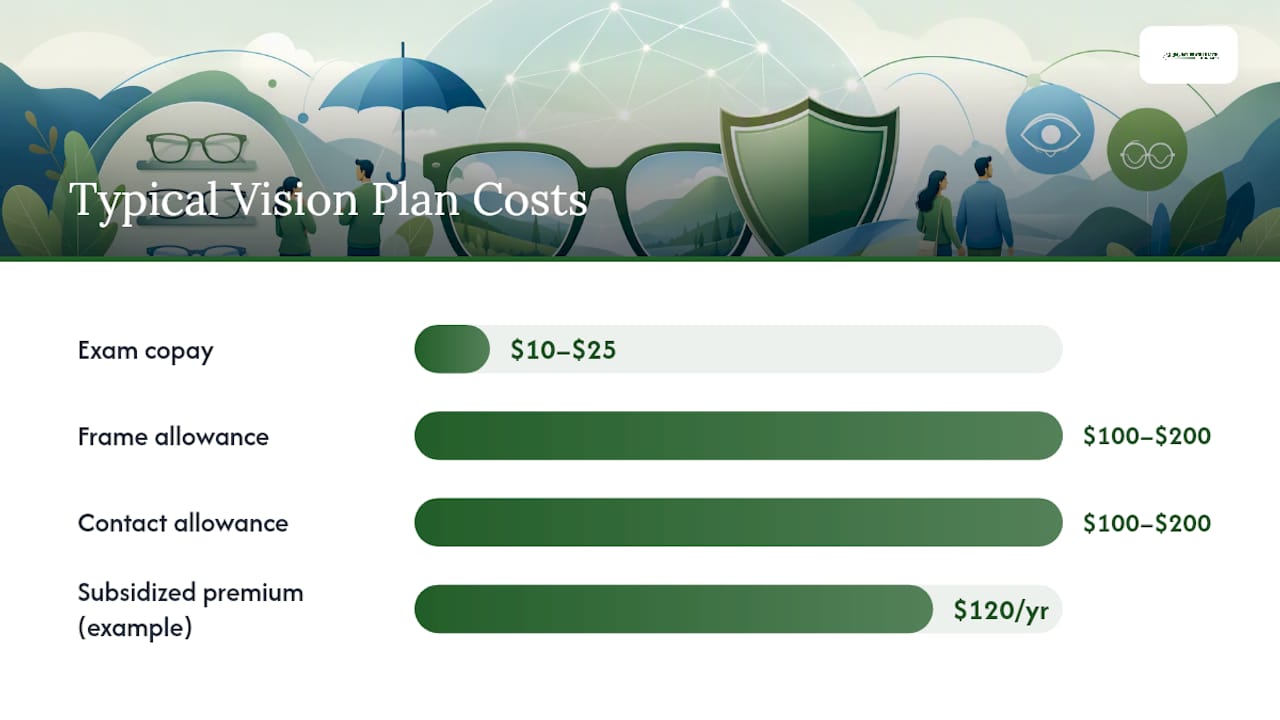
Vision insurance behaves less like protection against a catastrophe and more like a prepaid discount arrangement: you pay a fixed amount up front in exchange for fixed allowances and copays, regardless of what the market price ends up being.
Here’s what those allowances typically look like in practice:
| Plan Feature | Typical Range | What It Means for You |
|---|---|---|
| Monthly premium | A moderate monthly range | Varies annually, before any employer subsidy |
| Exam copay | $10 to $25 | Small out-of-pocket cost for your annual visit |
| Frame allowance | $100 to $200 | Applied toward frames; you pay the difference above that |
| Contact lens allowance | $100 to $200 | Usually replaces the frame allowance, not added to it |
| Frequency limit | Every 12 to 24 months | Determines how often you can actually use the benefit |
Two things swing this math harder than people expect. First, in-network pricing: the negotiated rate at a participating retailer is often lower than the same frame’s sticker price elsewhere, so your allowance stretches further. Second, frequency limits reset on a schedule, not on your timeline. If your plan allows new eyewear every 24 months but your prescription changes annually, you’re paying full price in the off years no matter what the plan promises. A subsidized plan changes the entire equation, since even a partially covered premium of $120 a year can be a clear win if your employer is paying most of it.
How to Run the Break-Even Calculation Step by Step
You don’t need a spreadsheet degree to figure this out. You need three numbers and five minutes.
- Calculate your annual premium. Take the monthly cost and multiply by 12. If your employer covers part of it, use your actual payroll deduction, not the sticker premium.
- Add up what you’d realistically spend in cash. Be honest here. Look at your last exam bill, your last pair of glasses, and your contact lens supply cost, and total what a full year of that would run without insurance.
- Apply the plan’s copays and allowances to that same spending. Subtract what you’d pay under the plan (copay plus any amount above the allowance) from what you’d pay in cash, then compare that savings to your annual premium.
Example one: the annual glasses buyer. Say your premium is $180 a year. Without insurance, you’d pay $150 for an exam and roughly $250 for new frames and lenses, or $400 total. With insurance, you pay a $20 exam copay and $40 above your $200 frame and lens allowance, or $60 total. Insurance saves you $340 on eyewear costs against a $180 premium, a net gain of $160.
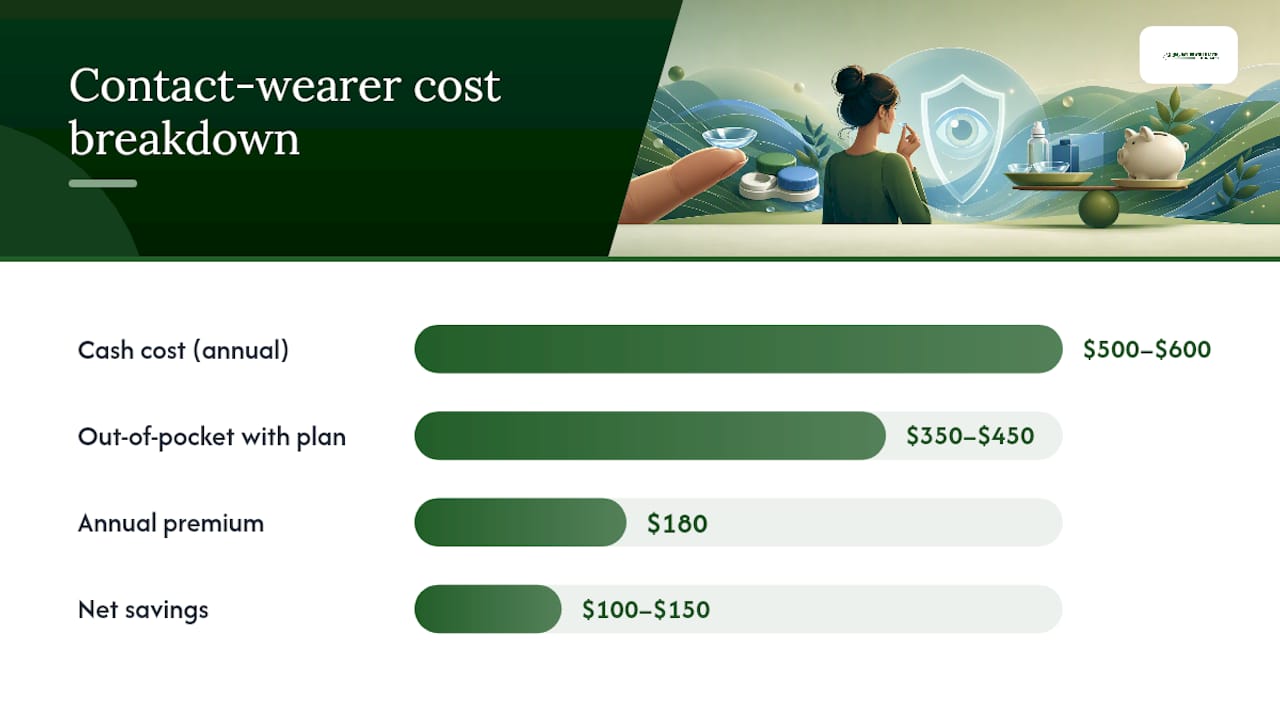
Example two: the daily disposable contact wearer. Premium is $180 a year. Cash cost for an annual supply of daily contacts plus a fitting exam often runs $500 to $600. A plan with a $150 contact allowance and a $25 exam copay might leave you paying $350 to $450 out of pocket. Subtract the $180 premium, and you’re still ahead by roughly $100 to $150.
Three pitfalls can quietly wreck this math: choosing an out-of-network provider, assuming your frequency limit matches your actual replacement schedule, and upgrading to premium lens coatings or transitions lenses that blow past your allowance and eat the savings you calculated.
Pro Tip: Pull your last two years of actual eye care receipts before you run this calculation. Guessing at “what you’d probably spend” is how people talk themselves into a plan they don’t need.
Alternatives to Vision Insurance and When They Win
Skipping the plan isn’t reckless if your numbers point that way. Several cash-based options can beat a monthly premium, sometimes by a wide margin.
- Warehouse club exams and eyewear. Retailers like Costco’s optical centers are known for running exams and glasses well below typical retail optical pricing, often cheap enough on their own to undercut a year of premiums.
- Online eyewear retailers. Buying frames and lenses online can cost a fraction of in-store optical pricing, especially for basic single-vision prescriptions without added coatings.
- Discount vision membership plans. These aren’t insurance. You pay a smaller flat fee for a percentage discount at partner providers, with no monthly premium commitment.
- Direct cash payment with price shopping. For people who rarely need new eyewear, paying full price every three or four years can cost less overall than years of premiums for a benefit you barely use.
The scenario where cash clearly wins: someone who replaces glasses every three years, has a stable prescription, and shops online. Two years of a $180 premium is $360 spent for a benefit used once, while buying that same pair of glasses online might cost less than the premiums alone. Vision insurance only earns its keep when your usage is frequent enough to catch up to what you paid for it.
How to Choose a Vision Plan (Questions to Ask)
If your break-even math says a plan is worth it, the next job is picking one that actually delivers on paper. Not all plans with similar premiums offer similar value.
Ask these questions before you enroll:
- Is my preferred optical retailer or eye doctor actually in-network, not just “accepted” in some limited way?
- What’s the exact frame allowance and contact lens allowance, and do they combine or replace each other?
- What’s the frequency limit, and does it match how often I actually replace eyewear or contacts?
- How does out-of-network reimbursement work, and is it a flat low amount or a percentage of cost?
- Are lens upgrades (anti-glare, transitions, high-index) included, or will they burn through my allowance fast?
Pro Tip: Call the optical retailer directly and ask what a specific plan’s negotiated pricing looks like for the frames you’d actually choose. Provider staff often know plan quirks better than a generic benefits summary does.
Red flags worth walking away from: allowances under $100, exam copays over $30, or exclusion language so broad it barely covers standard lenses. If a plan is offered through an employer, always check the subsidized rate first. Employer-sponsored vision benefits with even partial subsidies routinely beat any standalone plan you’d buy on your own, and comparing that option against your other health insurance choices is worth doing at the same time you evaluate vision.
How Vision Fits Into Your Bigger Benefits Picture
Vision decisions rarely happen in isolation. The $180 a year you spend or save on a vision plan is small compared to the choices you’re making on your main health insurance, and I’ve seen people obsess over a vision premium while overpaying by hundreds on their medical plan.
That’s the real value of stepping back. At Sobal Nationwide Health, we walk self-employed individuals and families through exactly this kind of comparison, weighing vision, dental, and supplemental options against the medical premium tradeoffs that matter more to your monthly budget. A vision plan is a small line item. Where you land on deductibles and premium tiers usually moves the needle further.
If your own math feels murky, a broker can run these numbers with you in minutes instead of an evening with a spreadsheet.
— Bernie S
Get Help Comparing Your Vision and Health Benefits
You can get help from brokers who run the numbers with you instead of providing generic plan comparison charts. Vision coverage is one piece of a much larger conversation about where your premium dollars actually do the most good.
Our brokers walk you through what a vision allowance is really worth against your specific eyewear habits, and how that stacks up against skipping the plan and paying cash. We do the same side-by-side math for dental, supplemental accidental coverage, and your core medical plan, so you’re not guessing at any single piece in isolation. There’s no sales pressure and no cost to talk it through. If you want a clear answer on whether a plan makes sense for your household, connect with Sobal Nationwide Health and get a personalized comparison before you enroll in anything.
Sources
- What does vision insurance cover, costs, exclusions and more | LegalClarity
- Why eye exams are important | CDC
This article is general information, not a substitute for advice from a qualified financial advisor. Consult a qualified financial professional about your own circumstances before acting on anything here.
FAQ
Is $300 Expensive for Glasses?
It depends on the lenses. A basic single-vision pair priced at retail is typically on the higher end without insurance, but with coatings like anti-glare or high-index lenses, that price is close to typical retail pricing, and a vision plan’s frame and lens allowance can bring that down significantly.
Should I Opt Out of Vision Insurance?
Opting out usually makes sense if you buy eyewear online, replace glasses every few years, or rarely visit an eye doctor. Run the break-even math from your last two years of receipts before deciding either way.
Does Vision Insurance Really Save Money?
It saves money for people who use it regularly. Coverage increases how often people actually use eye care services and can improve prescription accuracy, but the dollar savings depend heavily on staying in-network and using your full allowance each cycle.
What Is a Good Price for Vision Insurance?
A standalone plan in the $10 to $25 monthly range is typical. Anything above that needs a frame allowance of at least $150 and a reasonable exam copay to still be worth the higher premium.
