






For individual and family plans, you generally don’t pay a broker anything extra: brokers are usually paid by the insurance company whose plan you pick. The one exception is a separate fee, which a broker must disclose in writing before you agree to anything.
I’m Bernie Sobalvarro, a licensed broker, and this is the question I hear most from self-employed people, families and small business owners. Here is how the money flows, where fees can appear, and what to ask so nothing surprises you.
TL;DR
- Brokers typically earn a commission from the insurer, not from you, so the plan’s price to you doesn’t go up because you used one.
- A separate fee is the exception, and rules in states such as Minnesota require written disclosure of it before services begin.
- Ask every broker how they are paid and which insurers they work with, since not every broker contracts with every plan.
- Using a broker doesn’t cost you Marketplace savings if the broker enrolls you through the Marketplace.
Table of Contents
- How health insurance brokers get paid
- Can a broker charge you a separate fee?
- Fees for small businesses
- Does using a broker cost you savings?
- Do you have to use a broker?
- Who this matters to most
- Questions to ask any broker
- How we work
- Our perspective
- FAQ
- Sources
How health insurance brokers get paid
A broker is a licensed professional who helps you compare and enroll in coverage. In most states the legal term is “producer.” The DC Health Benefit Exchange Authority explains that agents are typically paid only commissions, and most brokers are paid through commissions too. Some brokers who work mainly with large employers charge the client a fee instead.
Think of it like this: the insurer builds the cost of distribution into the plan’s rate. Whether you buy through a broker or on your own, the premium for the same plan is the same. You aren’t paying extra for the help. You are using help that is already built into the price.
That is why the advice costs you nothing out of pocket. A broker earns income when you enroll, which is also why the way they are paid matters, and why it is fair to ask about it.
Can a broker charge you a separate fee?
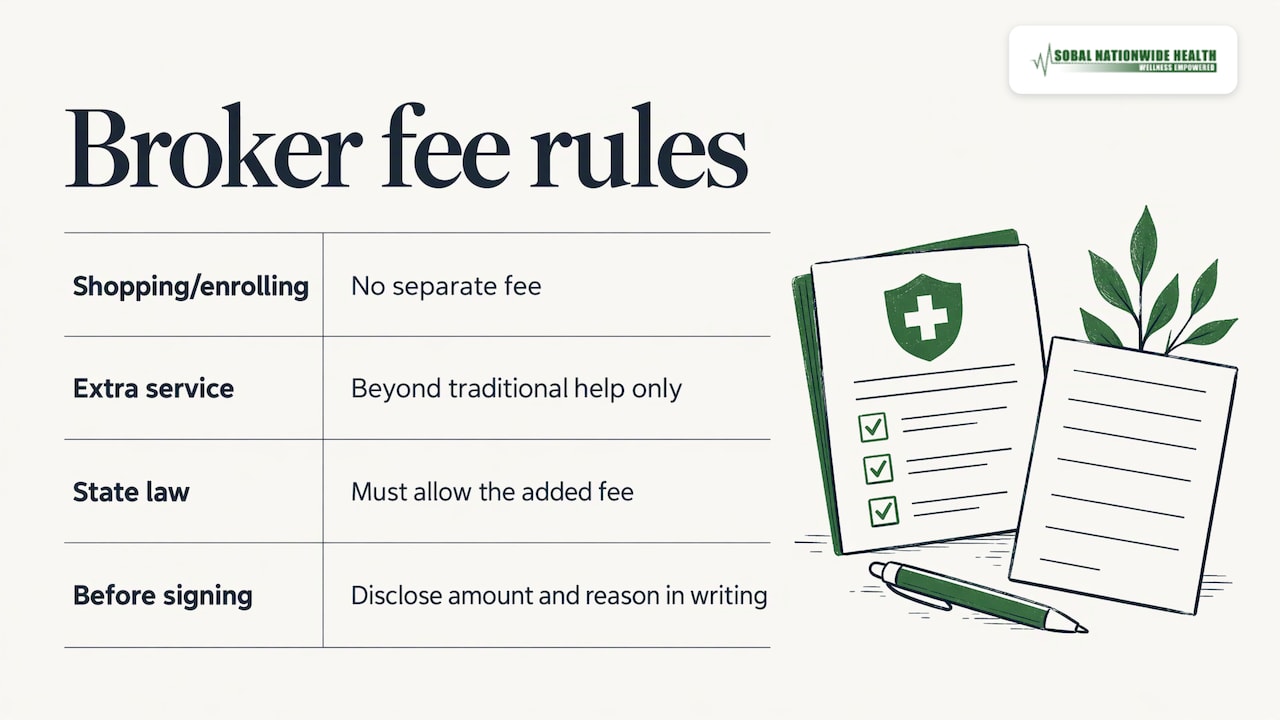
Sometimes, depending on the state and the situation. Federal guidance for web-brokers on the federal Marketplace says consumers shouldn’t be charged a separate transaction or service fee just for shopping or enrolling. An added fee may be appropriate only for a real service beyond traditional help, if state law allows it and a disclaimer states the amount and the reason.
States add their own rules. Minnesota, for example, says a producer must not charge a fee for soliciting, negotiating or servicing a contract without written disclosure beforehand. Maryland’s state Marketplace says there is no fee when you use an authorized broker.
The takeaway for you: if a fee ever comes up, it should be in writing, with an amount and a reason, before you sign.
Fees for small businesses
If you own a business with 2 to 30 employees, the picture can look a little different. Some brokers who serve employers work on a fee basis paid by the business, rather than on commission. Our business health insurance page lists broker fees among the services we handle for employers. An agent can walk you through all the options and explain how any fee would work for your situation.
Does using a broker cost you savings?
No. HealthCare.gov states that you can still qualify for a premium tax credit and other savings with a broker, as long as the broker enrolls you through the Marketplace. Savings depend on your estimated household income, not on who helps you.
Many of the people I work with earn too much for those subsidies. For them, private plans outside the Marketplace are worth a look. Our open enrollment page compares private plans with Marketplace plans for higher earners.
Do you have to use a broker?
No. You can enroll on your own through HealthCare.gov, by phone, or with free Navigators and Certified Application Counselors. The American Lung Association notes that Marketplace open enrollment for 2027 coverage runs November 1, 2026 to January 15, 2027 in most states, with a few extending later.
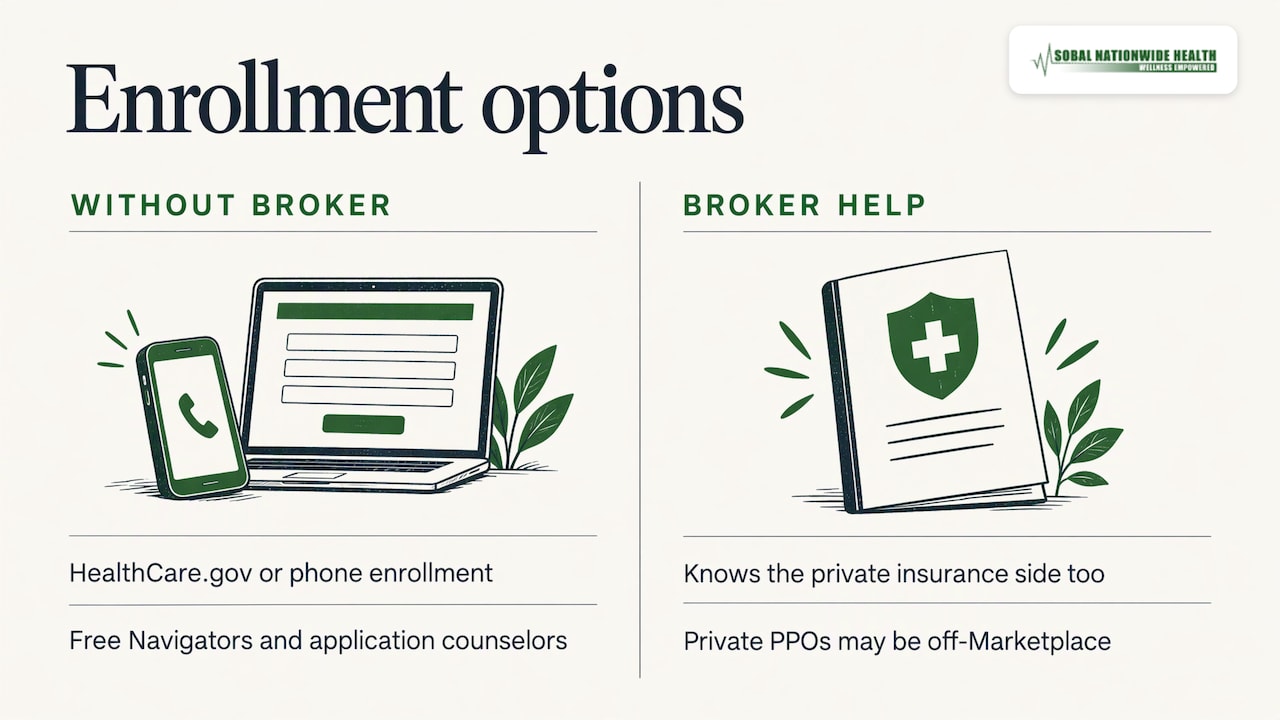
What a broker adds is a person who knows the private side too. Many private PPO-style plans, which let you see doctors and hospitals nationwide, aren’t sold on the Marketplace at all. These plans are medically underwritten, meaning the insurer reviews your health history before approving you. Our guide to medically underwritten insurance explains how that works. We never ask health questions on our quote form, only zip code and birthdates.
Who this matters to most
- Self-employed and 1099 workers, including realtors and owner-operator truckers, who buy coverage without an employer. See our 1099 contractor guide.
- People leaving COBRA or a job, who want a private option.
- Families priced out of a spouse’s employer plan.
- Young adults turning 26 and leaving a parent’s plan.
- Small business owners comparing group options.
We don’t offer Medicare or Medicaid.
Questions to ask any broker
The American Lung Association advises asking brokers how they are compensated, since higher commission on one plan could sway a recommendation. Good questions are:
- How are you paid, and will I be charged anything beyond the premium?
- Are you licensed in my state?
- Which insurers can you offer me, and which can’t you?
- Will you put any fee in writing first?
- Who do I call after I enroll?
Our page on questions to ask a health insurance broker goes deeper, and our resources library covers the basics of premiums, deductibles and out-of-pocket maximums. If you’re in Florida or Texas, see our Florida broker page or Texas broker page. Texas clients are served by phone or webinar screen share.
How we work
Sobal Health is a commission-based brokerage: we are paid by the insurance carriers when a client enrolls. We work with self-employed individuals, families and small businesses across 31 states, and you can reach a broker in English or Spanish. Our approach is one-on-one education, without sales pressure. Our personal and family page shows the kinds of coverage we offer, including dental, vision, accident and critical illness. To find the right person for you, start with find a health insurance broker.

Our perspective
The most common fear I hear is that a broker means a higher bill. It doesn’t have to. I’d rather you ask me how I’m paid on the first call than wonder about it for weeks.
What I care about is that you understand your plan: the premium is what gets you in the door, the deductible is what you pay before the plan starts sharing costs, and the out-of-pocket maximum is your financial safety net. If I explain those well, you can choose with confidence, whether that’s a private PPO-style plan or something else.
Some clients tell us they saved on premiums by switching. I never promise savings or coverage, because every quote depends on your age, location and the plan. What I can promise is a straight answer and no pressure.
Bernie S
FAQ
How are health insurance brokers paid?
Most earn a commission from the insurance company when you enroll. HealthCare.gov says their services are generally free to consumers for this reason. Some brokers who serve large employers are paid a fee by the client.
Is it more expensive to use a broker?
HealthCare.gov states you won’t pay anything additional if you enroll with an agent or broker. The plan’s price is the same whether you buy directly or through one.
What is a reasonable broker fee?
For individual plans, no separate fee is the norm. If a broker proposes one, it should be disclosed in writing with the amount and reason before you agree, as in Minnesota’s rules.
Do I have to go through a broker?
No. You can apply through HealthCare.gov or call the Marketplace center. A broker can help if you want to compare private plans as well, and we can walk you through the options by phone or webinar screen share.
Does the quote form ask about my health?
No. We only need your zip code and birthdates.
Ready to see your options? Get a free quote at sobalhealth.com/#quote or call (305) 680-0125.
Sources
- HealthCare.gov: Agent and broker glossary
- HealthCare.gov: Get contacted by an agent/broker
- DC Health Benefit Exchange Authority: Agents and brokers FAQ
- CMS: Application fees guidance
- MNsure: Broker fees policy
- Maryland Health Connection: What is an insurance broker?
- American Lung Association: Health Insurance Marketplaces 101
- NAIC: FAQ about health care reform