

If you run an S corporation, four routes actually work: SHOP for employers with staff, a CHOICE Arrangement (also called an ICHRA) that reimburses employees for coverage they pick themselves, individual Marketplace or off-Exchange plans bought directly by employees, and broker-assisted medically underwritten plans for owners who want more control. We will walk through each one so you can see which fits your situation, whether you are a solo owner or running payroll for a small team.
TL;DR:
- SHOP generally requires at least one common law employee who is not an owner or family member, so a solo owner usually cannot enroll.
- Employers under 25 FTEs may qualify for a tax credit covering up to 50% of premium contributions if they meet wage and coverage requirements.
- For 2026, an ICHRA is affordable when the employee’s net monthly cost for the area’s lowest priced individual Silver plan stays below 9.96% of household income.
- Marketplace plans are the only route to premium tax credits; individual coverage generally requires open enrollment or a qualifying life event for special enrollment.
- Solo owners or those seeking portable coverage can ask a broker about medically underwritten private plans, though availability depends on their circumstances.
Table of Contents
- Top options for S corp owners and employees, at a glance
- How SHOP works and when an S corp can use it
- What CHOICE Arrangements and HRAs do for S corp owners
- Individual market and off-Exchange options: enrollment and timing
- How to choose the right route for your S corp
- Publisher perspective: how a broker supports S corp decisions
- Get broker-led help choosing your S corp’s coverage
- FAQ
- Sources
Top options for S corp owners and employees, at a glance
Think of these four paths as different doors into the same room: health coverage that actually fits your budget and your team’s needs.
- SHOP (Small Business Health Options Program): a traditional group plan route built for employers with 1 to 50 full-time equivalent employees who want to offer one health plan or a short menu of plans.
- CHOICE Arrangements (ICHRAs) and other HRAs: employer-funded reimbursement accounts that let each employee shop for their own individual plan instead of being locked into one group policy.
- Individual Marketplace and off-Exchange plans: coverage employees buy directly, either through Healthcare or straight from an insurer, often paired with an HRA contribution.
- Broker-assisted, medically underwritten plans: private plans sold outside the Marketplace that can offer lower premiums for healthy applicants, a possible option for owners to discuss with a broker.
Each one solves a different problem. SHOP gives you predictable group pricing, a CHOICE Arrangement lets employees choose individual coverage while giving employers a defined contribution, and the individual and off-Exchange markets give flexibility to people who want to shop on their own terms.
How SHOP works and when an S corp can use it
SHOP is built for small employers who want to offer a traditional group plan without the overhead of a large-group policy. According to HealthCare.gov’s SHOP overview, employers with 1 to 50 full-time equivalent employees in most states can enroll any time of year, choose one plan or several, set contribution levels, and work through an insurer or a SHOP-registered agent or broker.
A few mechanics matter before you apply:
- Owners, partners, and family members are excluded from SHOP’s employee counts.
- Check the official SHOP information for availability in your area.
- Check the official SHOP information before you commit to a plan.
If your business meets the size and wage thresholds, you may also qualify for the Small Business Health Care Tax Credit, worth up to 50% of your premium contributions when you have fewer than 25 FTEs, pay average wages under the qualifying limit, and cover at least 50% of each enrolled employee’s premium. Owners, partners, and their family members do not count toward your FTE total or your participation numbers.
Pro Tip: Run your FTE count through the official SHOP calculator before assuming you qualify. Owner-only S corps may not meet SHOP’s employee eligibility requirements.
What CHOICE Arrangements and HRAs do for S corp owners
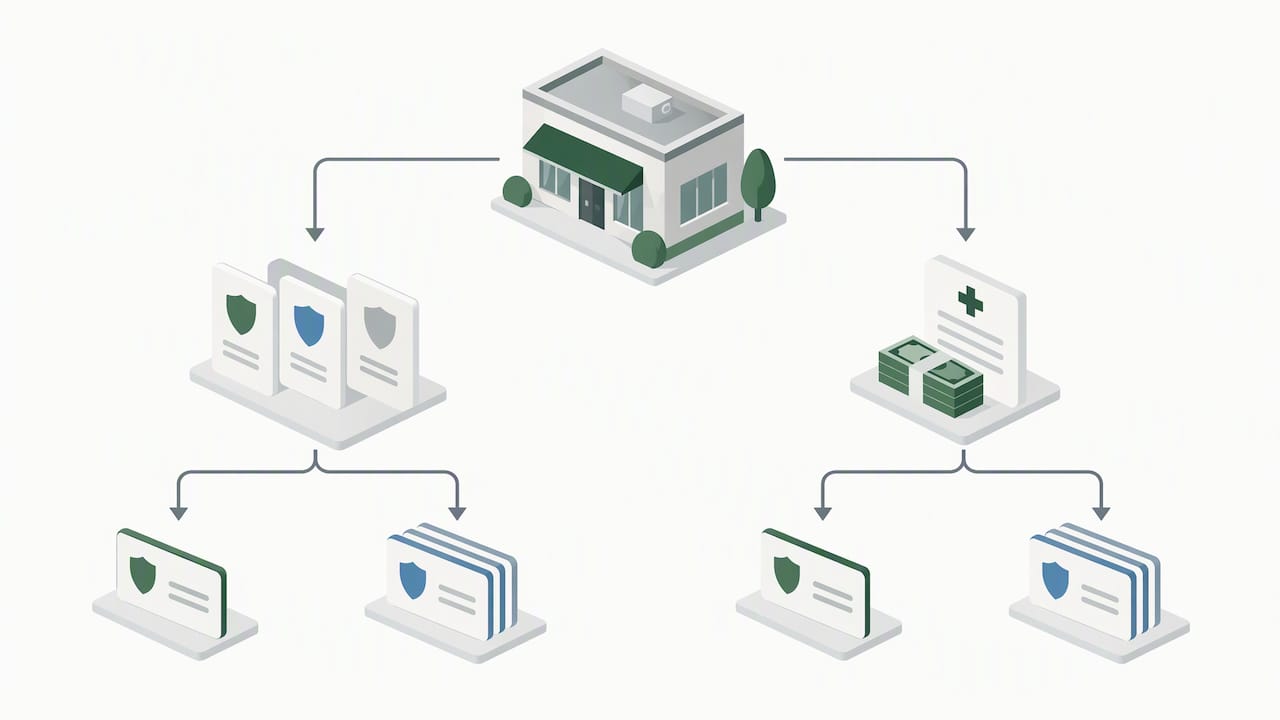
A CHOICE Arrangement, more formally an Individual Coverage HRA, flips the traditional model. Instead of picking one group plan for everyone, you set aside a fixed reimbursement amount and let each employee buy the individual plan that fits their life, whether that is a Marketplace plan, an off-Exchange plan, or Medicare. According to CMS’s overview of CHOICE Arrangements, you cannot offer this to an employee who is also offered a traditional group plan from your business, and you must offer the same terms to everyone within a given class of employees.
Design rules worth knowing before you set one up:
- You can organize employees into permitted classes, subject to the applicable rules.
- Class structures must follow the applicable rules.
- You will need to handle substantiation and send required notices, which is why many employers lean on a third-party administrator or broker to manage the paperwork.
For 2026, a CHOICE Arrangement counts as affordable if an employee’s monthly cost for the self-only lowest-cost Silver plan in their area, after your reimbursement, comes in under 9.96% of their household income. That threshold decides whether your employees can still claim Marketplace premium tax credits on top of what you contribute, so it is worth checking before you finalize contribution amounts.
Individual market and off-Exchange options: enrollment and timing
Employees who buy their own coverage, whether reimbursed through an HRA or completely on their own, work within the same calendar as everyone else in the individual market. Enrollment timing depends on the applicable enrollment period and whether an employee qualifies for a special enrollment period. Check HealthCare.gov for current details.
There is a real difference between buying on-Exchange and off-Exchange:
- On-Exchange (Marketplace): the only place to apply premium tax credits, and the required path if an employee wants to claim subsidies.
- Off-Exchange: plans purchased directly from an insurer or through a broker, often useful when an employee does not qualify for subsidies or wants a plan type the Marketplace does not list.
- HRA interaction: if your CHOICE Arrangement is considered affordable under the LCSP test, employees generally need to opt out of the HRA and decline the reimbursement before they can claim Marketplace tax credits instead.
That last point trips up a lot of employees, so it is worth spelling out clearly during enrollment season rather than letting people guess.
How to choose the right route for your S corp
The right path depends less on what sounds appealing and more on three concrete facts about your business: how many people you employ, how predictable you need your budget to be, and whether portability matters to you personally.
- Confirm your FTE count and whether you have non-owner common-law employees. This single fact rules SHOP in or out immediately.
- Run the Small Business Health Care Tax Credit calculator to see if group coverage comes with a meaningful offset.
- Model a CHOICE Arrangement using the lowest-cost Silver plan in your area if you want fixed costs and employee flexibility instead of one group plan.
- Talk to a broker or TPA about off-Exchange and medically underwritten options if you are an owner-only S corp or want coverage that travels with you regardless of employment status.
- Document your notices and substantiation process before your first plan year starts, especially if you choose an ICHRA.
If you have employees and want the simplicity of one group plan, start with SHOP. If you want fixed contributions and employees who each pick their own coverage, a CHOICE Arrangement usually fits better. If you are the only person on payroll or you travel between states for work, a private, medically underwritten plan through a broker is often worth a serious look.
Pro Tip: Do not assume you can add yourself to a group SHOP plan as the sole employee. Owners typically need at least one non-family, common-law employee for SHOP eligibility to apply.
Publisher perspective: how a broker supports S corp decisions
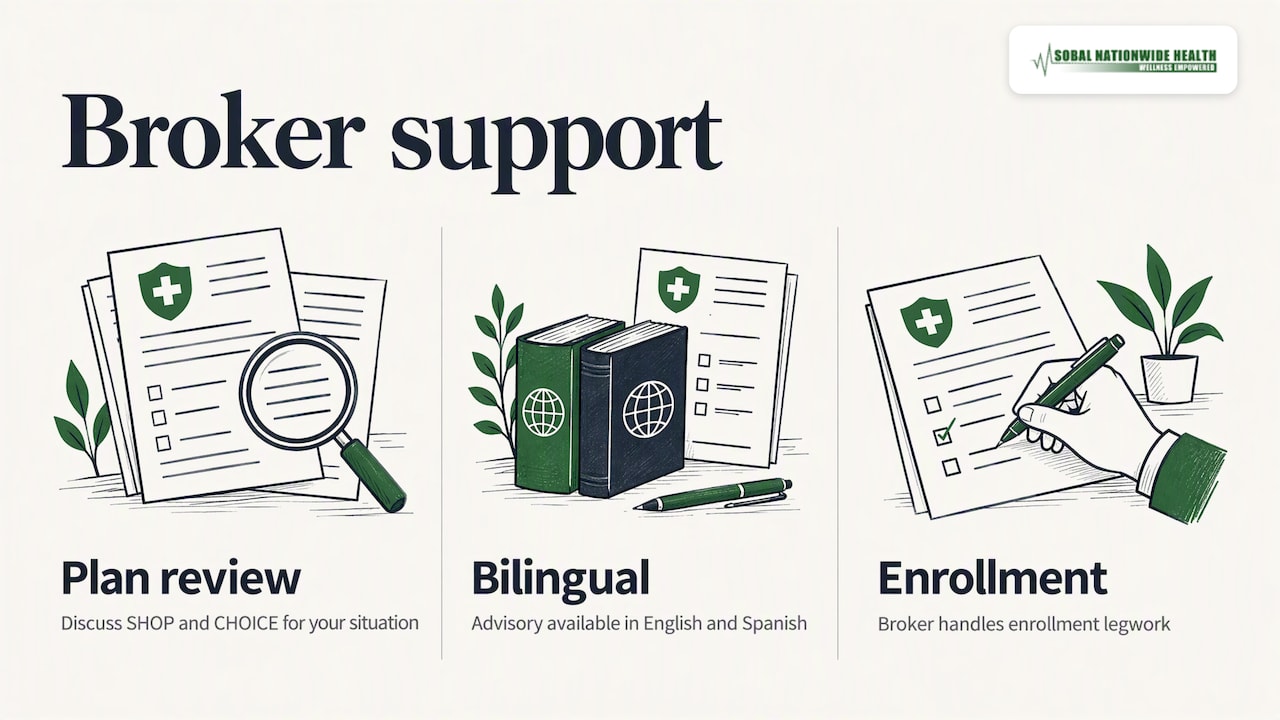
We work with S-corp owners who are stuck between SHOP paperwork, ICHRA math, and a Marketplace plan that does not quite fit. Our role is to walk through the real numbers with you, not just hand you a brochure.
At Sobal Nationwide Health, we operate as a brokerage and can discuss SHOP and CHOICE Arrangements for your specific situation. We offer advisory in English and Spanish, and we handle the enrollment legwork so you are not reading plan documents alone at midnight. If you want a second set of eyes on your options before you commit, a short consult usually clears up more than another hour of searching.
— Bernie S
Get broker-led help choosing your S corp’s coverage
Whether you are enrolling your first employee in a SHOP plan or shopping for a private, medically underwritten option as a solo owner, having someone walk through the numbers with you saves real time. We offer:
- Personalized advisory for business health insurance, including enrollment support for S corps with staff.
- Access to private, medically underwritten plans not listed on the public Marketplace, for owners who want portable, nationwide coverage.
- Broker guidance in English and Spanish, with no pressure to buy before you are ready.
Visit our business health insurance page to see your options, or reach out for a consult if you would rather talk through your specific situation first.
FAQ
Can a one-person S corp enroll in a SHOP plan?
Generally, no. SHOP requires at least one common-law employee who is not an owner, partner, or family member, so an owner-only S corp typically does not meet the participation threshold.
What is the difference between SHOP and a CHOICE Arrangement?
SHOP is a traditional group plan where you pick one policy (or a small menu) for everyone, while a CHOICE Arrangement, or ICHRA, gives each employee a fixed reimbursement to buy their own individual plan. The right choice depends on whether you want one shared plan or more flexibility for each employee.
Does offering an HRA affect an employee’s Marketplace tax credit?
Yes, if your CHOICE Arrangement is considered affordable under the lowest-cost Silver plan test, the employee generally cannot also claim Marketplace premium tax credits unless they opt out of the HRA. This makes it worth modeling affordability carefully before you set contribution levels.
Are medically underwritten plans a realistic option for S corp owners?
Owners considering coverage options can discuss them with a broker to determine what is available for their circumstances.
When can employees enroll in individual Marketplace coverage?
Employees can enroll during the annual open enrollment period or during a special enrollment period triggered by a qualifying life event such as a new job or loss of other coverage. Coverage bought off-Exchange follows similar timing but is purchased directly from an insurer or broker rather than through HealthCare.gov.
