

Family accident insurance is a supplemental policy that pays you a cash benefit when a covered accident injures you, your spouse or your kids. It does not replace your health plan. It sits beside it and helps with the bills your health plan leaves behind: deductibles, copays, time off work, and the everyday costs of a bad week. If you have kids in sports, a long commute, or a high-deductible plan, it is worth understanding. If your budget is already tight, it may not be the first dollar you spend. Below, we walk through how it works, what it leaves out, and how to decide.
TL;DR
- Accident insurance is supplemental. It pays fixed cash amounts after a covered accidental injury, and your regular health insurance still pays the medical bills.
- Benefits usually go straight to you, and you can spend them on deductibles, rent, groceries or lost income.
- Every policy has exclusions and limits, so read the list for pre-existing conditions, risky activities and work-related injuries before you enroll.
- It tends to make the most sense for families with a high deductible, active kids, or an income that stops when a parent can’t work.
- Compare the monthly premium against the benefit schedule, not the headline price alone.
Table of Contents
- What family accident insurance actually is
- How the benefits are paid
- What accident insurance may cover
- What accident insurance usually leaves out
- What it costs
- Is it worth it for your family?
- Where accident insurance fits with your main plan
- How to choose a policy, step by step
- Our perspective: what we see when families ask us about this
- Get help comparing options
- FAQ
- Sources
What family accident insurance actually is
Think of your health plan as the main structure and accident insurance as a small cushion beside it. The National Association of Insurance Commissioners (NAIC) explains that accident-only supplemental coverage pays a benefit after an accident causes injuries requiring hospitalization or treatment. Depending on the policy, that is either a lump sum or a fixed dollar amount tied to a specific service, such as an emergency room visit.
The same NAIC overview is clear about what it is not. Supplemental benefits are not comprehensive medical coverage, and they do not pay medical expenses on an expense-incurred basis. They usually pay fixed amounts directly to the insured, for any purpose.
That last part is what people tend to find surprising. The money is not a reimbursement sent to the hospital. It is cash that lands with you.
How it differs from health insurance
Your health plan is built around network rules, deductibles and coinsurance. Accident insurance is built around a schedule: this injury pays this amount. A broken wrist might pay one figure, an ambulance ride another, a night in the hospital another. You do not need to wait until you have met your deductible for the benefit to apply.
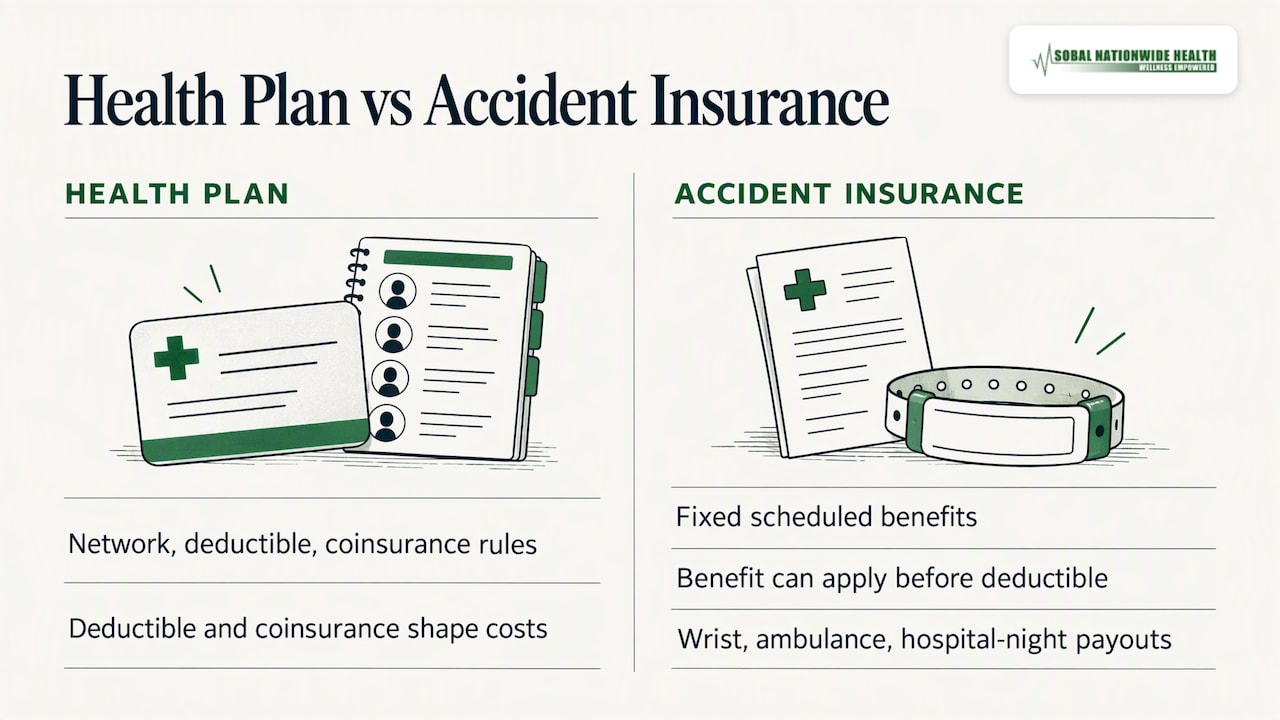
That is why people who have a high-deductible plan often look at it first. The premium gets you in the door, and the benefit helps cover the gap before your main plan starts paying more.
Where the word “family” comes in
Most carriers let you choose a coverage level: you alone, you and a spouse, you and your children, or the whole household. Exact eligibility, age limits for children and what counts as a dependent differ by carrier and state, so confirm those in the policy outline before you apply. Some policies also offer riders for organized sports injuries, which matter if your kids play on school or club teams.
We do not publish a fixed list of carrier terms here, because they change. When we work with a family, we pull the current outline for each option and go through it together.
How the benefits are paid
After you show proof of medical care for a covered accidental injury, benefits are generally paid directly to you. According to HealthInsurance.org, some policies pay a lump sum regardless of what you spent out of pocket, while others limit the payment to your actual costs. Payments may come up front or be spread across follow-up treatment.
The American Council of Life Insurers describes supplemental benefits as generally paid to the policyholder and usable for unexpected household and out-of-pocket expenses. In plain terms: the check is yours to direct.
What families typically use the cash for
- The deductible or copays on the emergency room visit and follow-up care
- Physical therapy visits and prescriptions
- Gas, parking or a rental car for repeated trips to specialists
- Childcare while a parent recovers
- Regular bills when a paycheck is interrupted
Because benefit types vary, the most important question is simple: does this policy pay a fixed amount, or only what you actually spent? A fixed amount gives you more flexibility. A capped reimbursement gives you less.
What accident insurance may cover
Benefit lists differ by policy, but most are built from the same building blocks. Typical categories include:
| Category | What it usually means |
|---|---|
| Emergency care | A set payment for an ER or urgent care visit after a covered accident |
| Ambulance | A set payment for ground or air transport |
| Fractures and dislocations | A payment that depends on the bone and the severity |
| Hospital stay | A payment for admission, sometimes a daily amount after that |
| Follow-up care | Payments for physician visits, therapy or X-rays tied to the injury |
| Accidental death or dismemberment | A larger lump sum for the most serious outcomes |
The categories above are the common structure, not a promise from any one plan. Dollar amounts depend on the carrier and the tier you pick. Always ask for the full benefit schedule, since two policies with similar premiums can pay very differently for the same injury.
What accident insurance usually leaves out
This is the part nobody enjoys reading, and it is where families get caught off guard. Accident policies pay for accidents, not illness, and they come with a list of exclusions.
The NAIC’s model minimum-standards regulation lists exclusions and limits that states commonly permit. They include pre-existing conditions, mental or emotional disorders, alcoholism or drug addiction, pregnancy, war, participation in a felony or riot, military service, aviation, cosmetic surgery, certain foot care, dental care, eyeglasses and hearing aids, and routine exams.
State rules shape this too. Texas, for example, publishes an exhibit of permissible exclusions for accident-only policies. It includes suicide and intentional self-injury, racing, professional athletics, hazardous occupations or hobbies, and services covered by workers’ compensation.
HealthInsurance.org also notes that exclusions commonly involve illness, natural disasters, certain risky activities, work-related circumstances and self-inflicted injuries, and that the exact list depends on the policy.
Three exclusions families should check first
- Sports and recreation. Ask whether organized sports, trampoline parks, dirt bikes or similar activities are covered, limited, or only available with a rider.
- Work-related injuries. If a parent is hurt on the job, workers’ compensation generally takes the lead, and the accident policy may not pay.
- Pre-existing conditions. A fall that aggravates an old injury may be treated differently from a brand-new one.
If an exclusion is unclear, ask for the policy wording in writing before you enroll, not after a claim.
What it costs
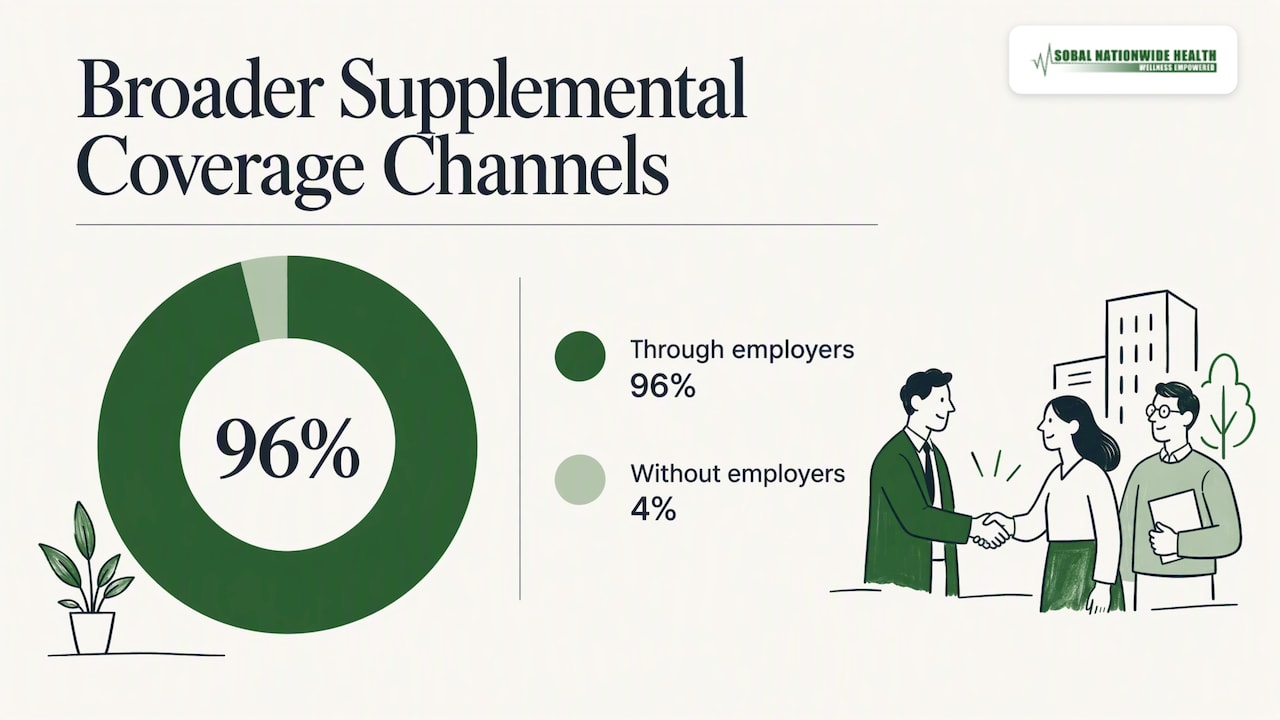
Prices vary with the carrier, the benefit level, the number of people covered and where you live. The NAIC notes that 96% of supplemental accident, hospital-indemnity and specified-disease policies are made available through employers, and only 4% are sold without employer involvement. That figure covers the broader supplemental category, not accident insurance alone, but it explains why so many families who are self-employed or between jobs have never been offered a policy and have to seek one out.
For a closer look at price ranges and when a policy pays back, see our guide to accident insurance cost in the U.S.. It breaks down what moves the monthly premium so you can set a realistic budget before you shop.
When you compare quotes, line up three things side by side: the monthly premium, the benefit schedule for the injuries you most worry about, and the exclusions. The NAIC’s shopping guide advises comparing premiums and out-of-pocket costs, and that habit applies here too.
Is it worth it for your family?
There is no one answer. Here is how we think it through with families.
It tends to fit when
- Your deductible is high. If a bad afternoon at the ER could mean thousands before your main plan pays more, a fixed cash benefit softens that.
- Your kids are active. Playground falls, bike crashes and sports injuries are the most common reasons families use these plans.
- Your income depends on you. If you are self-employed or a 1099 contractor, a week away from work can mean a week without pay. Our guide on accident insurance for the self-employed goes deeper on matching benefits to your cash runway.
- You have no employer plan to lean on. With no group benefits, you build your own safety net.
It may not be your first priority when
- You don’t yet have solid major medical coverage. Accident insurance cannot stand in for it. Start with the main plan.
- The premium would strain your monthly budget. A cushion that you can’t afford to keep paying helps nobody.
- You already have a cash-benefit plan that covers the same ground.
What about kids?
For children, the case rests on how often they get hurt and how much a single injury can disrupt the household. A broken arm means urgent care, X-rays, follow-up visits and often a parent missing work. Accident insurance does not prevent any of that, but a cash benefit takes some pressure off. Check the child age limits and any sports exclusions before you decide.
Where accident insurance fits with your main plan
The order matters. First, get a solid health plan. Then decide whether a supplemental policy helps close the gaps. If you are still working on the first step, our guides on how much a family health insurance plan costs and on ACA subsidy income limits can help you see where you stand.
Here is how the pieces work together:
| Piece | Its job | Think of it as |
|---|---|---|
| Premium | What you pay each month to keep coverage active | Getting in the door |
| Deductible | What you pay before your health plan shares costs | The first hurdle |
| Out-of-pocket maximum | The most you pay in a plan year for covered care | A financial safety net |
| Accident insurance benefit | Cash paid after a covered accident | A cushion beside the plan |
If you want to compare family plans in Florida specifically, our walkthrough of tips for comparing family health insurance plans covers the questions to ask.
How to choose a policy, step by step
- Decide who needs coverage. Just the kids? Both parents? The whole household? Price it each way.
- Look at your deductible. Your accident benefit should be big enough to make a dent in it.
- Request the benefit schedule. Check amounts for the ER, ambulance, fractures, hospital stays and follow-up care.
- Read the exclusions. Search for sports, work injuries and pre-existing conditions.
- Check how claims work. Ask what proof you need, how long payment usually takes and whether there is a filing deadline.
- Compare the total picture. Premium, benefits and limits together, not the cheapest number alone.
- Ask questions before you sign. A good advisor will answer in plain English and won’t rush you.
Our perspective: what we see when families ask us about this
We are an independent brokerage, and we sell accident insurance alongside medically underwritten health plans, ACA marketplace plans, dental, vision, critical illness and group coverage. That mix shapes how we think about accident insurance: it is rarely the whole answer, and it is rarely the wrong question.
Most people who call us are self-employed, between jobs, or earn too much for marketplace subsidies. They are often paying a lot for a plan with a high deductible and wondering how they would handle a surprise bill. For them, a modest supplemental policy can be a sensible part of the picture, as long as the main plan comes first.
Our approach is education before enrollment. We walk you through the benefit schedule, point out the exclusions that matter for your family, and tell you honestly when a policy is not worth your money. You can talk with a broker in English or Spanish, and there is no sales pressure. Clients who rework their whole health coverage with us have reported savings of up to $400 per month, though results depend on your situation and aren’t guaranteed.
My advice: don’t buy accident insurance because a quote is cheap. Buy it because you can name the bill it would help pay.
— Bernie S
Get help comparing options
If you would like a second set of eyes on your family’s coverage, we can help. Sobal Health works with self-employed individuals, families and small businesses in 31 states, and we can review your current plan, explain where a gap might be, and show you accident, critical illness and other supplemental options next to your main coverage.

Browse the personal and family coverage options we offer, or reach out through our main site to talk with a licensed broker about what fits your household.
FAQ
What is family accident insurance?
It is a supplemental policy that pays you cash after a covered accidental injury to you, your spouse or your children. The NAIC describes it as paying a benefit, either a lump sum or a fixed amount, after an accident causes injuries that need treatment or hospitalization. It works alongside your health plan and does not replace it.
Is it worth paying for accident insurance?
It depends on your deductible, your budget and how much a few weeks of lost income would hurt. Families with high deductibles, active kids or self-employed parents tend to get the most from it. If the premium would strain your budget, or you don’t yet have solid major medical coverage, fix that first.
Is accident insurance worth it for kids?
It can be, because children’s injuries are frequent and a single fracture can mean several visits and missed work for a parent. Check the child age limits, whether organized sports are covered, and whether a sports rider costs extra. If your kids are not very active and you have a low deductible, the benefit may matter less.
Does accident insurance cover illness?
No. It pays for injuries from covered accidents, not illnesses, and policies commonly exclude pre-existing conditions and certain activities. For illness, you would look at your major medical plan or a separate product such as critical illness coverage.
How much does it cost?
Premiums depend on the carrier, the benefit level, who is covered and your state. Our guide to accident insurance cost explains the range and what drives it. A broker can pull current quotes for your household.
Sources
- NAIC, Supplemental Benefits overview
- NAIC, minimum standards regulation for accident and health insurance
- NAIC, Shopping for Health Insurance
- ACLI, How Supplemental Benefits Provide Financial Protection
- Texas Department of Insurance, permissible exclusions in individual accident policies
- HealthInsurance.org, Accident insurance
