

Check the individual Marketplace first to see whether you qualify for premium tax credits based on your projected self-employment income. If subsidies don’t make a Marketplace plan affordable, look at spouse coverage, COBRA, Medicaid, or a private medically underwritten plan instead. The fastest path forward: estimate this year’s net income today, run it through HealthCare.gov, and call a licensed broker if your situation involves pre-existing conditions or fluctuating income.
TL;DR:
- Subsidy eligibility depends heavily on accurate income estimates, requiring entrepreneurs to regularly update their projections to avoid surprises at tax time.
- Private medically underwritten plans can offer substantial savings compared to Marketplace options, especially for healthy individuals with pre-existing conditions.
- Spouse coverage or employer group plans generally provide better benefits and lower costs when available, while COBRA is suitable for short-term continuity.
- Medicaid eligibility varies by state, and many adults can qualify outside of the Open Enrollment period, making it worth checking income thresholds frequently.
- Proper plan comparison emphasizes total cost, including deductibles and network access, rather than just the premium, with HSA options providing tax advantages for high-deductible plans.
Table of Contents
- Coverage Options for Health Insurance for Entrepreneurs
- How Do You Choose the Right Health Plan?
- When Can You Enroll, and Does Hiring Change Your Options?
- What Does Health Insurance Actually Cost?
- When Should You Skip the Marketplace?
- What I’ve Learned Helping Entrepreneurs Navigate This
- The Real Problem Isn’t the Plan. It’s the Guesswork.
- Get a Personalized Plan Comparison
- Sources
Coverage Options for Health Insurance for Entrepreneurs
Health insurance for entrepreneurs comes down to five realistic routes, and most business owners only know about one or two of them.
ACA Marketplace plans are the default for a reason. Every ACA-compliant individual and family plan covers the same 10 essential health benefits, from maternity care to prescription drugs, and none of them use medical underwriting. That means a chronic condition or a recent cancer diagnosis can’t get you rejected or charged more. The tradeoff is that “no underwriting” spreads risk across everyone, which is part of why premiums can run higher than a healthy 32-year-old might expect to pay.
Spouse or employer coverage beats almost everything else on cost if it’s available to you. Group plans are typically subsidized by an employer, use larger risk pools, and often have broader networks than an individual plan bought solo.
COBRA lets you keep your old employer’s plan for up to 18 months after you leave a job, but you pay the full premium yourself, plus a 2% administrative fee. It’s a bridge, not a destination.
Medicaid eligibility varies by state, with many states using income thresholds tied to the federal poverty level, and adults under those limits can enroll year-round rather than waiting for Open Enrollment.
Short-term plans fill gaps but shouldn’t be mistaken for real coverage. They often exclude essential benefits and pre-existing conditions, and availability and allowed duration vary by state, so what works in one state may not exist in another.
Private medically underwritten plans are the option most entrepreneurs never hear about. They require a health screening, but for applicants who qualify, they can deliver meaningful savings compared to standard Marketplace plans, depending on the state and the applicant’s health profile.
- ACA Marketplace: no underwriting, 10 essential benefits, subsidy-eligible
- Spouse/employer plan: usually the cheapest option when available
- COBRA: continuity of care, full-price premium plus a small fee
- Medicaid: income-based, state-specific rules
- Short-term plans: temporary bridge only, limited benefits
- Private medically underwritten plans: possible savings, requires health screening
How Do You Choose the Right Health Plan?
Picking a plan isn’t about finding the lowest premium. It’s about matching a plan type to your actual business situation and then stress-testing the total cost, not just the sticker price.
- Confirm your eligibility and enrollment window. Are you inside Open Enrollment, or do you need a qualifying life event to trigger a Special Enrollment Period?
- Estimate your net self-employment income for the coming year. This number drives whether you qualify for premium tax credits and how large they’ll be.
- Compare total cost, not just premium. Add the premium to the deductible, the out-of-pocket maximum, and whatever it costs to see the specialists you actually use. A proper cost comparison includes premium, deductible, coinsurance, and network access for your key providers, not premium alone.
- Check HSA eligibility. Pairing a high-deductible plan with a Health Savings Account can meaningfully lower your tax bill while building a cash cushion for medical costs.
- Verify your network covers the clinicians who matter to you. A cheap plan that excludes your specialist isn’t actually cheap.
When you talk to an insurer or a broker, ask directly: How does billing work if I use an out-of-network provider in an emergency? What’s the prior-authorization process for common procedures? Will my premium tax credit amount change if my income shifts mid-year? What happens at renewal?
Watch for red flags: a premium that looks too good next to a suspiciously thin benefit list, a network that quietly excludes major hospital systems, or vague answers about prior authorization. For non-ACA plans specifically, ask directly about pre-existing condition exclusions before you sign anything.

Pro Tip: If your household income involves 1099 contracts, seasonal swings, or a spouse with separate employer coverage, a broker can usually spot subsidy interactions and medically underwritten options that a solo Marketplace search will miss entirely.
When Can You Enroll, and Does Hiring Change Your Options?
Open Enrollment for ACA Marketplace plans typically runs from November 1 through January 15 in most states. Miss that window, and you need a qualifying life event, like losing coverage, getting married, or having a baby, to open a Special Enrollment Period.
Subsidy eligibility hinges on your projected income for the coming year, not last year’s tax return. That’s a common trip-up for entrepreneurs whose income doesn’t look like a steady paycheck.
- Underestimating income can mean repaying credits at tax time
- Overestimating can mean missing subsidies you actually qualified for
- Review your estimate whenever a big contract lands or falls through
One rule catches business owners off guard: SHOP and small-group plans generally require at least one employee who isn’t the owner or the owner’s spouse. The moment you hire your first non-family employee, your options and tax picture can shift, so it’s worth reassessing coverage annually as your team grows.
What Does Health Insurance Actually Cost?
Full-price Marketplace premiums can run several hundred dollars a month, but that number is misleading on its own. Most people who qualify for advance premium tax credits pay substantially less than the sticker price, sometimes a fraction of it, depending on income and household size.
On the tax side, self-employed individuals can often deduct health insurance premiums in many scenarios, though how that interacts with other deductions depends on your specific situation, which is worth confirming with a tax professional.
A few ways to lower your effective cost:
- Recalculate your income estimate whenever your revenue shifts significantly
- Compare metal tiers (Bronze, Silver, Gold) against your actual healthcare usage, not just price
- Pair a high-deductible plan with an HSA if you’re healthy and want the tax advantage
- Ask a broker whether you’d qualify for a private medically underwritten plan
Experts generally advise treating health coverage as a real business expense and comparing total cost of care rather than chasing the lowest monthly number alone.
When Should You Skip the Marketplace?
Spouse coverage usually wins when it’s on the table: better network, employer-subsidized premium, less paperwork. COBRA makes sense when you want to keep the same doctors for a short stretch, even at full price, while you sort out longer-term coverage.
Medicaid is worth checking any time your income drops, since state rules and income thresholds vary and many adults qualify without waiting for Open Enrollment. Short-term plans only belong in your plan as a bridge between jobs or coverage gaps, given their exclusions for pre-existing conditions and essential benefits.
- Spouse plan: best network and cost, if available
- COBRA: continuity, full price, time-limited
- Medicaid: income-based, check state rules directly
- Short-term: bridge only, never a long-term plan
- Private medically underwritten: possible savings, requires screening and varies by state
What I’ve Learned Helping Entrepreneurs Navigate This
Most entrepreneurs I talk to have never heard of a medically underwritten private plan, and that gap costs some of them hundreds of dollars a month. Sobal Nationwide Health works across 31 states connecting self-employed people, families, and small business owners to exactly these options, alongside standard ACA Marketplace plans, when someone qualifies.
Clients who switch from a standard Marketplace plan to a private medically underwritten option have reported savings of up to $400 a month, without giving up meaningful coverage, once they’ve gone through health screening and confirmed eligibility.
If your situation involves a pre-existing condition, a spouse with separate coverage, or income that swings month to month, that’s exactly when a conversation with a licensed broker pays off. Come ready with your projected income, a list of current medications or ongoing care needs, and the names of any specialists you don’t want to lose.
The Real Problem Isn’t the Plan. It’s the Guesswork.
Most advice on this topic treats plan selection as the hard part. It isn’t. The hard part is the income estimate that determines your subsidy, and most entrepreneurs guess at that number instead of calculating it properly.
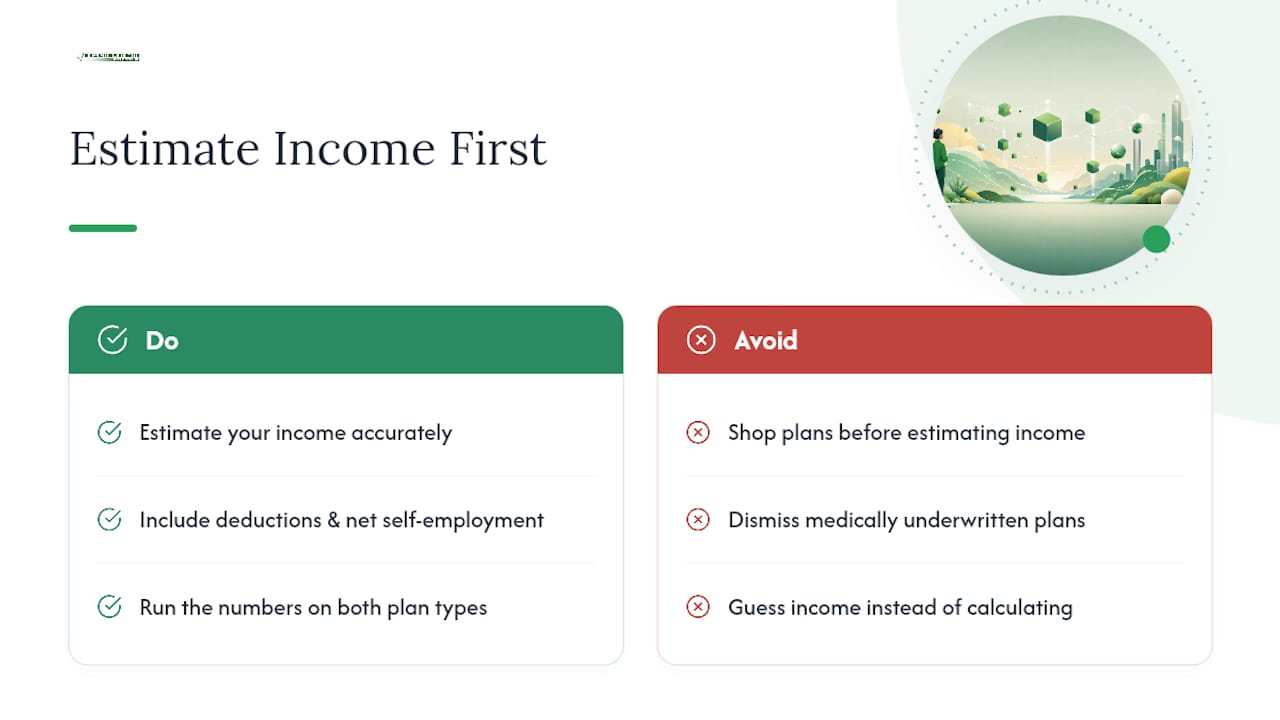
I’d argue the conventional wisdom has this backwards: it tells you to shop plans first and worry about income later. Flip that. Get your income projection right, because it changes which plans are even worth comparing. A Silver plan that looks unaffordable at your guessed income might be genuinely cheap once you’ve correctly accounted for your actual deductions and net self-employment earnings.
The second thing overlooked constantly: medically underwritten plans get dismissed as “risky” or “not real insurance” by people who’ve never actually looked at one. For a healthy entrepreneur without major pre-existing conditions, that dismissal can mean overpaying for years. The right move isn’t picking Marketplace or private coverage on principle. It’s running the numbers on both and letting the math decide.
— Bernie S
Get a Personalized Plan Comparison
You don’t have to guess your way through this alone. Sobal Nationwide Health helps self-employed entrepreneurs compare ACA Marketplace options against private medically underwritten plans, side by side, so you can see real numbers instead of assumptions.
A consultation includes a review of your current policy or income estimate, a subsidy calculation if you’re considering Marketplace coverage, and a comparison across plan types so you know what you’re actually choosing between. There’s no pressure to buy, just clear numbers and honest advice from someone licensed to give it. If you want to know whether a medically underwritten plan could lower your monthly cost, or you simply want a second opinion before Open Enrollment closes, request a free plan review with a licensed broker today.
This article is general information, not a substitute for advice from a qualified financial advisor. Consult a qualified financial professional about your own circumstances before acting on anything here.
