

Yes, you can get reimbursed for out-of-network care, but only under the right conditions. PPO and POS plans typically pay a share of out-of-network costs; HMO and EPO plans usually don’t, except in emergencies. Your insurer sets the “allowed amount” using its own benchmark, not the provider’s bill, so expect a gap between what you paid and what comes back. The No Surprises Act closes that gap entirely for emergencies and certain involuntary out-of-network care.
TL;DR:
- Out-of-network reimbursement is usually available only with PPO and POS plans, and the amount paid is based on the insurer’s allowed rate, which can be significantly lower than the provider’s bill.
- Filing a claim requires careful steps, including verifying benefits, submitting detailed documentation like superbills with correct codes, and adhering to strict deadlines to avoid outright denial.
- Insurers often base payments on UCR, FAIR Health data, or Medicare rates, which can lead to large balance bills if the provider’s charge exceeds the allowed amount.
- The No Surprises Act protects against balance billing for emergencies, certain services at in-network facilities, and specific air transports, but outside these, balances may still accrue.
- Consulting a broker can help clarify out-of-network coverage options and improve the claim process, though it cannot guarantee insurer reimbursement.
Table of Contents
- How Do I File an Out-of-Network Reimbursement Claim?
- What Does a Superbill Need to Include?
- How Do Insurers Calculate Your Out-of-Network Payment?
- When Does the No Surprises Act Block Balance Billing?
- Why Do Out-of-Network Claims Get Denied, and How Do You Appeal?
- What Should You Do When a Filing Deadline Is Days Away?
- How Do You Read an EOB and Handle a Balance Bill?
- Should You Ask a Broker for Help With an Out-of-Network Claim?
- Balancing Provider Choice Against Billing Risk
- Get a Plan That Actually Fits Your Out-of-Network Needs
- Where to Verify the Rules Yourself
- Sources
- FAQ
How Do I File an Out-of-Network Reimbursement Claim?
Getting reimbursed for out-of-network care is a paperwork process, not a phone call. Miss a step and your claim stalls, or worse, gets denied outright. Here’s the sequence that actually works.
- Verify your benefits first. Call member services or check your portal for your out-of-network deductible, coinsurance percentage, the allowed-amount methodology your plan uses, and whether prior authorization applies.
- Confirm the timely-filing deadline for your plan. This detail matters more than almost anything else in the process.
- Get a superbill and proof of payment at the visit, or shortly after. If the insurer requests it, ask the provider for a completed W-9 too.
- Download the member claim form from your insurer’s portal, or request one directly.
- Assemble your packet: superbill, proof of payment, any EOB the provider already generated, and relevant medical records if the visit involved a procedure or diagnosis dispute.
- Submit the claim and write down the confirmation or claim number immediately.
- Follow up after the insurer’s stated processing window passes. Ask specifically for an adjudication status update, not just “is it in process.”
Some providers will bill your insurer directly through an assignment of benefits, which skips the pay-and-reimburse cycle entirely. Ask before your appointment whether this option is available.
Pro Tip: Photograph or scan every document the day you receive it. Claims packets get lost more often at the mailroom stage than at the review stage, and a digital backup saves you from starting over.
If your claim comes back denied, don’t treat that as final. It usually means one field was wrong, one deadline was missed, or one form was incomplete, all of which are fixable with an internal appeal.
What Does a Superbill Need to Include?
A superbill is the itemized receipt your out-of-network provider gives you to submit to insurance. It’s not the same as a regular receipt, and insurers reject vague ones constantly.
A claim-ready superbill needs:
- Patient’s full legal name and date of birth
- Exact date(s) of service
- CPT or HCPCS procedure codes for every service rendered
- ICD-10 diagnosis codes tied to those services
- Provider’s National Provider Identifier (NPI) and Tax ID
- Itemized billed charges and a clear total
- Provider signature, stamp, or other identifying credential
The most common reasons claims stall aren’t dramatic. A wrong NPI digit, a missing diagnosis code, or a date of service that doesn’t match your appointment record are enough to trigger a denial letter. Insurers don’t call to flag these errors. They just deny and move on.
If you spot an error, contact the provider’s billing office and request a corrected version in writing. Keep a log of the date, the person you spoke with, and get the corrected PDF emailed to you directly rather than relying on a promise that “it’s fixed in the system.”
Pro Tip: Request your superbill before you leave the office, not weeks later. Front-desk staff turn over, and a superbill request made by phone a month after your visit takes far longer to fulfill.

How Do Insurers Calculate Your Out-of-Network Payment?
Insurers don’t pay a percentage of what your provider billed. They pay a percentage of what they’ve decided the service is worth, and that number often comes from one of three sources: an insurer’s internal Usual, Customary, and Reasonable (UCR) rate, independent FAIR Health data, or a multiple of the Medicare fee schedule.
The gap that catches people off guard: if your plan pays 130% of Medicare’s rate for a procedure Medicare prices at $200, your insurer’s allowed amount is $260, no matter what your provider actually charged. If the bill was $800, you’re on the hook for the $540 difference on top of your coinsurance, unless a federal protection applies.
That difference between billed charge and allowed amount is exactly what fuels most balance-billing disputes. Before scheduling elective out-of-network care, a few checks help:
- Ask your provider’s office for the CPT codes they plan to bill
- Run those codes through the FAIR Health cost lookup if your plan uses that benchmark
- Call your insurer and ask directly which of the three methods applies to your plan
Knowing your plan type matters here too. PPO and POS plans generally offer some out-of-network benefit; HMO and EPO plans typically offer none outside emergencies.
When Does the No Surprises Act Block Balance Billing?
Federal law removes the guesswork in specific situations. The No Surprises Act requires insurers to apply in-network cost-sharing, and prohibits the provider from billing you the difference, when care falls into one of these categories:
- Emergency services, regardless of which hospital or provider treats you
- Ancillary services (anesthesiologists, radiologists, pathologists) at an in-network facility, even if that specific provider is out-of-network
- Certain air ambulance transports
If you receive a bill that looks like it violates these protections, save every notice you got, request an itemized EOB from your insurer, and contact the No Surprises Help Desk or pursue the federal independent dispute resolution process if the provider or facility won’t correct it.
Why Do Out-of-Network Claims Get Denied, and How Do You Appeal?
Most denials trace back to five causes: missing superbill fields, a missed timely-filing window, no prior authorization when one was required, a medical-necessity dispute, or a coding mismatch between the diagnosis and the procedure billed.
The appeal sequence:
- Read the denial letter carefully; it must state the specific reason.
- Request a letter of medical necessity from your provider if the denial cites necessity.
- Gather supporting records: chart notes, test results, prior treatment history.
- Submit a formal internal appeal to your insurer in writing.
- If denied again, escalate to external review through your state regulator or, for certain plans, CMS.
Internal appeals for services you’ve already received are commonly required to be resolved within 60 days. If your situation is urgent, ask explicitly for expedited review; insurers have separate, faster timelines for those requests.
Pro Tip: A one-paragraph letter from your provider stating why the treatment was medically necessary carries more weight in an appeal than pages of records with no context attached.
What Should You Do When a Filing Deadline Is Days Away?
Timely-filing windows range from roughly 90 days to a full year depending on your plan, and missing that window is one of the most common, and most avoidable, reasons claims get denied outright.
If you’re close to the deadline:
- Send whatever documentation you already have; a partial packet beats a late one
- Note in your submission that additional records will follow, and keep proof you said so
- Call member services and ask specifically for your claim number, the exact deadline on file, and the appeals address in case you need it later
Pro Tip: Submitting an incomplete claim before the deadline and following up with missing pieces is a tactic many insurers accept rather than an automatic denial for paperwork gaps.
How Do You Read an EOB and Handle a Balance Bill?
Your Explanation of Benefits breaks a claim into four numbers: the billed charge, the allowed amount, what the insurer paid, and what you owe. Confirm the math adds up, and confirm which benchmark, UCR, FAIR Health, or Medicare-based, the insurer used to set the allowed amount.
If the numbers don’t reconcile, or the allowed amount seems far below the FAIR Health estimate for the same service, that’s your opening to dispute it directly with the insurer rather than assuming the bill is correct.
Before paying a provider’s balance bill, check whether a No Surprises Act protection applies. If it doesn’t, you can still negotiate: ask the billing office for a self-pay or prompt-payment discount, or request a payment plan while your appeal is pending. If negotiation fails and you believe the charge is unfair or the insurer’s calculation is wrong, your state insurance regulator is the next stop.
Should You Ask a Broker for Help With an Out-of-Network Claim?
Health insurance brokers can provide personalized plan review and educational resources, along with enrollment assistance and general claim guidance for people trying to make sense of out-of-network benefits. That kind of help can save real time: a broker can verify what your specific policy language says about out-of-network coverage, point you to the right claim form, and tell you whether assignment of benefits is an option with your provider.
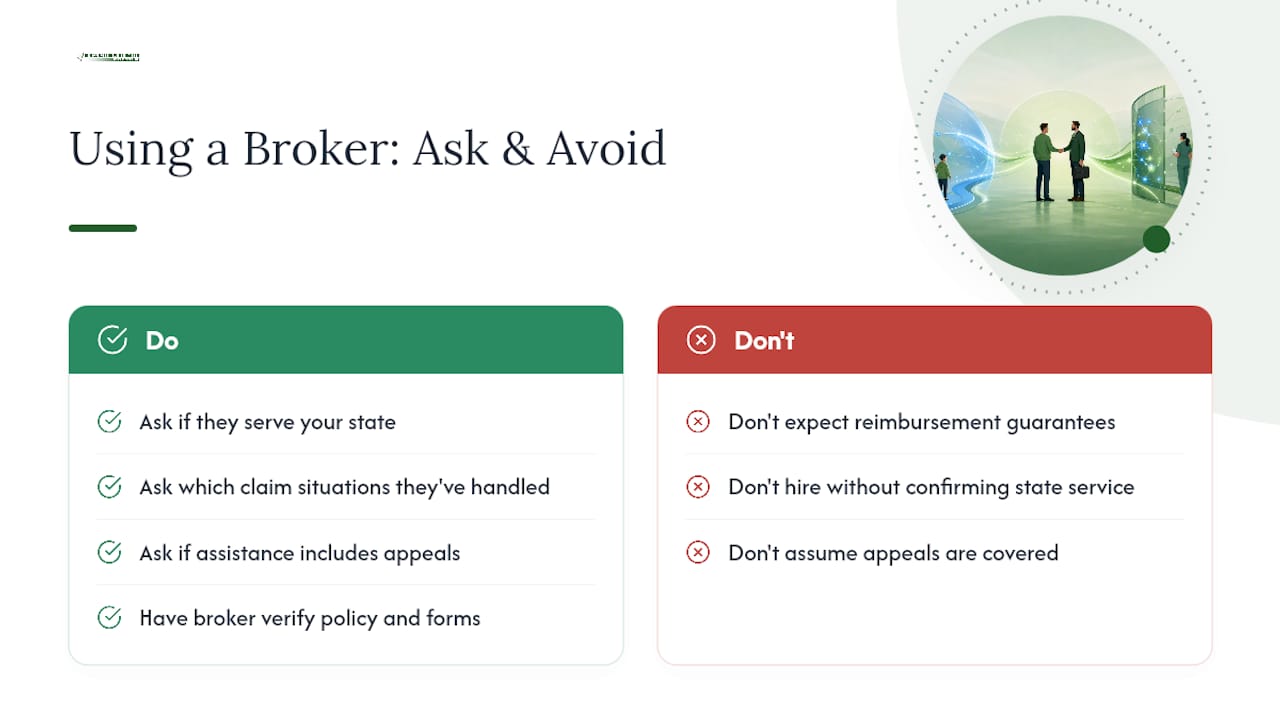
If you’re considering broker support, ask directly whether they serve your state, what kinds of claim situations they’ve helped with, and whether their assistance extends to appeals. One honest caveat: no broker can guarantee an insurer’s reimbursement decision. What good guidance does is improve your odds by making sure nothing in your submission gives the insurer an easy reason to deny it.
Balancing Provider Choice Against Billing Risk
Going out-of-network makes sense when the provider’s expertise genuinely outweighs the financial gap, a specialist with no in-network equivalent, for instance. It rarely makes sense for routine, shoppable care where an in-network alternative exists.
Pro Tip: Get a written cost estimate before you schedule anything elective out-of-network. It’s your best evidence if the final bill doesn’t match what you were told.
— Bernie S
Get a Plan That Actually Fits Your Out-of-Network Needs
If you’re tired of guessing how your plan handles out-of-network care, there are services designed to help clear up that confusion. Unlike a marketplace search that hands you a list of plans and no context, our brokers walk you through what “out-of-network benefit” actually means for your specific policy, at no cost to you, with no sales pressure attached.

Some brokers work across multiple states, offering private medically underwritten plans and ACA marketplace options side by side, so you can compare what each one actually covers before you’re locked into a year of surprise bills. If you’re not sure whether your current plan, or a new one, gives you meaningful out-of-network protection, see how health insurance actually works and then talk to one of our advisors about your specific situation. A broker can’t force an insurer to pay a claim, but the right plan from the start means you’re far less likely to need one.
Where to Verify the Rules Yourself
- Department of Labor’s No Surprises Act guidance for balance-billing protections
- FAIR Health Consumer’s cost lookup for allowed-amount estimates
- UnitedHealthcare’s claim submission guide for filing deadlines and forms
- Chameleon’s breakdown of out-of-pocket healthcare costs for planning ahead
This article is general information, not a substitute for advice from a qualified financial advisor. Consult a qualified financial professional about your own circumstances before acting on anything here.
Sources
- Avoid surprise healthcare expenses — U.S. Department of Labor (EBSA)
- Types of out-of-network reimbursement — FAIR Health Consumer
- How to Fill Out and Submit an Out-of-Network Claim Form — LegalClarity
- How to submit a claim — UnitedHealthcare
FAQ
Can I Get Reimbursed for Out-of-Network Care?
Yes, if your plan includes out-of-network benefits, typically a PPO or POS plan rather than an HMO or EPO. Reimbursement is based on your insurer’s allowed amount, not your provider’s billed charge, so expect to receive less than the full bill unless the No Surprises Act applies.
What Is an Example of Out-of-Network Reimbursement?
Say your provider bills $800 for a service, and your insurer’s allowed amount, based on 130% of the Medicare rate, comes to $260.
Does Insurance Still Pay if a Provider Is Out-of-Network?
Often yes, but only up to the insurer’s allowed amount, and only if your plan offers out-of-network benefits at all. HMO and EPO plans generally pay nothing outside emergencies, while PPO and POS plans usually pay a reduced percentage after a separate, often higher, out-of-network deductible.
How Do I Get Insurance to Pay for Out-of-Network Care?
Verify your out-of-network benefits before your appointment, collect a complete superbill and proof of payment, and submit your insurer’s member claim form well before the timely-filing deadline. If your claim is denied, request the specific denial reason and file an internal appeal with supporting documentation from your provider.
What if My Plan Doesn’t Cover Out-of-Network Care at All?
If you have an HMO or EPO plan, out-of-network reimbursement is typically unavailable except for emergencies protected under federal law. Reviewing your deductible and plan structure before you need care is the best way to know what you’re actually working with.
