

Part-time employees are not guaranteed health insurance under federal law, and whether your employer offers it usually comes down to your hours and how large the company is. If work doesn’t come with a plan, you still have real paths forward: Marketplace coverage (often with premium tax credits), Medicaid or CHIP if your income qualifies, COBRA if you’re leaving a job that had coverage, or a spot on a spouse’s or parent’s plan. Start by asking HR for the written eligibility rules, then check your Marketplace subsidy estimate the same week.
TL;DR:
- Most part-time workers are unlikely to qualify for employer-sponsored coverage unless working around 30 hours per week at large companies, making Marketplace plans or Medicaid their primary options.
- A full-time eligibility threshold of 30 hours a week applies only to large employers, while smaller companies can set their own minimum hours for offering benefits or choose not to at all.
- Because employer mandates only affect large employers, many part-time workers remain uninsured, with uninsured rates higher than for full-time employees, especially in households without full-time workers.
- When employer coverage is unavailable, comparing Marketplace subsidies, Medicaid eligibility, and COBRA costs can help find the most affordable, comprehensive option, with subsidies often making Marketplace plans cheaper.
- Timing enrollment carefully is crucial, as losing coverage triggers a 60-day window for Marketplace or Medicaid options, and waiting too long or misunderstanding rules can result in gaps in coverage.
Table of Contents
- Health Coverage Options for Part-Time Employees at a Glance
- When Does an Employer Have to Cover Part-Time Workers?
- Your Options When Your Job Doesn’t Offer Health Insurance
- What Will Part-Time Coverage Actually Cost You?
- Enrollment Timing: The 90-Day Rule and Your Deadlines
- A Step-by-Step Checklist to Confirm Your Coverage Options
- When a Broker Actually Saves Part-Time Workers Money
- Where to Verify These Rules Yourself
- Get Help Comparing Your Real Options
- Sources
- FAQ
Health Coverage Options for Part-Time Employees at a Glance
Before you dig into the rules, it helps to see the whole board. Part-time employee health coverage generally comes from one of five places, and which one fits you depends on your hours, your income, and what your employer decides to offer.
- Employer-sponsored coverage: available if your employer voluntarily extends it, or if you meet the ACA’s 30-hour/week full-time threshold at a large employer.
- Marketplace plans: open to anyone, with premium tax credits that can cut your monthly bill based on household income.
- Medicaid or CHIP: free or low-cost coverage for lower-income individuals and families, with eligibility rules that vary by state.
- COBRA continuation: lets you keep a former employer’s plan temporarily, usually at full price plus a small administrative fee, if that employer has 20 or more workers.
- Dependent or short-term coverage: riding on a spouse’s or parent’s plan, or bridging a gap with a short-term policy while you sort out something longer-term.
Most part-time workers end up comparing two or three of these at once rather than picking blind.
When Does an Employer Have to Cover Part-Time Workers?
Here’s the part that surprises a lot of people: the Affordable Care Act doesn’t require any employer to offer health insurance to part-time staff. The federal mandate only kicks in for Applicable Large Employers, or ALEs, generally defined as companies with 50 or more full-time equivalent employees. And even then, the mandate applies specifically to workers who average at least 30 hours a week or 130 hours a month.
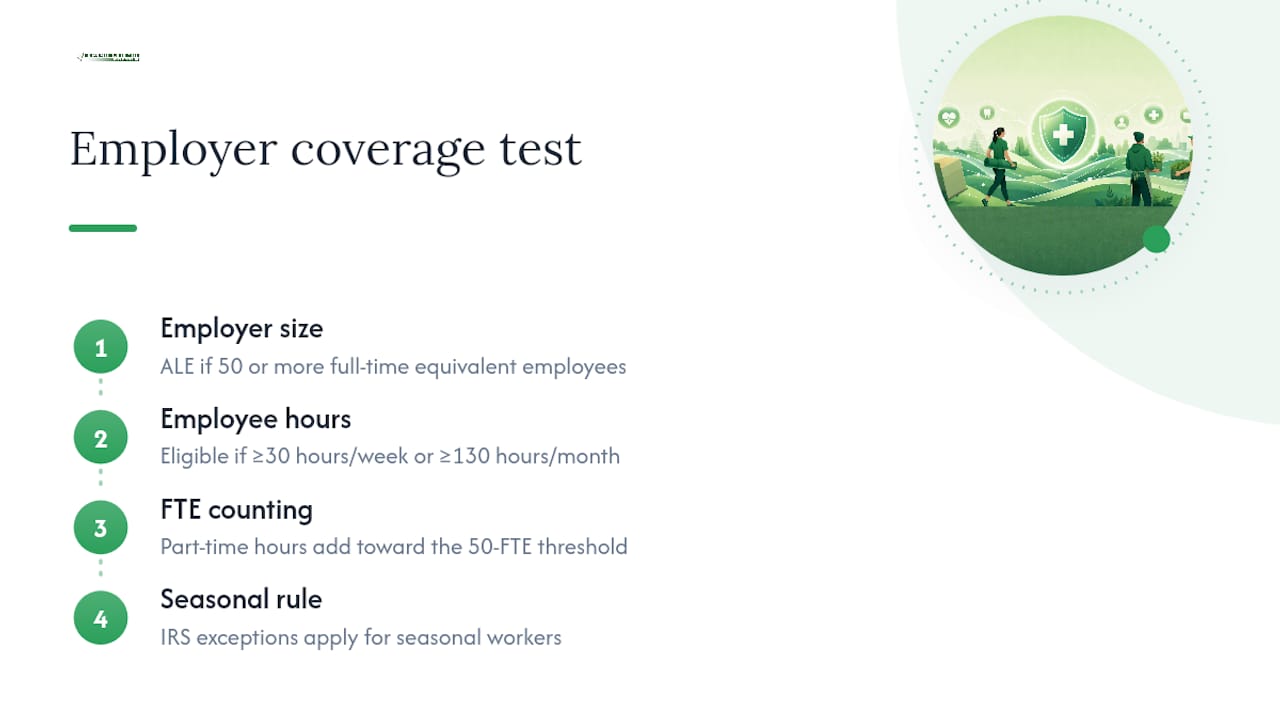
That 30-hour line is the whole ballgame. Below it, you’re outside the mandate’s protection no matter how big your employer is.
FTE math matters too. Employers add up part-time hours to see if they cross the 50-FTE threshold, even if no single part-timer works close to 30 hours. The IRS guidance on determining ALE status walks through the counting method, including exceptions for seasonal workers.
Because part-time employees don’t trigger the employer shared responsibility penalty, many companies have no financial incentive to cover them. Learn more about your obligations as an employer regarding continued salary payment during illness. Some still do, voluntarily, often setting their own eligibility bar somewhere between 20 and 30 hours a week as a way to attract and keep good staff. The result: part-time workers are far more likely to go without job-based coverage. KFF data puts the uninsured rate for part-time workers at 13%, compared to 9% for full-time employees, and that gap widens to 17% for part-timers in households with no full-time worker at all.
Your Options When Your Job Doesn’t Offer Health Insurance
If HR tells you there’s no plan available, you still have three solid doors to try, and each one fits a different situation.
- Marketplace coverage. You can enroll in a Marketplace plan any time during open enrollment, and losing job-based coverage or having your hours cut triggers a 60-day special enrollment period. Premium tax credits scale with household income, so a part-time paycheck often qualifies for meaningful savings.
- Medicaid or CHIP. Eligibility depends on income and where you live, since states that expanded Medicaid under the ACA cover a wider income band than states that didn’t. This is usually the cheapest route if you qualify.
- COBRA continuation. If your former employer has 20 or more employees and offered a plan, you can keep that exact coverage temporarily. The catch: you pay the full premium yourself, plus up to a 2% administrative fee, since your employer stops subsidizing it.
Pro Tip: Run the numbers before you assume COBRA is your only option. A subsidized Marketplace plan is frequently cheaper than COBRA’s full premium, even though COBRA feels like the “safe” default because it keeps your existing doctors and plan design.
Medicaid tends to win on pure cost when you qualify. Marketplace tends to win on flexibility and subsidy potential. COBRA tends to win only when you’re mid-treatment and switching plans would disrupt care.
What Will Part-Time Coverage Actually Cost You?
This is where a lot of part-time workers get stuck, because “affordable” on paper doesn’t always match what lands in your bank account. The ACA’s affordability test measures whether your share of an employer’s premium exceeds a set percentage of your household income, not your paycheck alone.
Premium tax credits work on a sliding scale: they’re calculated against the cost of the benchmark silver plan in your area, and lower household income means a bigger credit. A part-time worker earning $22,000 a year can see a dramatically different subsidy than one earning $40,000, even with the same job title.
To get a real number instead of a guess:
- Pull your most recent pay stubs and estimate annual household income.
- Run a Marketplace subsidy calculator before assuming employer coverage is your cheapest option.
- Compare metal tiers (bronze, silver, gold) on both premium and out-of-pocket maximum, not premium alone.
- Ask HR for the exact employee premium share in writing, not a verbal estimate.
Part-time workers often decline an employer’s offer because the premium looks steep next to a part-time paycheck, without realizing the Marketplace alternative, after credits, might cost less. KFF’s analysis also flags that subsidy stability matters here. If enhanced premium tax credits get scaled back, the math between employer coverage, Marketplace, and COBRA can shift fast.
Enrollment Timing: The 90-Day Rule and Your Deadlines
Timing mistakes cost people coverage more often than eligibility mistakes do, so this section is worth reading twice.
- The 90-day cap. Once your employer decides you’re eligible for its plan, federal rule 45 CFR 147.116 prohibits a waiting period longer than 90 days. If HR tells you it’s six months, that’s not standard, and it’s worth confirming in writing.
- Special enrollment triggers. Losing job-based coverage or having your hours cut below eligibility opens a limited window to enroll in a Marketplace plan. Missing that window may require waiting for the next open enrollment period.
- COBRA election window. You typically have 60 days to elect COBRA after a qualifying event, and federal COBRA applies to employers with 20 or more employees. Some states run “mini-COBRA” programs extending similar rights to workers at smaller companies.
- Act fast on documentation. The moment you know coverage is ending, get the loss-of-coverage letter from HR and start your Marketplace or Medicaid application the same week.
A Step-by-Step Checklist to Confirm Your Coverage Options
Cut through the confusion with a short sequence instead of trying to research everything at once.
- Step 1: Ask HR in writing for your employer’s exact eligibility rules, hours requirement, and waiting period. Don’t rely on what a coworker told you.
- Step 2: Check your Marketplace subsidy estimate at HealthCare.gov using your actual household income, not a rough guess.
- Step 3: Look up your state’s Medicaid income limits, since expansion states cover a meaningfully wider band than non-expansion states.
- Step 4: If you’re losing coverage, compare COBRA’s full premium against a subsidized Marketplace plan before the special enrollment window closes.
Pro Tip: Gather your last two pay stubs, any benefit notice from your employer, and your prior insurance ID card before you start any application. Having these on hand turns a 45-minute Marketplace application into a 15-minute one.
When a Broker Actually Saves Part-Time Workers Money
Most part-time workers can handle a single, simple comparison on their own. Where it gets messy is when your income comes from more than one part-time job, your hours shift month to month, or your state’s Medicaid rules don’t line up neatly with what you read online. That’s when a second set of eyes pays for itself.
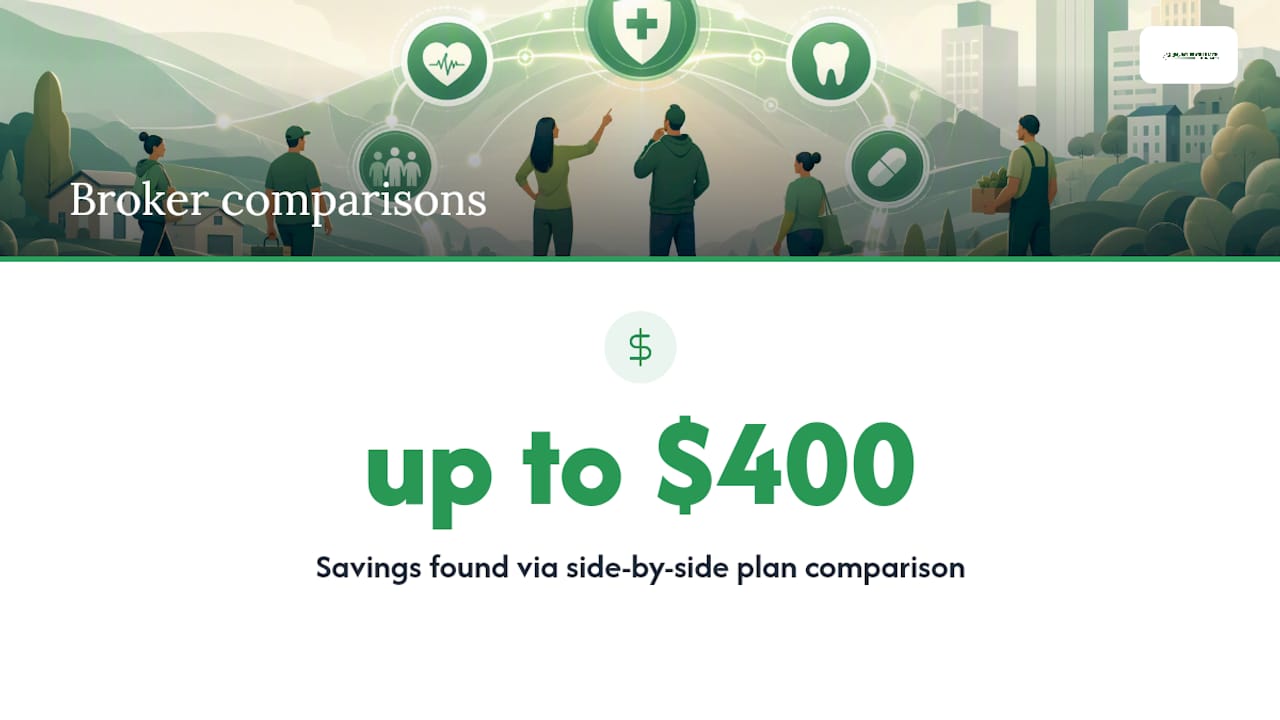
A licensed broker can lay employer coverage, COBRA, and a Marketplace plan side by side and show you the real monthly cost of each, not just the sticker premium. Some clients have uncovered savings by comparing private medically underwritten plans against standard Marketplace options. In some cases, monthly savings of up to $400 have been reported once the full picture is seen side by side. If your household income is irregular or your hours vary week to week, that kind of side-by-side comparison is worth fifteen minutes of a broker’s time before you commit.
— Bernie S
Where to Verify These Rules Yourself
Don’t take any of this secondhand. These are the sources worth bookmarking:
- Healthcare covers Marketplace eligibility and special enrollment triggers directly from the federal Marketplace.
- The IRS employer shared responsibility Q&A explains ALE rules and the 30-hour standard in plain terms.
- KFF’s coverage research gives the statistical backdrop on how part-time status affects insurance access.
- HHS’s healthcare resources page links to enrollment assisters and official Marketplace support in your area.
- Our own health insurance FAQ and cost calculators can help you sanity-check subsidy estimates before you enroll.
Get Help Comparing Your Real Options
Comparing employer coverage, Marketplace subsidies, COBRA, and Medicaid on your own is doable, but the numbers rarely line up as cleanly as the calculators suggest, especially with irregular part-time hours. Sobal Nationwide Health gives you a licensed broker who runs that comparison for you, at no cost to you, and shows you where a private medically underwritten plan might beat a standard Marketplace option on price and coverage.
Licensed brokers can assist individuals, families, and small business owners, including part-time workers piecing together income from multiple jobs. These advisors can help clarify eligibility rules and provide real monthly cost estimates instead of generic quotes. If you’re weighing a Marketplace plan against what your employer offers, start with a free coverage consultation and get a side-by-side cost comparison before your enrollment window closes.
This article is general information, not a substitute for advice from a qualified financial advisor. Consult a qualified financial professional about your own circumstances before acting on anything here.
Sources
- Healthcare
- KFF — Part-time workers have less access to employer-based coverage
- eCFR — 45 CFR 147.116 Prohibition on waiting periods
FAQ
Do part-time employees get health insurance through their job?
Not automatically. Federal law only requires large employers (50+ full-time equivalents) to offer coverage to employees averaging 30+ hours a week; below that threshold, coverage is entirely at the employer’s discretion.
How many hours can you work part-time before you qualify for benefits?
There’s no universal number, but the ACA’s full-time threshold is 30 hours a week or 130 hours a month at Applicable Large Employers. Many employers that voluntarily cover part-timers set their own bar between 20 and 30 hours a week, so ask HR for the exact policy.
What is the 3-month rule for jobs?
This usually refers to the maximum waiting period employers can impose before eligible coverage begins. Federal rule 45 CFR 147.116 caps that waiting period at 90 days, roughly three months, once you’re deemed eligible.
How many hours do you have to work to get insurance through an employer?
If your employer is an Applicable Large Employer, you generally need to average 30 hours a week to fall under the federal mandate. Smaller employers can set any threshold they choose, or offer no part-time coverage at all.
If my employer doesn’t offer coverage, what’s my fastest option?
Check your Marketplace subsidy estimate first, since premium tax credits often make it the most affordable option, then compare that against Medicaid eligibility and COBRA if you’re transitioning out of a job with existing coverage.
