

Georgia employers have three main paths to offering health coverage: SHOP, ICHRA, and QSEHRA. If you’re not sure which fits, start by checking your SHOP eligibility at GeorgiaAccess.gov or calling a certified agent. Many employers with fewer than 25 workers also qualify for a federal tax credit worth exploring before you commit to a plan.
TL;DR:
- Small businesses with fewer than 25 employees and pay at least half of premiums may qualify for a tax credit worth up to 50 percent of their contribution.
- SHOP eligibility requires 1 to 50 full-time equivalent employees, a Georgia-based worksite, and at least 70 percent employee participation.
- Remote teams or multi-state employees generally benefit more from ICHRA, which allows individualized reimbursements rather than group plans.
- Cost estimates show many Georgia small employers pay several hundred dollars per month per employee for single coverage, with costs rising for family plans.
- Working with a licensed broker can streamline enrollment, help compare options, and provide tailored quotes based on payroll and staffing profiles.
Table of Contents
- What Are My Small Business Health Coverage Options in Georgia?
- What Are the SHOP Eligibility Rules and Tax Credit Requirements?
- How Do I Enroll in SHOP, ICHRA, or QSEHRA?
- SHOP vs. ICHRA vs. QSEHRA: How Do I Choose?
- What Does Small Business Health Insurance Cost in Georgia?
- What Sobal Health Sees Working for Georgia Employers
- Get Help Choosing and Enrolling in a Georgia Small Business Plan
- Sources
- FAQ
What Are My Small Business Health Coverage Options in Georgia?
Choosing among small business health plans in Georgia usually comes down to three routes, plus a few alternatives worth knowing about. Here’s the plain-English version of each, because the acronyms alone won’t tell you which one fits your team.
- SHOP (Small Business Health Options Program): A state-facilitated marketplace where you pick a group plan and offer it to your employees. It works best for employers with a stable Georgia-based workforce who can hit the participation requirement. The tradeoff: it comes with enrollment rules that don’t bend easily.
- ICHRA (Individual Coverage Health Reimbursement Arrangement): You set a monthly reimbursement allowance, and employees buy their own individual plan and get reimbursed tax-free. It fits remote teams, multi-state staff, or businesses that want predictable costs without managing a group policy. The catch is you’re handing employees more responsibility for shopping.
- QSEHRA (Qualified Small Employer HRA): Similar to ICHRA but designed specifically for businesses under 50 employees that don’t offer any group plan. It’s simpler to administer but caps how much you can reimburse annually.
Beyond these three, some Georgia employers explore a chamber-based SMART Plan or MEWA for group buying power, level-funded plans that blend group coverage with claims-based refunds, Direct Primary Care memberships, or health-sharing ministries. Each comes with real tradeoffs, particularly around shared risk and coverage guarantees, so read the fine print before you sign anything.
What Are the SHOP Eligibility Rules and Tax Credit Requirements?
SHOP eligibility in Georgia hinges on a handful of concrete numbers, and missing one of them is the most common reason applications stall.
- Your business must have 1 to 50 full-time equivalent employees, with at least one non-owner employee on payroll.
- You need an office or worksite located in Georgia.
- You must offer coverage to all full-time employees, not just a select group.
- You must meet the participation requirement, meaning a significant majority of eligible employees who aren’t already covered elsewhere have to enroll, according to Georgia Access SHOP policy.
Quick fact: Georgia allows SHOP enrollment for any business with up to 50 FTEs, and there’s no legal mandate forcing you to offer coverage in the first place. That said, if you want to compete for talent, offering it often pays for itself in retention.
If your business has fewer than 25 FTEs, average annual wages below the federal threshold, and you pay at least 50% of employee-only premiums, you may qualify for the Small Business Health Care Tax Credit, worth up to 50% of your premium contribution. Count part-time hours toward your FTE total when you calculate this. It trips up more employers than any other step.
How Do I Enroll in SHOP, ICHRA, or QSEHRA?
Enrollment mechanics differ by option, but each follows a predictable sequence.
For SHOP:
- Confirm eligibility (FTE count, Georgia worksite, 70% likely participation).
- Choose your employer-choice approach, meaning which plan category or specific plan you’ll offer.
- Contact a certified agent or issuer listed through Georgia Access.
- Submit your SHOP application and retain the eligibility determination if you’re claiming the tax credit.
- Set your effective date. SHOP has no fixed open enrollment window; you can start coverage anytime beginning November 1 for the plan year.
For ICHRA: Define your employee classes, set a monthly reimbursement amount, require proof of qualifying individual coverage, and build a payroll workflow to substantiate reimbursements each month.
For QSEHRA: Confirm you’re under 50 employees with no group plan, set your annual reimbursement caps, notify employees in writing, and collect documentation of their individual coverage.
Pro Tip: Keep a folder with your FTE count, average wage figures, and prior-year payroll records before you call an agent. It cuts a 45-minute intake call down to 15.
SHOP vs. ICHRA vs. QSEHRA: How Do I Choose?
The right option usually reveals itself once you weigh five things: workforce size, geographic spread, how much you’re using benefits to recruit, how predictable you need your monthly cost to be, and how much administrative work you’re willing to take on.
A few red flags point away from SHOP specifically:
- Your team is small enough, or turnover is high enough, that hitting the 70% participation rule looks unlikely.
- You have employees working from multiple states, since SHOP requires a Georgia office or worksite and ICHRA has no such restriction.
- You want to avoid managing group plan renewals and prefer employees to choose their own coverage.
When you talk to a broker or carrier, ask specific questions rather than general ones: Which carrier plans are actually available in your employees’ ZIP codes? What would sample premiums look like for your workforce’s age mix? Does your business qualify for the tax credit, and does that change if you switch from SHOP to ICHRA? What administrative fees come with each option? A detailed comparison framework can help you organize these answers side by side before you commit.
What Does Small Business Health Insurance Cost in Georgia?
Employer costs vary widely by county, carrier, and plan design, but published guides suggest many Georgia small employers pay several hundred dollars per employee per month for single coverage, with family coverage running higher. Treat that as a planning bracket, not a quote.
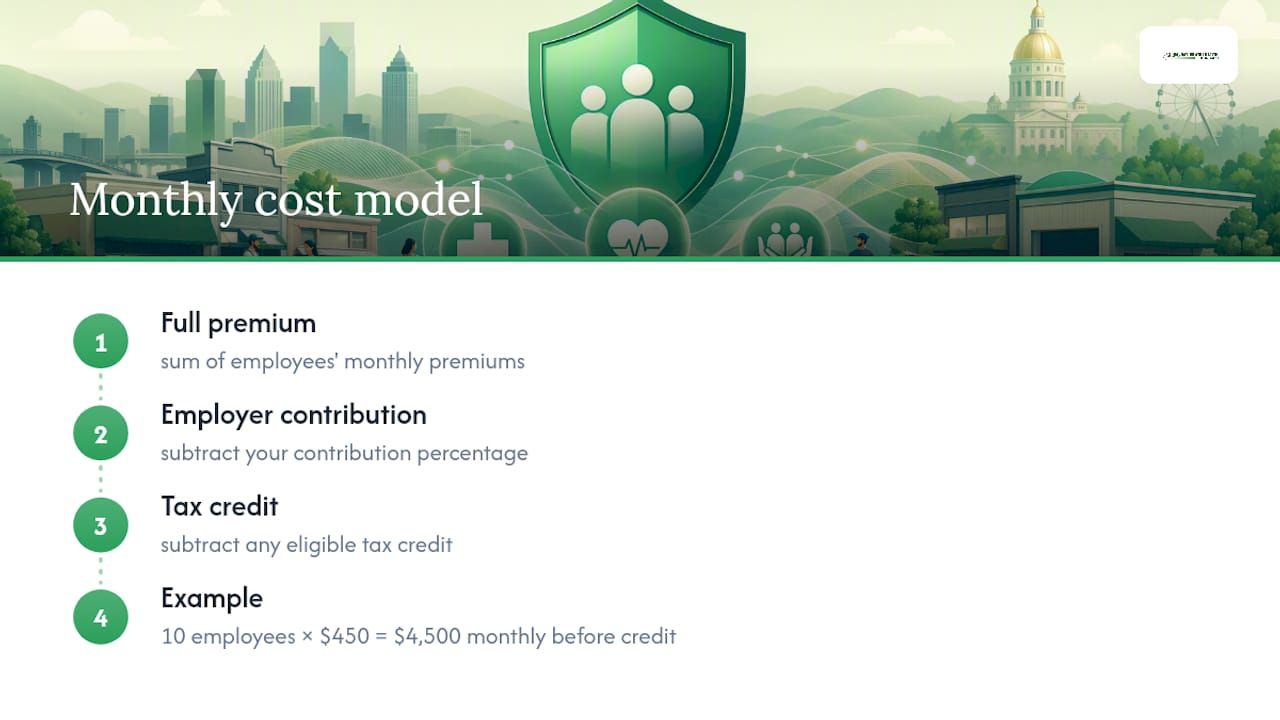
To model your real monthly cost, start with the full premium, subtract your employer contribution percentage, then subtract any tax credit you qualify for. A business with 10 employees paying $450 per person toward single coverage, for example, is looking at $4,500 monthly before any credit offset, so running the math before you shop for plans saves you from sticker shock later.
A few tactics can bring that number down. Pairing an ICHRA with individual-market shopping often beats group rates for younger, healthier teams. Level-funded plans can return money if claims run low. Adding a Health Savings Account lets employees cover out-of-pocket costs with pretax dollars, and negotiating dental or vision as a bundled ancillary rate frequently shaves a few dollars per employee off the total.
What Sobal Health Sees Working for Georgia Employers
Working with small employers across the region, a pattern shows up again and again: businesses with tight-knit, in-state teams tend to do well on SHOP, while businesses with contractors or remote staff scattered outside Georgia almost always land better with ICHRA. A licensed broker can advise on both paths, including access to private medically underwritten plans that may undercut standard marketplace premiums for certain groups. Before a broker call, gather your FTE count, average wages, current premium quotes if you have any, and a list of employees’ home ZIP codes. That single folder speeds up the entire process.
— Bernie S
Get Help Choosing and Enrolling in a Georgia Small Business Plan
A licensed broker provides Georgia employers an alternative to navigating SHOP paperwork or assembling an ICHRA independently. They compare group and individual-market options side by side, including private medically underwritten plans not listed on public exchanges.
A first consultation typically covers your FTE count and likely tax-credit eligibility, a comparison of SHOP versus ICHRA costs for your specific workforce, and a walk-through of realistic premium ranges before you apply anywhere. The broker will ask for basic payroll records, current premium (if any), and employee ZIP codes to pull accurate quotes; most employers receive a clear recommendation within days. If you want to see what your monthly numbers could look like, check what a family plan actually costs or reach out directly through Sobal Health’s contact page to start the conversation.
Sources
FAQ
What is the best health insurance for small business owners in Georgia?
There’s no single best option. SHOP fits stable, in-state teams that can meet the 70% participation rule, while ICHRA often works better for remote or multi-state teams, and QSEHRA suits very small employers without a group plan.
What is the average cost of health insurance for a small business in Georgia?
Costs vary by county and carrier, but many Georgia employers pay several hundred dollars per employee monthly for single coverage, with family coverage costing more. Get a personalized quote before budgeting, since local variance is significant.
Can you get cheaper health insurance with an LLC in Georgia?
Business structure alone doesn’t lower your premium, but forming an LLC or corporation can qualify you for group options like SHOP or the Small Business Health Care Tax Credit that sole proprietors without employees can’t access.
How does a small business owner get health insurance in Georgia?
Owners typically qualify through SHOP if they have at least one non-owner full-time employee, or they set up an ICHRA or QSEHRA to reimburse individual coverage. Working with a licensed broker helps identify which path fits your specific payroll and staffing situation.
Does my business qualify for the Small Business Health Care Tax Credit?
You likely qualify if you have fewer than 25 full-time equivalent employees, pay average wages below the federal threshold, and contribute at least 50% toward employee-only premiums through a SHOP-purchased plan.
