

Accident insurance typically costs a few dollars a month through an employer group plan, or more when purchased individually. It’s worth buying if you carry a high-deductible health plan, keep less than three to six months of expenses in savings, or have an active household with real injury risk. The payout goes straight to you in cash, not to a hospital billing department.
TL;DR:
- Accident insurance offered through employer plans often costs between $2 and $15 monthly, whereas individual policies can range from $10 to over $50, depending on risk factors.
- The coverage pays fixed cash benefits for events like fractures or hospital stays, without reimbursing medical bills or covering illnesses.
- Premium costs vary mainly by age, benefit level, occupation, location, and how comprehensive the plan’s payout schedule and waiting periods are.
- It is more cost-effective to buy coverage through work, especially when bundled with other benefits, or to choose plans with longer waiting periods and lower payout caps.
- If you have a high-deductible health plan, minimal savings, or an active household, accident insurance can provide valuable financial protection; otherwise, it may be redundant.
Table of Contents
- What Does Accident Insurance Actually Cover?
- How Much Does Accident Insurance Cost?
- What Drives Your Accident Insurance Premium?
- Is Accident Insurance Worth It? Run the Math Yourself
- How to Compare Accident Insurance Plans Before You Buy
- How a Broker Can Sharpen Your Accident Insurance Decision
- How Insurers Actually Calculate Your Premium
- Ways to Lower What You Pay for Accident Coverage
- Bottom Line for U.S. Buyers
- Get Help Comparing Accident and Supplemental Plans
- Sources
- FAQ
What Does Accident Insurance Actually Cover?
Accident insurance pays a fixed dollar amount for a specific covered event, like a broken wrist or an overnight hospital stay. It doesn’t reimburse a percentage of a bill the way major medical insurance does, and it won’t touch anything caused by illness. That’s the core mechanic to understand before you even look at pricing: you’re buying a set of cash payouts tied to a list of accidents, rather than a general safety net for your health.
The NAIC’s supplemental benefits overview confirms this fixed-benefit structure. Payments go to you, the policyholder, and the insurer can’t reduce what it owes just because your health plan already covered part of the bill.
Here’s what separates accident insurance from its lookalikes:
- Accident-only policies pay fixed benefits for injuries like fractures, dislocations, and burns.
- AD&D (accidental death and dismemberment) pays a lump sum only for death or loss of a limb, eye, or similar, and nothing for a routine ER visit.
- Supplemental accident coverage fills gaps your major medical plan leaves open, according to Healthinsurance, such as deductibles, copays, or lost income during recovery.
- Most of these policies are sold through employer group plans rather than purchased individually on the open market.
How Much Does Accident Insurance Cost?
Group rates through work run cheap. Individual rates cost more because you’re not splitting the insurer’s risk pool with a whole company payroll.
- Employer group plans: commonly $2 to $15 a month, often payroll-deducted with little underwriting.
- Individual policies: typically $10 to $50 or more a month, with seniors and higher-risk occupations landing at the top of that range, according to Gerald’s accident insurance premium guide.
- Family or multi-person plans: priced higher than an individual policy but usually far less than multiplying the individual rate by each family member.
Quick math: If your plan costs a moderate annual amount and an ER visit pays out a fixed benefit, you only need a moderate chance of a qualifying accident in a given year for the coverage to break even on paper.
Sample benefit schedules from Gerald’s cost structure breakdown show typical payouts of $500 to $1,500 for an ER visit, $500 to $3,000 for a fracture, and $5,000 or more for a hospital admission, depending on the plan. If you’re being quoted a very high monthly premium for “accident insurance,” you’re probably not looking at a standard supplemental policy but rather a different product such as critical illness or disability insurance, or a bundled policy with richer benefits.
What Drives Your Accident Insurance Premium?
Two people can get wildly different quotes for what looks like the same coverage. The gap almost always comes down to a handful of variables the insurer weighs before setting your rate.
- Age: older applicants pay more because injury recovery tends to take longer and cost more.
- Benefit level: richer payout schedules and lower waiting periods cost more per month than bare-bones tiers.
- Group vs. individual: an employer-sponsored plan spreads risk across the whole workforce, which is why it’s almost always cheaper than buying solo.
- Occupation and lifestyle: construction workers, athletes, and parents chasing toddlers around a soccer field represent more claims risk than a desk job.
- Family size: adding dependents raises the premium, but a family rider is typically priced below what you’d pay stacking individual policies for each person.
Location plays a role too, since medical costs vary by state, and a plan priced for a market with higher average ER charges will reflect that in the premium.
Is Accident Insurance Worth It? Run the Math Yourself
The honest answer depends on your deductible, your savings, and how likely you are to actually use the coverage. That’s not a dodge. It’s the actual decision framework insurers and financial advisors use, just simplified for a policy you can evaluate in ten minutes.
- Check your risk profile. A high-deductible health plan, less than three to six months of expenses saved, or an active household (think teenagers in contact sports or a job with physical risk) all push the decision toward buying, according to GoodRx’s accident insurance guide.
- Estimate your expected value. Multiply your annual premium against the rough odds of a covered event times the average payout. If the math is close, the nonfinancial upside often tips the scale.
- Weigh the cash-in-hand factor. Because the payout goes to you rather than a hospital, it can cover rent, groceries, or lost wages while you’re out of work, not just medical bills.
- Skip it if you’re already covered. A low-deductible major medical plan, a solid emergency fund, or comprehensive employer benefits can make a standalone accident policy redundant.
Pro Tip: Pull up your health plan’s deductible before you shop for accident insurance. If your out-of-pocket max is already low, you may be paying twice for the same protection.
How to Compare Accident Insurance Plans Before You Buy
The premium is the easy number to compare. The benefit schedule is where plans actually differ, and it’s the part most people skip reading.
- Compare per-incident payouts line by line, not just the monthly price tag.
- Check for exclusions, waiting periods, and what documentation you’ll need to file a claim.
- Look at employer group options first. They’re almost always priced lower than anything you’d find shopping solo.
- Ask the insurer directly about claim turnaround times and request real examples of paid claims.
- Run your break-even math (annual premium versus likely payout) before you sign anything, especially if you’re comparing two or three quotes side by side.
If you’re also reviewing your primary coverage while you’re at it, understanding what a deductible actually does to your out-of-pocket costs makes the accident insurance decision a lot clearer.
How a Broker Can Sharpen Your Accident Insurance Decision
A broker can work with self-employed individuals, families, and small businesses across multiple states, comparing employer group options against private, medically underwritten alternatives that most people never see on a marketplace search. A broker can pull your current health plan summary, a recent pay stub, and basic household details, and turn those into an apples-to-apples comparison in one conversation instead of a week of tab-switching.
The real value isn’t finding a cheaper accident rider. It’s realizing your break-even math changes entirely once you see a different plan design, or an alternative to your current major medical coverage, that neither you nor your HR department would have surfaced on your own.
How Insurers Actually Calculate Your Premium
Every accident insurance rate starts with actuarial tables, the same statistical models health and life insurers use to price risk across large populations. Insurers look at how often people in your age bracket, occupation category, and geography file a claim, then estimate the average payout per claim, then add a margin for administrative costs and profit.
CDC data on emergency department visits gives insurers (and readers doing their own math) a sense of how frequently accidents actually generate ER visits, which is one of the baseline inputs feeding those risk models. The insurer isn’t guessing. It’s running your demographic profile against millions of historical claims to land on a number that, on average, covers expected payouts plus overhead.
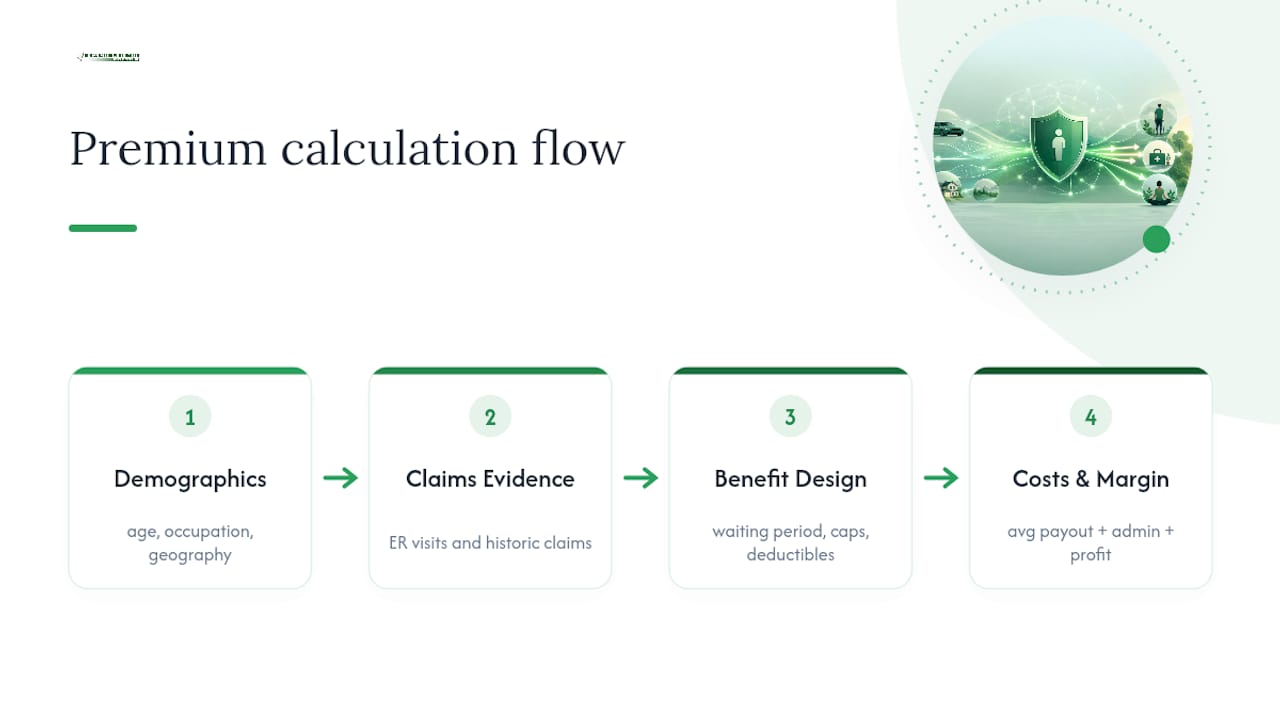
This is why a 25-year-old office worker in a low-cost-of-living state gets a noticeably cheaper quote than a 55-year-old construction supervisor in a state with higher average medical charges. Neither person is being penalized unfairly. The math simply reflects two different claims histories for two different risk pools.
Benefit design factors into the formula too. A plan with a 30-day waiting period and modest payout caps costs less to underwrite than one that pays out immediately with no waiting period and a rich benefit schedule. Every lever you pull on the coverage side (deductible, waiting period, payout cap) moves the premium in a predictable direction, because the insurer is recalculating expected losses each time you change the plan design.
Ways to Lower What You Pay for Accident Coverage
The single biggest lever is simple: take it through work if it’s offered. Employer group plans benefit from bundling and shared risk pools, which is why group rates commonly land at $2 to $15 a month versus $10 to $50 or more for an individual policy covering similar events. If your employer subsidizes part of the premium, your actual out-of-pocket cost can be even lower than the sticker price on the benefits portal.
A few other ways to trim the bill:
- Bundle with other voluntary benefits. Some employers and carriers discount accident coverage when it’s paired with critical illness or hospital indemnity riders.
- Choose a longer waiting period or lower payout cap if your emergency fund can absorb a smaller gap, which reduces the premium accordingly.
- Review family coverage instead of individual policies for each household member. A family rider is typically cheaper than stacking multiple individual plans, especially once you have two or more dependents.
- Ask about annual versus monthly billing. Some carriers shave a small discount off the total when you pay the year upfront instead of monthly.
If you’re self-employed and don’t have access to employer group pricing at all, it’s worth comparing individual health insurance costs alongside any standalone accident rider, since bundling both through the same advisor sometimes surfaces pricing you wouldn’t find shopping each policy separately.
Bottom Line for U.S. Buyers
If you’ve got a high-deductible plan and a thin emergency fund, accident insurance is one of the cheapest ways to buy yourself breathing room after a bad fall or a car accident. If your major medical coverage is already solid and your savings can absorb a surprise bill, skip it and put that $10 to $15 a month somewhere else. Check your employer’s open enrollment materials first, then run your own break-even math against your actual deductible before you decide.
— Bernie S
Get Help Comparing Accident and Supplemental Plans
Shopping accident insurance quotes on your own means comparing benefit schedules across a handful of carrier websites and hoping you didn’t miss an exclusion buried on page four. A health insurance broker can do that comparison for you, weighing employer group options against private, medically underwritten plans across multiple states, with no sales pressure and no hidden agenda pushing you toward one carrier over another.
A consultation typically starts with a look at your current health plan summary, a recent pay stub, and a quick rundown of your household’s risk factors, whether that’s a physically demanding job, active kids, or a high-deductible plan that leaves you exposed. From there, your broker can show you exactly how the math changes with different plan designs, including options you’d likely never find searching alone. Whatever you decide, read the benefit schedule closely and compare more than one quote before enrolling. If you’re ready to see what’s actually available in your state, start a conversation with Sobal Nationwide Health and get a personalized comparison built around your numbers, not a generic sales script.
Sources
- NAIC supplemental benefits overview
- Healthinsurance
- Emergency department visits | CDC NCHS
- What Is Accident Insurance, and Is It Worth It? | GoodRx
This article is general information, not a substitute for advice from a qualified financial advisor. Consult a qualified financial professional about your own circumstances before acting on anything here.
FAQ
How much does accident insurance cost?
Employer group plans typically run $2 to $15 a month, while individual policies usually cost $10 to $50 or more a month depending on age, benefit level, and occupation.
Is accident insurance worth the money?
It’s usually worth it if you have a high-deductible health plan, less than three to six months of savings, or an active lifestyle with elevated injury risk; otherwise, it may duplicate coverage you already have.
Is $300 a month a lot for accident insurance?
Yes. A very high monthly premium is far above typical accident insurance pricing and likely signals a different product, such as a critical illness or disability policy, rather than a standard accident-only plan.
What is the best accident insurance plan for me?
The best plan is whichever one offers a benefit schedule matching your actual risks at the lowest premium, and comparing employer group options against private plans through an advisor like Sobal Nationwide Health can help you spot that fit faster.
