

Balance billing protection is a set of legal limits that stop certain providers from billing you the gap between their full charge and what your insurance pays. Since January 1, 2022, the federal No Surprises Act has applied those limits to emergency care, to some out-of-network care at in-network facilities, and to air ambulance rides. It does not cover everything, and the gaps are where people get hurt.
I’m a licensed independent health insurance broker, and I see the same scene often: someone opens a bill for hundreds or thousands of dollars after a visit they thought was covered. This guide walks through what the law protects, what it leaves out, how your state fits in, and what to do step by step if a bill looks wrong.
TL;DR
- Balance billing means a provider bills you for the difference between its charge and the amount your plan allows. The federal No Surprises Act limits it for most emergency care, certain out-of-network care at in-network facilities, and air ambulances.
- When the protection applies, you owe only your normal in-network cost-sharing: copayments, coinsurance, or deductible.
- Ground ambulances, out-of-network doctor’s offices, and services your plan would not cover anyway are generally outside the federal rules. Some states fill part of that gap.
- Medicare, Medicaid, and a few other programs are outside the Act because they have their own protections.
- If a bill looks wrong, gather your bill and explanation of benefits, then call the federal No Surprises Help Desk at 1-800-985-3059 or contact your state insurance department.
Table of Contents
- What balance billing is, and why it feels like a surprise
- When the No Surprises Act took effect, and who it protects
- What the federal law protects
- What the federal law does not cover
- How state laws fit in
- Self-pay and uninsured patients
- What to do if you get a bill that looks wrong
- How to lower your odds of a surprise bill
- Our perspective: protection is a floor, plan design is the rest
- Get a second set of eyes on your coverage
- FAQ
- Sources
What balance billing is, and why it feels like a surprise
HealthCare.gov defines balance billing as a provider billing you for the difference between the provider’s billed charge and the allowed amount your insurance plan covers.
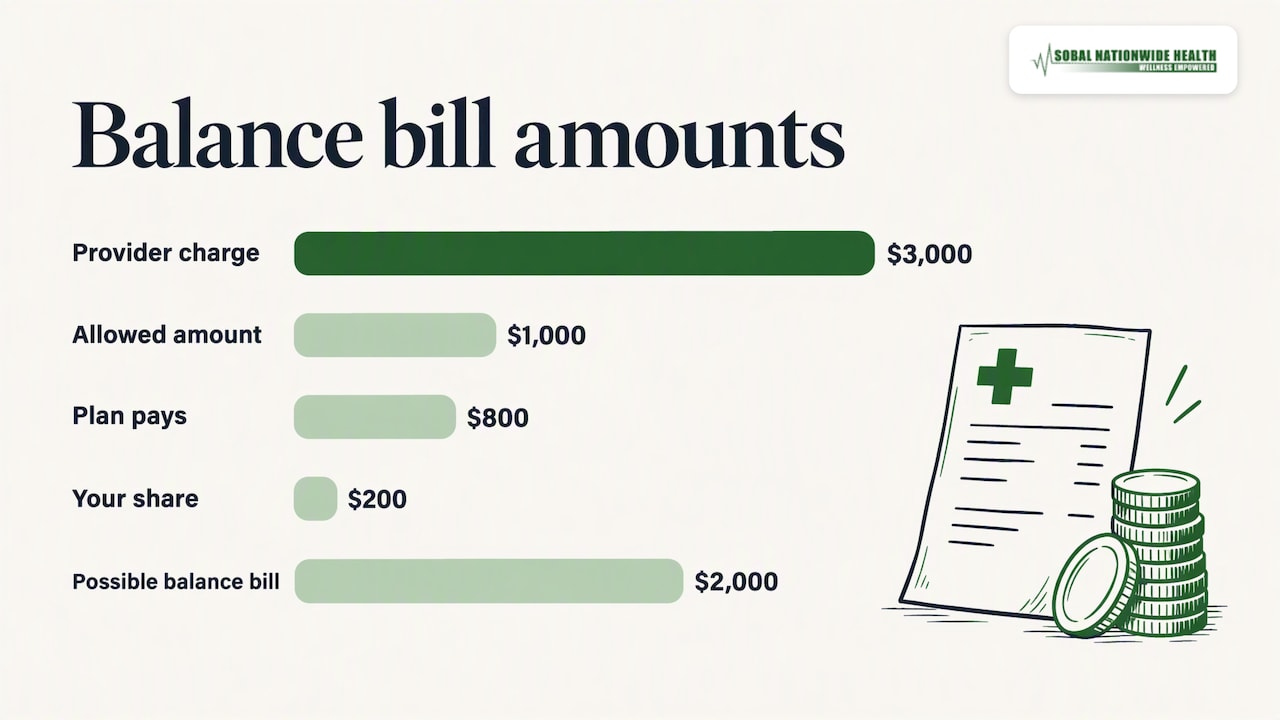
Here is a simple example. A provider charges $3,000 for a service. Your plan’s allowed amount is $1,000, and it pays $800 after your share. If the provider is in your network, it has agreed to accept the $1,000 and you owe your $200 share. If the provider is out of network, it has no such agreement. It may bill you the remaining $2,000 on top of your share.
That is the part people call a surprise. You did not choose that provider, you did not see the price, and you could not shop around. The classic cases:
- You go to an in-network hospital, and the anesthesiologist or radiologist on your case is not in your network.
- You are rushed to the nearest emergency room, which is not in your network.
- You are flown by air ambulance and the company has no contract with your plan.
A planned out-of-network visit that you chose is different. That is an ordinary out-of-network bill, and different rules apply. If you want the fuller picture of how network status changes what you pay, our guide on in-network versus out-of-network care covers it in plain English.
When the No Surprises Act took effect, and who it protects
The No Surprises Act is a federal law that took effect on January 1, 2022. According to CMS, it protects people covered by group health plans, group and individual health insurance, and the Federal Employees Health Benefits program.
That covers most people who buy their own plan or get one through an employer, including self-employed people and small business owners.
The Act does not cover people on Medicare, Medicaid, the Children’s Health Insurance Program, Indian Health Service, Veterans Affairs health care, or TRICARE. CMS explains that these programs generally have their own protections against balance billing.
One caution from my desk: the protections are written around insurance coverage. If you are in a health sharing arrangement rather than an insurance plan, do not assume the same rights apply. Ask the organization in writing how it handles out-of-network bills. Our comparison of health sharing versus insurance goes deeper on this.
What the federal law protects
Per CMS’s overview of key consumer protections, the Act protects you from surprise bills in three main situations.
Emergency services
If you need emergency care, you can go to the nearest emergency room without worrying about whether it is in your network. You also do not need prior approval first. The out-of-network emergency provider cannot balance bill you for the covered emergency care.
Non-emergency care at an in-network facility
Say you choose an in-network hospital or surgical center for a planned procedure. Some of the people who treat you, such as an anesthesiologist, assistant surgeon, or lab and imaging provider, may be out of network. The Act generally protects you from balance bills in that setting, too.
Air ambulance services
Air ambulance bills can run very high, and you cannot compare companies while being flown. The Act covers these services as well.
What you pay when protection applies
When these protections apply, you can be charged only your normal in-network cost-sharing: a copayment, coinsurance, or deductible. The out-of-network provider and your insurer then sort out the rest between themselves.
This is the part that is easy to misread. “Protected” does not mean “free.” You still owe what you would have owed in network. If you want to see how that share is calculated, read our explainer on coinsurance versus copay, which shows how a 20% share can become a four-figure bill on a large claim.
Here is how the pieces fit together:
| Situation | Balance billing allowed? | What you generally owe |
|---|---|---|
| Emergency room visit, out-of-network hospital | No, for covered emergency care | In-network cost-sharing |
| Planned surgery at in-network hospital, out-of-network anesthesiologist | Generally no | In-network cost-sharing |
| Air ambulance, out-of-network company | No | In-network cost-sharing |
| Ground ambulance | Not covered by the federal Act | Depends on your state and plan |
| Visit to an out-of-network doctor’s office | Not covered by the federal Act | Depends on your plan and the provider |
What the federal law does not cover
This is the section I wish more people read before they need it. CMS says the federal protections do not apply to:
- Ground ambulance services
- Non-emergency care in out-of-network facilities, or in settings like doctors’ offices
- Services that your insurance would not otherwise cover
Ground ambulances deserve a closer look. A Commonwealth Fund analysis notes that many states have guardrails on ground ambulance billing, but there are no federal protections. So your state law may matter more than the federal one for this type of bill.
The “not otherwise covered” point matters, too. If your plan excludes a service, or you have used up a benefit limit, the Act does not turn that service into a covered one. You can still be asked to pay the full price.
Giving up your protections by consent
In limited cases, you can sign a notice and consent form that waives your protections, for example for certain non-emergency services or post-stabilization care. CMS explains these limited circumstances.
My rule: never sign one in a rush, and never feel pressured to. You are never required to give up your protections, and you are not required to get care out of network. If a front desk hands you a form at check-in, read it, ask what it means for your bill, and ask whether an in-network provider could do the same work.
How state laws fit in
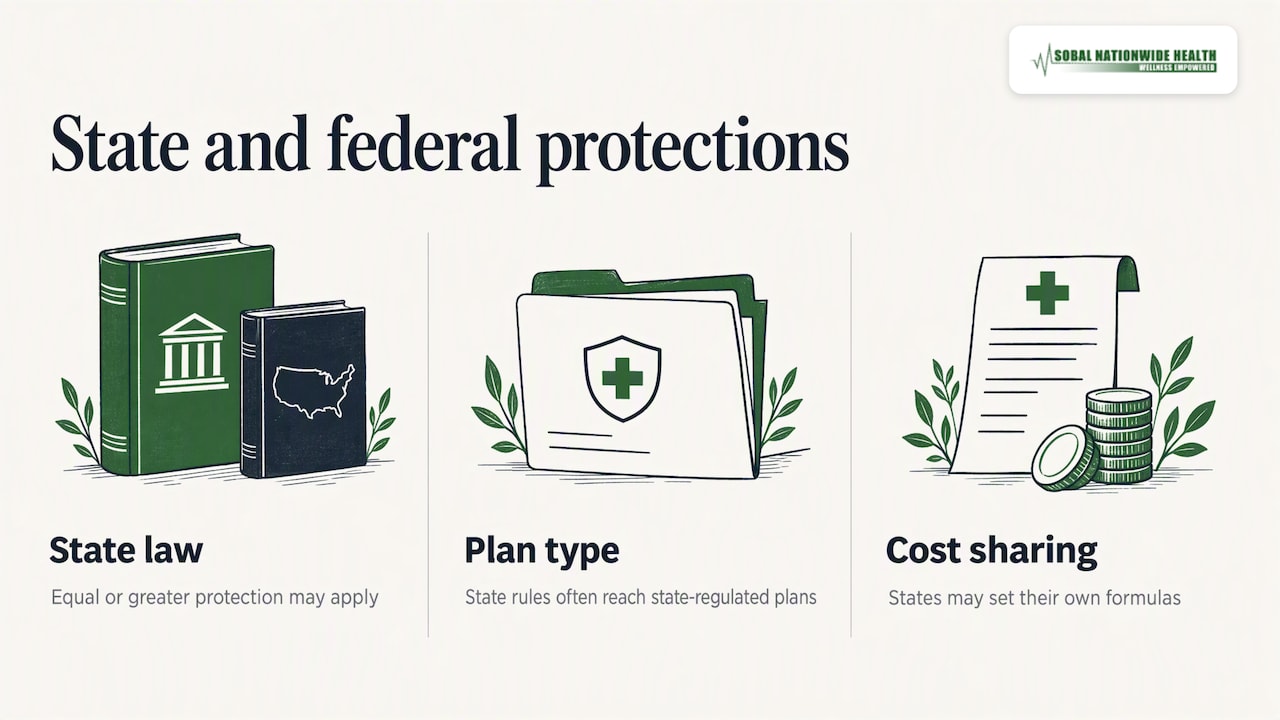
The No Surprises Act is a floor, not a ceiling. CMS says some states have their own surprise billing laws, and when a state law gives equal or greater protection, it generally applies to your bill instead of, or alongside, the federal Act. CMS also advises checking first whether a state law applies to the specific bill, since states can use their own formulas for your cost-sharing and the provider’s payment.
Another CMS resource is blunt about it: the Act does not replace state surprise billing laws, and your state Department of Insurance is the place to ask.
There is one more wrinkle. Even before the federal law, billing rates differed a lot by place. Peterson-KFF found that emergency and in-network inpatient out-of-network charges were more likely in states like Texas and Florida for people with large employer coverage, and less likely in others. Your state’s rules may also depend on what kind of plan you have, since state laws often reach only plans the state regulates.
So, what states do not allow balance billing? There is no tidy list I can honestly hand you, because protections vary by state, by plan type, and by service. The practical answer is to check two things for any bill: does the federal Act apply, and does your state have a stronger rule for this service?
Self-pay and uninsured patients
If you have no insurance, or you choose not to use it, a different protection applies. HHS announced that under the Act, uninsured and self-pay patients can get a good faith estimate of expected costs before non-emergency care. If the final bill is $400 or more above the estimate, you can use a patient-provider dispute resolution process.
If you are self-employed and between plans, this matters. Ask for the estimate in writing before any scheduled care, and keep it.
What to do if you get a bill that looks wrong
Do not pay it yet, and do not ignore it either. Work through these steps.
- Pull your explanation of benefits (EOB). It shows what the provider charged, what your plan allowed, and what you owe. Our guide to comparing an EOB with the bill shows how to match line items.
- Ask what type of care it was. Emergency? An out-of-network provider at an in-network hospital? An ambulance? The answer decides which protections apply.
- Call your insurer. Ask whether the claim was processed under the No Surprises Act or a state law, and whether it was paid at in-network rates.
- Call the provider’s billing office. Say you believe the bill may be a prohibited balance bill. Ask them to hold it while it is reviewed, and ask for that in writing.
- File a complaint if it is not fixed. CMS says you can contact the No Surprises Help Desk at 1-800-985-3059 or through its online portal. Have your medical bill, EOB, and any related letters ready. The Help Desk reviews complaints, investigates compliance, and may refer them to state or federal enforcement.
- Try your state too. Your state Department of Insurance, Attorney General’s office, or Consumer Assistance Program can help and can tell you whether a state law applies, per CMS.
If the bill came after an accident, there can be an extra layer. Some states require hospitals to bill your health insurance first. One example from Colorado explains why hospitals must bill health insurance after an auto accident. If you were injured and a provider is asking you to pay up front, ask your insurer and your state insurance department what your state requires.
When a provider was out of network and the protections do not apply, you may still be able to get some money back from your plan. Our seven-step guide to out-of-network reimbursement explains how.
How to lower your odds of a surprise bill
The law helps after the fact. These habits help before.
- Check the network for the facility and the doctor. Being in network at the hospital does not guarantee the surgeon’s group is in network.
- Ask for in-network providers for each part of a planned procedure. That includes anesthesia, pathology, and imaging.
- Read your Summary of Benefits and Coverage. It tells you how out-of-network care is treated. Our post on POS versus PPO plans shows what to look for.
- Know your out-of-pocket maximum. Think of it as a financial safety net: once you hit it, your plan pays covered in-network costs for the rest of the year.
- Keep paperwork. Save estimates, consent forms, EOBs, and the names of people you spoke to.
- Think about a plan with out-of-network benefits. A PPO usually pays something toward out-of-network care, where an EPO may pay nothing. See our look at EPO versus PPO for the tradeoffs.
As a quick reminder, the premium just gets you in the door. What really decides how a hard year feels is the deductible, the coinsurance, the network, and the out-of-pocket maximum working together.
Our perspective: protection is a floor, plan design is the rest
We are glad the No Surprises Act exists. It took away some of the scariest bills in health care. But in our daily work with self-employed people, families, and small business owners, we see that the law is only one layer of protection.
Many of our clients come to us because they earn too much for marketplace subsidies and are tired of high premiums and confusing deductibles. Some are between jobs and weighing COBRA. Most of them ask the same thing: “Will I be able to see any doctor, and what happens if I end up somewhere out of network?”
Our honest answer is that you should look at three things together:
- The law protects you in emergencies and certain facility situations, and your state may add more.
- The plan decides how much you pay when you choose care yourself. A nationwide PPO with out-of-network benefits gives you room to move. Our article on when a nationwide PPO is worth the extra cost walks through the math.
- The paperwork decides whether a mistake gets fixed. Most wrong bills are corrected when someone asks the right question with the EOB in hand.
We also offer access to private, medically underwritten plans, which can be a good fit for healthy people who want broader choice or lower premiums. They work differently from marketplace plans, so we explain the tradeoffs openly. You can read more in how medically underwritten insurance works.
No pressure, ever. We would rather you understand your plan than buy one you cannot explain.
— Bernie S
Get a second set of eyes on your coverage
If you are comparing plans, or you are not sure how your current one treats out-of-network care, we can help. Our brokers work with self-employed individuals, families, and small businesses in 31 states, and you can talk with us in English or Spanish. We review your plan with you, explain what you would owe in real situations, and help with enrollment if you decide to move ahead. Start on our personal and family insurance page, or if you run a business, see our business health insurance options.
FAQ
What is balance billing in healthcare?
It is when a provider bills you for the difference between its full charge and the amount your insurance allows. It usually happens with out-of-network providers, who have no contract limiting what they can charge. The No Surprises Act now blocks it in several situations, such as emergencies.
When did the No Surprises Act take effect?
The federal law took effect on January 1, 2022. It applies to most group and individual health plans. It does not apply to Medicare, Medicaid, TRICARE, and certain other government programs, which have their own rules.
Can you just refuse to pay medical bills?
I would not recommend ignoring a bill, because unpaid bills can be sent to collections. Instead, ask for an itemized bill, compare it with your EOB, and dispute it in writing if it looks wrong. If you think it is a prohibited balance bill, ask the provider to pause collection while you file a complaint with the No Surprises Help Desk or your state insurance department.
What states do not allow balance billing?
There is no single simple list, because state laws differ by service and by plan type. Federal law sets a baseline, and a state law with equal or greater protection can apply to your bill. Your state Department of Insurance can tell you what covers your situation.
Does the No Surprises Act cover ambulance rides?
It covers air ambulances but not ground ambulances. For a ground ambulance bill, look to your state law and your plan’s terms, and ask your state insurance department whether protections exist.
Sources
- Balance billing, HealthCare.gov glossary
- Know your medical bill rights when using insurance, CMS
- The No Surprises Act at a Glance, CMS
- Overview of Key Consumer Protections, CMS
- State Surprise Billing Laws and the No Surprises Act, CMS
- No Surprises Act Toolkit for Consumer Advocates, CMS
- Submit a complaint, CMS
- HHS new protections from surprise medical bills, CMS newsroom
- Expanding the No Surprises Act to ambulance bills, Commonwealth Fund
- An examination of surprise medical bills, Peterson-KFF Health System Tracker
