

In-network providers have a contract with your plan and accept its negotiated rates, so you usually pay less. Out-of-network providers have no such contract and can bill you more. KFF tracks how plans handle this, and Healthcare and the No Surprises Act limit surprise bills in many emergencies.
TL;DR:
- HMOs generally exclude nonemergency out of network care, while PPOs and POS plans usually cover it with higher cost sharing; check your plan documents.
- Federal protections cover emergency care and certain out of network services at in network facilities, but exclude ground ambulances and can be waived through signed consent.
- Before scheduled care, verify the exact plan with both the provider and facility, including anesthesia or lab groups, and request written confirmation.
- Compare every bill with your explanation of benefits, request an itemized statement, and appeal promptly; keep estimates, consent forms, and call notes for disputes.
- If no in network specialist can treat you, ask your insurer for an exception at in network rates and request a written estimate before booking.
Table of Contents
- What in-network and out-of-network actually mean
- How your plan type changes out-of-network coverage
- Emergency care and the No Surprises Act: when federal law steps in
- How to check a provider’s network status before you book
- If you get an out-of-network or surprise bill: a step-by-step plan
- When going out-of-network makes sense, and how to protect yourself
- A quick checklist to avoid surprise bills
- How network status affects deductibles and out-of-pocket maximums
- How network choice shapes premiums and plan selection
- Strategies for minimizing out-of-network costs
- What network rules mean for self-employed people and small businesses
- Why we check networks before we recommend a plan
- How we help you avoid network surprises
- FAQ
- Sources
What in-network and out-of-network actually mean
Think of your plan’s network as a list of doctors, hospitals and labs that signed a contract. In that contract, the provider agrees to accept a negotiated rate for each service. That is why in-network care tends to cost less: KFF’s employer survey explains that in-network providers have contracted with your insurer for lower rates, while out-of-network providers have no such contract. They can bill at higher rates, and you often pay a larger share, including higher copayments, higher coinsurance or even the full balance.
A few terms drive almost every bill you will see:
- Allowed amount: the most your plan will recognize for a covered service. In-network, it is the negotiated rate.
- Balance billing: when a provider bills you for the difference between what they charge and what your plan pays. CMS explains that balance billing happens when providers bill patients for amounts insurance does not cover.
- Copayment: a fixed amount you pay for a service. The HealthCare.gov glossary notes that an out-of-network copayment is usually higher than the in-network one.
- Coinsurance: the percentage of the allowed amount you pay. The same glossary says out-of-network coinsurance usually costs more than in-network coinsurance. Our guide to coinsurance vs copay shows how a coinsurance share can add up fast. CMS gives an example involving 20% coinsurance.
- Deductible: what you pay before your plan starts sharing costs on most services.
- Out-of-pocket maximum: the ceiling on what you pay in a plan year for covered care. Think of it as a financial safety net.
One more thing worth knowing: many HMOs do not cover non-emergency out-of-network care at all. Your plan documents control what is covered, so the label on your insurance card matters less than the fine print inside it.
How your plan type changes out-of-network coverage
Not every plan treats the network the same way. The plan type tells you how much freedom you have and what leaving the network costs.
- HMO: typically no coverage for non-emergency out-of-network care.
- PPO: lets you go out-of-network, but at higher cost-sharing. KFF’s California survey describes this split between HMOs and PPOs.
- POS: a hybrid. It allows out-of-network access at higher cost-sharing, though you usually pick a primary care doctor who coordinates referrals.
- EPO: check your plan documents to see how it handles out-of-network care. Our EPO vs PPO comparison walks through the trade-offs.
- HDHP: a deductible design, not a network design. A high-deductible plan can be built on an HMO, PPO or other network, and you pay more before the plan shares costs. Network status still decides whether you pay a negotiated rate or something higher.
Narrow and tiered networks
Employers and insurers also use narrow and tiered networks to manage costs. KFF explains that they negotiate deeper discounts with a curated group of providers, which puts more responsibility on you to verify a provider’s status for your specific plan. The trade-off is simple: lower premiums, less choice. A narrow network may leave out the specialist you already see.
How to tell which design you have
Your Summary of Benefits and Coverage (SBC) and plan summary answer this quickly. Look for phrases like “you must use network providers,” “referral required,” or separate cost-sharing columns for in-network and out-of-network care. If the out-of-network column says “not covered” outside emergencies, you are likely in an HMO or EPO style plan.
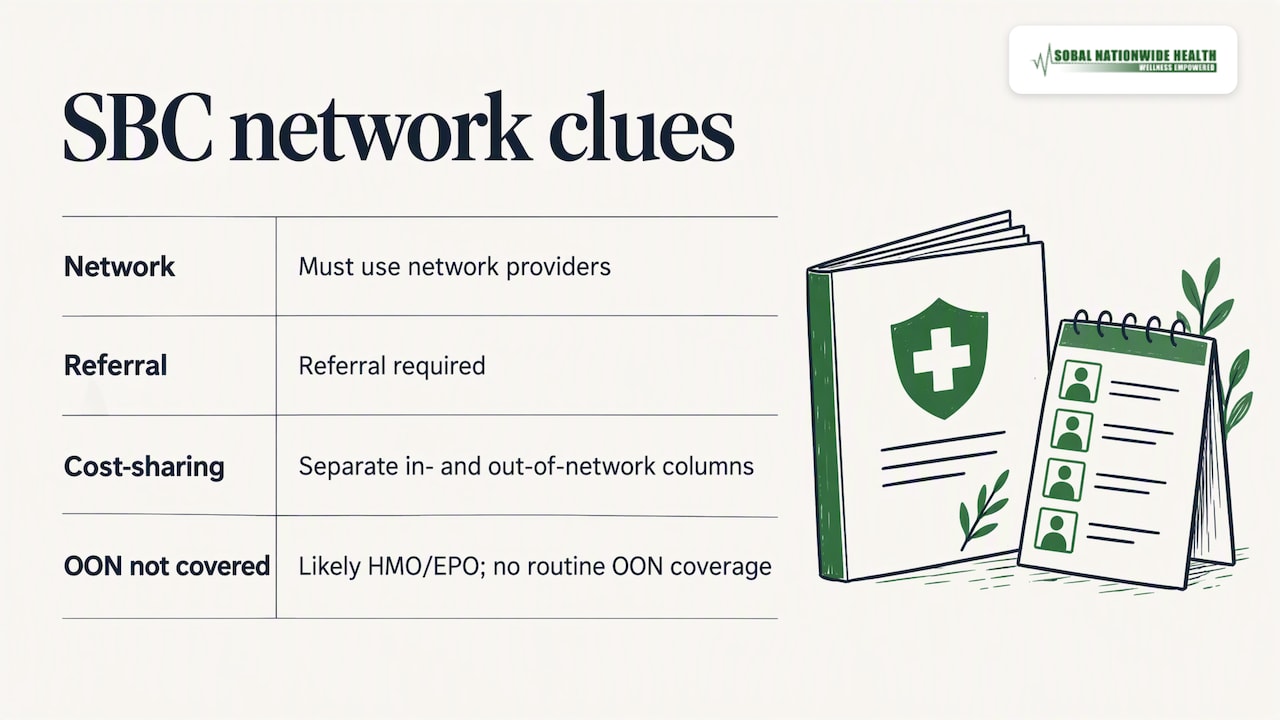
Pro Tip: Search your SBC for the words “out-of-network.” If you find a separate deductible or coinsurance for it, your plan may allow some out-of-network care. If you find “not covered,” plan on staying in-network.
If you are comparing broader options, we also break down when nationwide PPO coverage is worth the extra cost. And if you are on Medicare, our partners explain Medicare Advantage out-of-network rules, which differ from the commercial plans discussed here.
Emergency care and the No Surprises Act: when federal law steps in
An emergency is the one moment when network status should not drive your decisions. HealthCare.gov says to get care at the nearest facility, and federal rules prevent insurers from requiring prior authorization for emergency services or charging higher cost-sharing for an out-of-network emergency department.
The No Surprises Act took effect January 1, 2022. According to CMS, it protects people with employer, marketplace and many individual plans from unexpected out-of-network bills for emergency care and for certain services at in-network facilities. When the law applies, your cost-sharing cannot be greater than in-network cost-sharing.
What is and is not covered
The protections cover emergency services and some non-emergency services provided by out-of-network providers at in-network facilities. Two exceptions catch people off guard: ground ambulance services are not covered by the federal rules, and certain notice-and-consent situations can waive the protections if you sign away your rights. Treat any consent form as a decision to accept higher costs, because that is what it can mean.
You still owe your normal in-network cost-sharing. The law limits surprise bills, but it does not make emergency care free.
What to do after an emergency
- Get care first. Do not delay treatment to check a network directory.
- Write down the facility name, the providers who treated you and the date.
- Keep all paperwork, including discharge papers and every explanation of benefits (EOB) that arrives.
- Compare each bill to your EOB and confirm you were charged only in-network cost-sharing.
- If a bill looks wrong, call your plan and the provider, then escalate with a complaint if you suspect a surprise bill.
How to check a provider’s network status before you book
Checking your network before a scheduled visit can help you avoid surprise bills. Do not trust a single source.
- Start with your insurer’s online directory. Search by the exact plan name on your card, not just the insurer’s name.
- Call the provider’s billing office. Ask whether they participate with your specific plan product, not just the insurance company.
- Confirm the details. Ask about the specific provider, plan product and location.
- Check facility affiliations. A doctor can be in-network while the hospital, lab or anesthesia group they use is not.
- Get it in writing. Ask for an email or a note in your chart confirming network status and the date you asked.
Provider network status can change, so confirm it with your plan before care. That is why a phone call matters even when the website says “in-network.” KFF reminds members that narrow and tiered designs make it their job to confirm a provider’s current status for their plan.
For scheduled procedures, ask for a good-faith estimate from the provider and, when your plan offers it, a predetermination of benefits. Both give you a number to plan around before you commit.
Pro Tip: Ask the billing office: “Are you in-network with [exact plan name], and are the facility and any anesthesia or pathology groups in-network too?” That one question catches most ancillary surprises.
If you get an out-of-network or surprise bill: a step-by-step plan
A confusing bill is not a final bill. You have several ways to challenge it, and they work best in order.
- Get your EOB. Compare the billed amount to the allowed amount and see what your plan paid.
- Request an itemized bill. Look for services you did not receive or charges that repeat.
- Call the billing office. Ask for an explanation and whether they will adjust the balance. CMS lays out these steps in its key consumer protections overview.
- File an internal appeal with your insurer. Do this quickly, since appeal deadlines are limited.
- File a complaint. Contact your state department of insurance, or CMS where federal rules apply.
- Use the federal dispute process when eligible. CMS describes the Independent Dispute Resolution (IDR) process for payment disputes between plans and out-of-network providers. A CMS FAQ on implementation summarizes who is covered and how IDR works when parties cannot agree on an amount.
What to gather for an appeal or IDR
Build a folder before you start. It should hold:
- Every EOB related to the visit
- Itemized bills
- Any notices or consent forms you signed
- Written estimates you received
- Notes on each call: date, name, and what was said
If you chose to go out-of-network and need to get paid back for claims you paid yourself, our step-by-step guide on out-of-network reimbursement covers what to submit and when.
When going out-of-network makes sense, and how to protect yourself
Sometimes the in-network option is not the right one. Common reasons are real:
- No in-network specialist is available, or the wait is too long
- You are mid-treatment and continuity of care matters
- The procedure is highly specialized and not offered in-network
If you go that route, limit your exposure before the appointment, not after:
- Negotiate the price up front and get a written estimate
- Ask whether a bundled rate is available for the whole procedure
- Ask directly whether the provider will balance bill
- Do not sign a notice-and-consent form unless you accept the financial trade-off. CMS identifies these situations as an exception to the protections.
- Ask your plan for a predetermination of benefits, and double-check for an in-network alternative before you commit
Going out-of-network can be a sound choice when it is a choice you made with the numbers in front of you.
A quick checklist to avoid surprise bills
Keep this near your calendar. It works for scheduled care and for cleaning up afterward.
Before care
- Verify the provider’s network status for your exact plan.
- Check the facility and any ancillary groups, like anesthesia or labs.
- Request a written estimate.
- Confirm that ancillary providers are covered.
- Decline notice-and-consent forms unless you accept the cost.
After care
- Compare every bill to your EOB.
- Request an itemized bill.
- File appeals quickly.
- Contact state or federal channels if protections apply.
Pro Tip: Log every call with the date, the name of the person you spoke with and what they promised. Save every written confirmation. When a dispute arises, a clean paper trail often carries more weight than your memory.
How network status affects deductibles and out-of-pocket maximums
How in-network and out-of-network spending applies to your deductible and out-of-pocket maximum depends on your plan. Check your plan documents.
Some plans, mainly HMOs and EPOs, have no out-of-network benefit at all outside emergencies. In those cases, non-emergency out-of-network spending may not count toward anything, because the plan does not pay for it.
In an emergency, federal rules limit your cost-sharing to the in-network amount when the protections apply. Read your SBC and ask your plan how out-of-network spending is credited.
How network choice shapes premiums and plan selection
A wider network may cost more each month. Compare the premiums and provider lists for the plans you are considering. Narrow and tiered networks exist because they help control costs, and KFF’s survey shows employers use them for exactly that reason.
So the question is not “which plan is cheapest?” It is “which plan fits the doctors I actually use?” Before you enroll, write down your regular providers, your specialists, your preferred hospital and your prescriptions. Then check each against the plan’s network. A cheaper plan that leaves out your cardiologist is rarely cheaper in practice.
If you travel, split time between states, or want access across the country, a broad PPO may justify its price. If you stay local and your doctors are in a smaller network, a narrower plan can save real money.
Strategies for minimizing out-of-network costs
You cannot always avoid out-of-network care, but you can shrink the bill.
- Check referral rules. Review your plan documents to see whether a specialist visit requires a referral.
- Obtain prior authorization. Ask your plan whether the service needs approval, and get it in writing before the visit. Emergency care is the exception, since federal rules bar prior authorization for emergency services.
- Ask for a network exception. If no in-network provider can treat you, ask your plan to cover an out-of-network one at in-network rates. Plans do not always agree, but it is worth asking.
- Request estimates and bundled rates. Price the whole episode, including facility and ancillary fees.
- Keep records and appeal. Documentation turns a bad outcome into a winnable dispute.
None of these steps is complicated. They just have to happen before the visit.
What network rules mean for self-employed people and small businesses
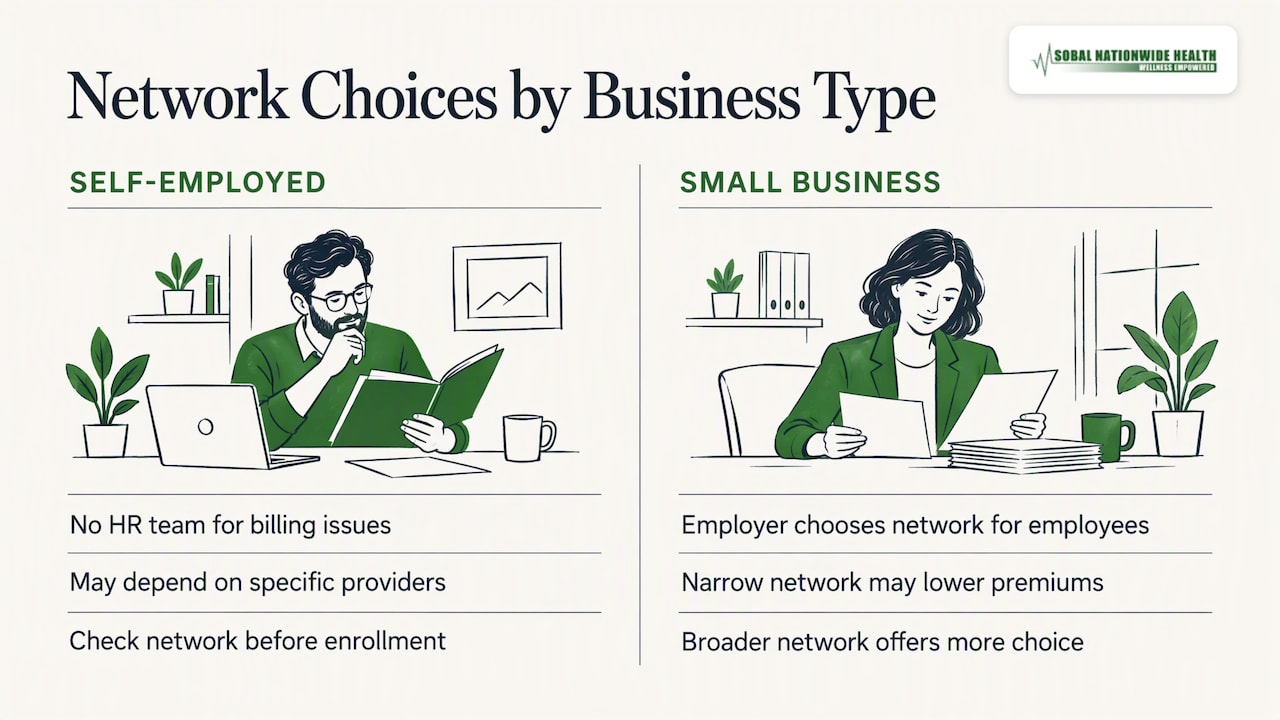
If you are self-employed, you are your own benefits department. There is no HR team to call when a bill goes wrong, so verifying the network before you enroll matters even more. Many self-employed buyers also depend on a few specific providers, such as a long-time primary care doctor or a specialist for a chronic condition. That makes a quick network check part of plan selection, not an afterthought.
Small businesses face a related choice. An employer picking a group plan is also picking a network for every employee. A narrow network may lower premiums, while a broader network offers employees more provider choice. One partner analysis looks at employer risks around reference-based pricing versus PPO plans under the No Surprises Act, which is useful background if your plan design is on the table.
Either way, ask for the network list in writing and match it to the people who will use it.
Why we check networks before we recommend a plan
Here is what we see in practice: people compare premiums and deductibles, then discover too late that their doctor is not in the network. We would rather you find that out before you enroll. When we review a plan with a self-employed client, we check the provider directory, confirm access to the key clinicians on their list, and plan around any scheduled procedure.
At Sobal Health, our brokers offer plan review, enrollment support and Spanish-speaking advisors, and we walk clients through out-of-network reimbursement steps when they need them. If a provider you rely on might be out-of-network, or your situation is complicated, working with a broker is a sensible move. It costs you nothing to ask the question before you commit.
— Bernie S
How we help you avoid network surprises
We review network fit for self-employed individuals, families and small businesses before you choose a plan, then help with enrollment and with reimbursement steps if you ever need them. You get a broker who answers questions in plain English, without sales pressure.

Here is how to get started:
- Schedule a plan review so we can compare your doctors and facilities against the networks you are considering
- Read our Resource Guide for practical how-tos
- Use our guide to out-of-network reimbursement if you already have claims to file
Ready to talk it through? Visit our Personal & Family Insurance page and book a plan review with one of our brokers today.
This article is general information, not a substitute for advice from a qualified financial advisor. Consult a qualified financial professional about your own circumstances before acting on anything here.
FAQ
Is it better to use in-network or out-of-network providers?
In-network is usually the better value because you pay negotiated rates and lower cost-sharing. KFF explains that out-of-network providers can bill higher rates and members often pay more. Out-of-network can still make sense when no in-network provider fits your needs.
Can a hospital be in-network while a doctor is out-of-network?
Yes. A facility and the doctors who work there can have separate contracts with your plan. The No Surprises Act protects you from many surprise bills in this situation, as CMS describes. Always confirm both the facility and the individual provider.
Will insurance still pay for out-of-network care?
It depends on your plan type. PPO and POS plans typically pay something at higher cost-sharing, while HMOs generally do not cover non-emergency out-of-network services, according to KFF’s California survey. Emergency care is treated differently under federal rules.
How much cheaper is in-network than out-of-network?
There is no single number, because it depends on your plan and the provider’s charge. In-network, you pay a negotiated rate with lower copayments and coinsurance. Out-of-network, you may pay higher cost-sharing plus any balance billing, unless a federal protection applies.
Does my insurance cover me out of state?
Many plans cover care through a nationwide network, and emergency care is protected wherever you are. A local HMO or EPO may limit non-emergency care to its service area. Check your SBC, or compare nationwide PPO options if you travel or live in more than one state.
Sources
- 2025 Employer Health Benefits Survey | KFF
- Healthcare
- Know your medical bill rights when using insurance | CMS
- 2025 California Health Benefits Survey | KFF
