

Divorce usually ends your coverage as a dependent on your spouse’s health plan, often on the date the divorce is finalized or your legal separation takes effect. Your first move is simple: pin down the exact termination date with HR or the plan administrator, because that date starts the clock on your options, including a COBRA election window and a Marketplace Special Enrollment Period, both lasting several weeks. COBRA can run for a limited period of months. Start gathering your divorce decree and a loss-of-coverage letter today, before you decide anything else.
TL;DR:
- Your exact health coverage termination date should be confirmed immediately with HR or the plan administrator to avoid missing COBRA or Marketplace enrollment windows.
- COBRA allows you to stay on your ex-spouse’s plan for up to 36 months but often at a higher cost since employer subsidies no longer apply, making Marketplace plans usually more affordable.
- Prioritize registering for Marketplace plans within 60 days of coverage loss and gather proof of coverage loss and income details to qualify for subsidies and special enrollment periods.
- For children, ensure enrollment details and premiums are clear, and verify coverage with healthcare providers ahead of plan switches to prevent delays or missing prescriptions.
- Avoid only comparing health plans based on monthly premiums, as total annual costs, including deductibles and out-of-pocket expenses, reveal the true affordability of each option.
Table of Contents
- How Divorce Affects Your Employer-Sponsored Health Plan
- What Are Your Coverage Options After Divorce?
- Who Covers the Children’s Health Insurance After Divorce?
- What Are the Key Deadlines After Losing Coverage?
- How Do You Choose the Best Plan After Divorce?
- Your 90-Day Health Insurance Checklist After Divorce
- What I’ve Seen Go Wrong (And How to Avoid It)
- How Sobal Health Can Help You Compare Options
- Where to Confirm the Rules Yourself
- Sources
How Divorce Affects Your Employer-Sponsored Health Plan
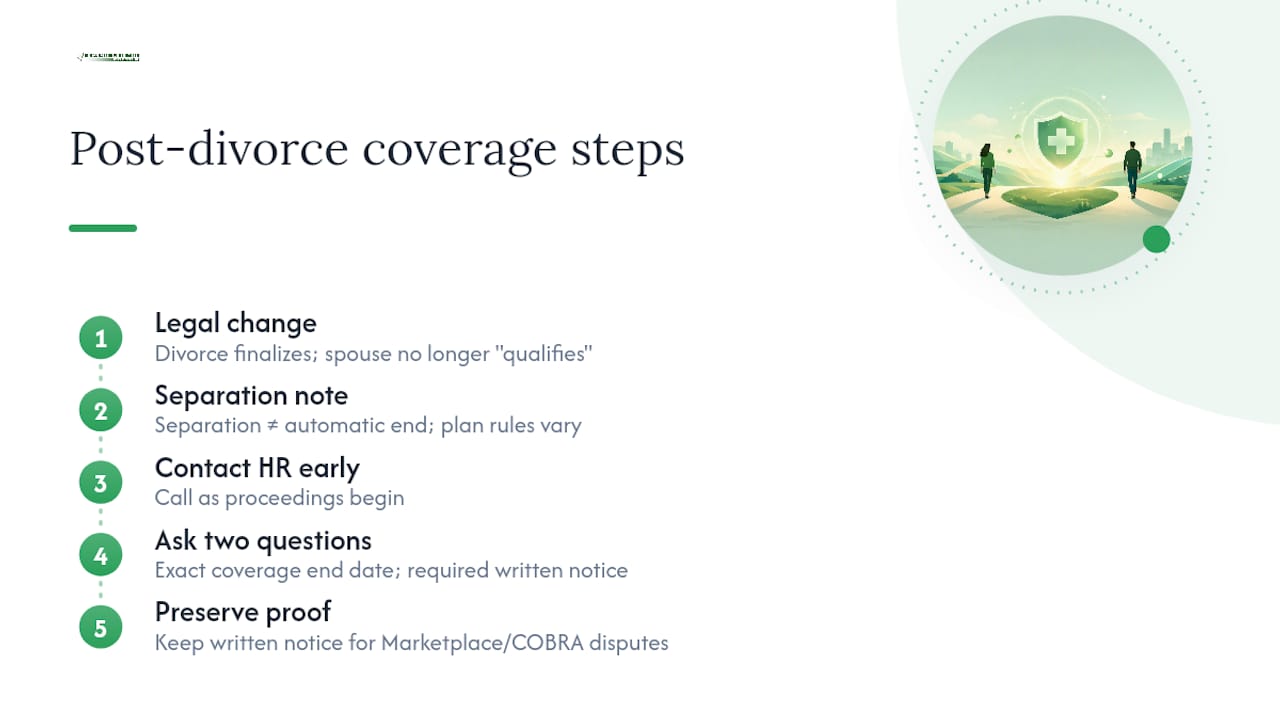
Employer plans define “dependent” narrowly, and a spouse typically stops qualifying the moment a divorce is finalized. That single word, “qualifying,” does a lot of work here. It’s not a moral judgment. It’s a contract term. Once your legal relationship changes, the plan document says you’re no longer eligible, and no amount of goodwill from your ex-spouse’s employer changes that.
Here’s where people get tripped up: separation and divorce are not the same event for plan purposes. Being legally separated or living apart doesn’t automatically end coverage. Some plans keep separated spouses covered until the divorce decree is final; others don’t. Temporary court orders during a separation might address who pays for insurance, but they rarely have the power to force an employer plan to keep covering someone who no longer meets its own definition of “spouse.” Federal employees have a slightly different set of tools, including Spouse Equity coverage and Temporary Continuation of Coverage, and should review OPM’s guidance for separating or divorcing employees early in the process.
The practical takeaway is this: don’t wait for paperwork to catch up on its own. Call your spouse’s HR department or plan administrator as soon as divorce proceedings begin, and ask two direct questions: what is the exact date coverage ends, and what notice do I need in writing? HIPAA and ERISA rules govern how that notice gets delivered, and getting the answer in writing protects you if a Marketplace or COBRA deadline is ever disputed later.
What Are Your Coverage Options After Divorce?
You have five realistic paths after divorce, and picking the right one depends on your health needs, your income, and how much continuity with current doctors matters to you.
COBRA continuation lets you stay on your ex-spouse’s exact plan for up to 36 months, but you pay the full premium, plus up to a 2% administrative fee. That’s the catch people miss: your ex-spouse’s employer likely covered a large chunk of that premium while you were married, and COBRA strips that subsidy away entirely.
By the numbers: Employer-sponsored plans typically cover a substantial share of the total premium for workers and families, which is exactly why full-price COBRA premiums often land far higher than what subsidized Marketplace shoppers pay for comparable coverage.
Your other main routes:
- New employer coverage, if you’re starting a job or your own employer offers a plan, counts as a qualifying life event. Ask HR how soon you can enroll outside the normal open enrollment window.
- ACA Marketplace plans give you a 60-day Special Enrollment Period after losing coverage, and you may qualify for an Advanced Premium Tax Credit based on your post-divorce income, which is often lower than your household income was while married.
- Medicaid or CHIP becomes worth checking the moment your individual income drops, since eligibility is state-based and income-sensitive, not tied to your former household earnings.
- Short-term or private off-exchange plans can bridge a gap in coverage, but they typically skip pre-existing condition protections and essential health benefits, so they work best as a short bridge, not a long-term plan.
Think of the premium as the price of admission and everything else, your deductible, your copays, your out-of-pocket maximum, as what happens after you walk through the door. A cheap monthly premium that comes with a $9,000 deductible isn’t actually cheap if you use much care at all.
Who Covers the Children’s Health Insurance After Divorce?
Most divorce settlements handle children’s coverage one of three ways, and courts are usually explicit about which one applies to you.
- One parent keeps the kids on their employer plan, and the decree specifies who pays the premium.
- The court orders a specific parent to “provide insurance,” which usually means through their employer or a Marketplace plan they purchase.
- Children enroll separately through the Marketplace or Medicaid/CHIP if neither parent has affordable employer coverage.
If your kids are switching plans, call their doctors and pharmacy before the switch takes effect, not after. Ask the old plan for a summary of recent claims and any prior authorizations, and hand that paperwork to the new plan’s member services line. This is the single most overlooked step in a divorce, and it’s the reason prescriptions get delayed at the pharmacy counter right when a family can least afford the hassle.
Keep the custody order itself, along with any specific insurance language from the decree, in one folder. You’ll need to show it to enroll a child outside open enrollment, and copies get requested more often than people expect.
What Are the Key Deadlines After Losing Coverage?
Missing a deadline here doesn’t just cost you money. It can cost you the coverage entirely, so treat these dates as fixed, not flexible.
- Within 60 days of the qualifying event, notify the plan administrator that your divorce has occurred, since failing to notify within this window can forfeit your COBRA rights entirely.
- Once notified, the plan sends a COBRA election notice, and you then have 60 days from that notice (or from your loss of coverage, whichever is later) to elect continuation coverage.
- Separately, you get a 60-day Special Enrollment Period to sign up for a Marketplace plan, and you’ll usually need to submit proof of your loss of coverage within about 30 days of starting your application.
COBRA can run for a limited period of months. It is the longest continuation option on this list, but that duration only helps if you actually elect it inside the required election window.
Start collecting documents now: your divorce decree, a written loss-of-coverage letter from the old plan, your COBRA election notice if one arrives, and pay stubs showing your current income. Request the loss-of-coverage letter directly from HR or the plan administrator in writing, and ask for a timestamp on when it was sent.
How Do You Choose the Best Plan After Divorce?
Comparing plans by monthly premium alone is the most common mistake people make right after divorce, and it’s an expensive one. Add up premium, deductible, and expected out-of-pocket costs for a full year, then compare that total across your options, not just the sticker price on the front page.
- Ask yourself how important it is to keep your current doctors versus saving money each month. If you’re mid-treatment for something ongoing, network continuity may outweigh a lower premium, since switching plans mid-treatment can mean re-doing prior authorizations or losing access to a specialist entirely.
- Estimate your post-divorce income honestly before assuming you don’t qualify for Marketplace subsidies. A lot of people carry over their old household income figure and miss meaningful premium tax credits they’d actually qualify for now.
- Treat COBRA as a short-term continuity tool, not a default. It’s often worth the higher cost only when you have active treatment, a surgery scheduled, or a small provider network you can’t easily replace.
Pro Tip: Before you commit to anything, call the plan administrator, your HR contact, and a licensed broker with the same three questions: What’s my exact termination date? What’s my COBRA premium? What would a Marketplace plan cost with my new income? Three different answers usually reveal the real gap between options.
If the math still feels murky, a comparison of current options side by side, rather than guessing at averages, tends to clarify things fast.
Your 90-Day Health Insurance Checklist After Divorce
Follow this in order, and don’t skip ahead even if a later step feels more urgent.
- Days 0-7: Confirm your exact coverage termination date with HR or the plan administrator, request your COBRA election notice in writing, and put a copy of your divorce decree in one dedicated file.
- Within 30 days: Collect proof of loss of coverage for your Marketplace application, check Medicaid or CHIP eligibility if your income dropped, and request medical records or claims history if you’re switching plans.
- Within 60 days: Submit your Marketplace enrollment or formally elect COBRA and set up your first premium payment.
- Ongoing: Save every confirmation email and enrollment letter, watch your first few bills closely for errors, and update your coverage again if you remarry or your income shifts.
What I’ve Seen Go Wrong (And How to Avoid It)
The gap in coverage I hear about most often isn’t caused by a lack of options. It’s caused by someone assuming their ex-spouse’s HR department would “handle it,” and the 60-day COBRA window closing before anyone filed the paperwork. One case that stuck with me: a client’s coverage lapsed for six weeks simply because nobody confirmed the exact termination date in writing. The fix is almost always the same: treat the notification step as your job, not the employer’s, and start the paper trail on day one.
— Bernie S
How Sobal Health Can Help You Compare Options
You don’t have to sort through COBRA math, Marketplace subsidy rules, and Medicaid eligibility alone while everything else about divorce is already demanding your attention. An independent broker can help compare ACA Marketplace plans against private, medically underwritten options side by side, so you see the real annual cost difference, not just a monthly premium quote.

That comparison matters most if your income just changed, you have ongoing treatment that makes network continuity a priority, or you simply want a private plan option that traditional Marketplace shopping won’t surface on its own. Advisors can walk through your specific situation, with no sales pressure attached, and explain how health insurance actually works in plain terms before you commit to anything. Spanish-speaking brokers may be available if that makes the conversation easier for your household. If you’re ready to see your real options laid out clearly, reach out to Sobal Nationwide Health today and get a comparison built around your actual post-divorce numbers, not a generic estimate.
For broader post-divorce financial planning beyond insurance, The Broken Seam’s practical roadmap covers the rebuilding process in more depth.
Where to Confirm the Rules Yourself
- Healthcare to apply for a Marketplace plan and confirm your Special Enrollment Period.
- DOL/EBSA for official COBRA election rules and notice requirements.
- Medicaid to check state-specific eligibility after an income change.
Sources
- Healthcare
- COBRA continuation coverage — U.S. Department of Labor (EBSA)
- COBRA continuation coverage FAQs — U.S. Department of Labor (EBSA)
- Medicaid
- Employer and worker contributions for premiums — KFF (2024)
