

Most LLC owners without employees should start by shopping Individual Marketplace (ACA) plans, since group coverage usually isn’t available unless you have at least one non-owner employee. Your LLC can pay or reimburse your premiums, but the tax treatment shifts depending on how the IRS classifies your business: single-member, partnership, S-Corp, or C-Corp. Here’s the quick version before we get into the details.
- No employees? Check Individual Marketplace plans and premium tax credits first.
- Have at least one non-owner employee? You may qualify for SHOP or other small-group coverage.
- Want tax-free employer coverage? That generally requires a C-Corp election, not just LLC status.
- Self-employed? You likely qualify for an above-the-line deduction on your personal tax return, no matter which Marketplace plan you pick.
Key Takeaways
Your LLC’s tax classification, not just the plan you pick, determines whether your health insurance premiums are actually deductible.
| Point | Details |
|---|---|
| Start with Marketplace | LLC owners without employees should check Individual Marketplace plans and subsidy eligibility first. |
| Classification drives deduction rules | Single-member, partnership, S-Corp, and C-Corp each report premiums differently on tax returns. |
| S-Corp owners need W-2 entries | Premiums must appear in W-2 Box 1 or the deduction is commonly disallowed. |
| Deduction caps at earned income | The self-employed health insurance deduction cannot exceed net business earnings for the year. |
| Get broker guidance | Sobal Health offers personalized plan comparisons and helps LLC owners handle payroll and tax reporting correctly. |
This article is general information, not a substitute for advice from a qualified financial advisor. Consult a qualified financial professional about your own circumstances before acting on anything here.
Table of Contents
- What Health Insurance Options Are Available to LLC Owners?
- How Does Your LLC’s Tax Classification Affect Health Insurance?
- What Will You Actually Pay After Subsidies?
- How Do You Enroll and Prepare Your Tax Documents?
- What Records Protect Your Health Insurance Deduction?
- Why Tax Classification Matters More Than Plan Shopping
- Get Personalized Help Choosing and Reporting Your Plan
- Sources
What Health Insurance Options Are Available to LLC Owners?
Your LLC’s structure decides which doors are actually open to you, so it helps to know all five before you pick one.
Individual Marketplace plans are the default for most solo LLC owners. These ACA-compliant plans cover the ten essential health benefits, and if your household income falls in a qualifying range, you may receive premium tax credits that lower your monthly cost. Healthcare that self-employed people and business owners without employees generally buy coverage this way. The tradeoff: premiums can run high without a subsidy, and plan networks vary by county.
SHOP (small-group) plans work only if you have employees. CMS defines SHOP eligibility as generally 1 to 50 employees, and it explicitly excludes businesses where the only people on payroll are owners or spouses. If that’s your setup, you typically do not qualify for SHOP.
Private medically underwritten plans ask health questions during the application and price your premium accordingly. For younger, healthier applicants, this can mean real savings over Marketplace rates, though pre-existing conditions may lead to higher pricing or exclusions. These plans work outside the ACA subsidy system entirely.

Short-term and supplemental plans fill narrow gaps, like bridging a coverage lapse between jobs or adding accident and critical illness protection on top of a major medical plan. They’re not built to replace comprehensive coverage on their own.
How Does Your LLC’s Tax Classification Affect Health Insurance?
The IRS doesn’t tax an LLC as a single entity type. It taxes the LLC based on how you’ve elected to be classified, and that election determines exactly how your health premiums get deducted.
- Single-member LLC (disregarded entity). You claim the self-employed health insurance deduction directly on Schedule 1 of your personal return, using Form 7206 to calculate the amount. The deduction cannot exceed your net earned income from the business for the year.
- Partnership or multi-member LLC. The partnership pays premiums, or reimburses partners, and reports them as guaranteed payments. Each partner then claims the deduction personally, based on their share reported on Schedule K-1.
- S-Corp owners with over 2% ownership. The company pays or reimburses your premiums, and that amount must be added to Box 1 of your W-2, but not Boxes 3 or 5. Skip this step, and the deduction is commonly disallowed entirely.
- C-Corp. Employer-paid premiums are tax-free to you as the employee, no W-2 addition required. This is one of the few scenarios where forming or electing C-Corp status genuinely pays off for health coverage, though it brings its own compliance overhead.
Pro Tip: If your spouse had access to subsidized employer coverage for even one month of the year, that month typically doesn’t count toward your deduction. Track eligibility month by month, not just annually.
Zero-profit years create another trap: no earned income means no deduction, regardless of what you paid in premiums.
What Will You Actually Pay After Subsidies?
Premium tax credits are calculated against your estimated household income for the coverage year, not last year’s tax return. For self-employed LLC owners, that means projecting net income from your Schedule C or K-1, which is trickier than a W-2 employee’s flat salary estimate.
A small survey found private medically underwritten plans can sometimes beat Marketplace pricing for healthy applicants who don’t qualify for a subsidy, though the underwriting tradeoffs matter. If your projected income lands you a strong subsidy, Marketplace usually wins. If your income is too high for meaningful credits and you’re in good health, it’s worth comparing both paths side by side.
- Estimate net self-employment income conservatively, then adjust once quarterly numbers firm up.
- Gather 1099s, profit-and-loss statements, or K-1 estimates before applying.
- Compare your subsidized Marketplace premium against a private plan quote for the same coverage tier.
How Do You Enroll and Prepare Your Tax Documents?
- Estimate your expected household income for the coverage year and check subsidy eligibility at HealthCare.gov.
- Gather business income records, Schedule C, K-1, or payroll reports, plus proof of any employer coverage your spouse might have access to.
- Apply directly through the Marketplace, or work with a licensed broker who can walk through private plan options alongside ACA plans.
- Ask your broker exactly how premiums will be paid or reimbursed, and how that arrangement will show up on your taxes.
- At year-end, confirm W-2 or K-1 entries are correct, keep every premium receipt, and prepare your Form 7206 worksheet if you’re claiming the deduction.
What Records Protect Your Health Insurance Deduction?
Sloppy recordkeeping is the single fastest way to lose a deduction you actually earned. Keep every premium receipt and maintain a dedicated bookkeeping line item for owner health premiums, separate from general business expenses.
- S-Corp owners: document the employer payment or reimbursement in writing, and confirm it lands on W-2 Box 1, not Boxes 3 or 5.
- Partnerships: guaranteed payments for health premiums need to appear on both the partnership return and each partner’s K-1.
- Never pay premiums straight from company funds without a written reimbursement plan and matching payroll or accounting entries.
Pro Tip: Set a calendar reminder in December to reconcile your premium payments against your bookkeeping before your accountant starts your return. Catching a missing W-2 entry in January is a headache; catching it in November is a five-minute fix.
Why Tax Classification Matters More Than Plan Shopping
Here’s what most guides get backward: they walk you through comparing plans first and mention taxes as an afterthought. In practice, your LLC’s tax classification should shape your shopping strategy from the start, because it determines what you can actually deduct, not just what you can buy.
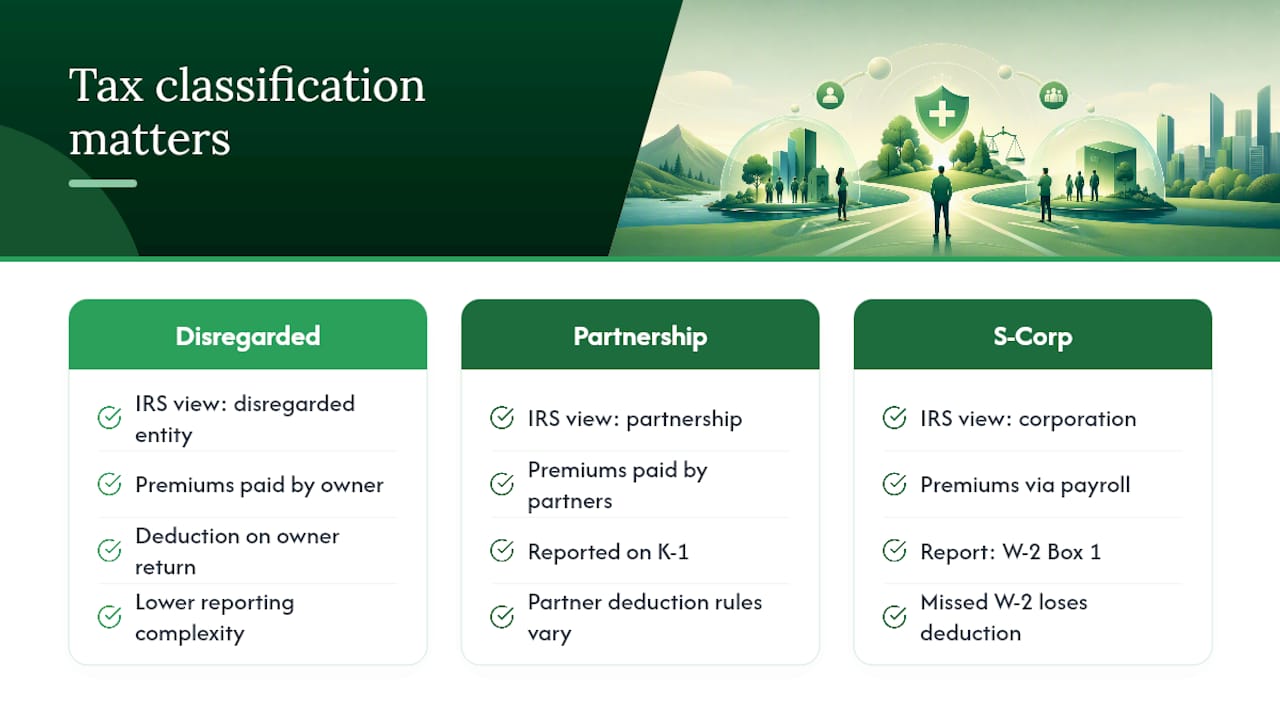
I’d argue the biggest blind spot for LLC owners is treating “LLC” as if it grants some special insurance status. It doesn’t. The IRS doesn’t see an “LLC plan.” It sees a disregarded entity, a partnership, or a corporation, and each one has different rules for who pays premiums and how that payment gets reported. An S-Corp owner who forgets the W-2 Box 1 step doesn’t just make a paperwork error. They can lose a deduction worth thousands of dollars, and often don’t find out until an accountant flags it the following spring.
My honest take: spend less time debating plan tiers and more time confirming your classification and payroll mechanics are correct. A mediocre plan with a properly documented deduction beats a great plan with a blown tax break.
— Bernie
Get Personalized Help Choosing and Reporting Your Plan
Sobal Health is the alternative to guessing your way through Marketplace tiers or private underwriting alone. As a licensed broker specializing in coverage for self-employed people and small business owners, Sobal Health gives you access to private medically underwritten plans that some clients have used to cut monthly premiums by up to $400, alongside standard ACA options, so you’re comparing real numbers instead of assumptions.

A consultation with Sobal Health walks through your specific LLC classification, your income estimate, and which plan type actually fits your situation, whether that’s a subsidized Marketplace plan or a private underwritten option. There’s no sales pressure and no obligation to enroll. If you’re ready to see what you’d actually pay, explore your self-employed health insurance options and get a real quote based on your numbers, not a generic estimate.
Sources
- Healthcare
- Small Business Health Options Program (SHOP) | CMS
- Limited Liability Company (LLC) | IRS
- Self-Employed Individuals Tax Center | IRS
- Self-Employed Health Insurance Deduction Under Section 162(l) | Beancount (2026)
Recommended
- Self-Employed Health Insurance in Florida: 7 Options Every 1099 Worker Should Know (2026 Guide) | Sobal Nationwide Health
- Best Health Insurance for Self-Employed in Florida (2026) | Sobal Nationwide Health
- Health Insurance FAQ & Cost Calculators | Sobal Nationwide Health
- 7 Ways Business Health Insurance Benefits Florida Employers | Sobal Nationwide Health
