

If you’re a sole proprietor, the Individual Marketplace is typically your best starting point because it’s the only route that offers premium tax credits. Pair that with the self-employed health insurance deduction on Schedule 1, and you’ve got the two biggest levers for lowering your real cost. Still, if your spouse has an employer plan, run the numbers there too. Sometimes it’s the cheaper answer.
TL;DR:
- Sole proprietors should primarily focus on the Individual Marketplace for coverage since it offers premium tax credits and ACA essential benefits.
- Running the income estimates accurately, including self-employment deductions, is critical for maximizing subsidies and avoiding reconciliation issues.
- Claiming the self-employed health insurance deduction on Schedule 1 reduces taxable income and can influence subsidy eligibility when combined with income adjustments.
- Comparing plan tiers requires analyzing total costs, including premiums and out-of-pocket expenses, rather than premiums alone, especially when pairing with health savings accounts.
- Coordinating tax deductions with subsidy calculations is essential, as misestimating income or choosing the cheapest plan without subsidy consideration can lead to higher overall costs.
Table of Contents
- What Health Insurance Options Do Sole Proprietors Have?
- How Do Premium Tax Credits Work for the Self-Employed?
- How Do You Claim the Self-Employed Health Insurance Deduction?
- What Does Sole Proprietor Health Insurance Actually Cost?
- How Do You Choose the Right Plan?
- Where Does Sobal Nationwide Health Fit Into This?
- What’s the Real Lesson Here for Sole Proprietors?
- Get a Free, No-Pressure Plan Review
- Sources
What Health Insurance Options Do Sole Proprietors Have?
You’ve got more choices than the ads suggest, but not all of them work the same way once tax season hits. Here’s the practical breakdown.
The Individual Marketplace is where most sole proprietors land, and for good reason. Plans there cover the 10 essential health benefits required under the ACA, including hospitalization, prescriptions, mental health care, and maternity coverage, and it’s the only place premium tax credits apply.
You might assume SHOP (the Small Business Health Options Program) is available since you technically run a business. It’s not, in most cases. SHOP requires at least one common-law employee besides yourself, so a solo operation without W-2 staff usually gets funneled straight to the Individual Marketplace instead.
Other routes worth knowing:
- Spouse’s employer plan: Often your cheapest option if available, since group plans spread risk across a larger pool. You’ll need to enroll during open enrollment or a qualifying life event.
- Private/non-Marketplace plans: Sold directly by carriers or brokers. These can offer competitive underwritten rates but never qualify for subsidies.
- Association health plans: Bundled through trade groups or chambers of commerce. Coverage quality varies widely, so check the network before assuming it’s a bargain.
- Short-term and health-sharing plans: Cheap upfront, but they routinely exclude pre-existing conditions and cap payouts. Read the fine print before betting your health on one.
How Do Premium Tax Credits Work for the Self-Employed?
Premium tax credits work on a sliding scale: the lower your projected household income relative to your local cost of living, the bigger the subsidy. This is the mechanism that makes Marketplace coverage cheaper than it looks on the sticker price, and it’s available exclusively through Marketplace plans. A private plan with a lower list price can end up costing more once you factor in the credit you’d be walking away from.
Estimating your income accurately matters more than people expect. Here’s how to approach it:
- Start with last year’s net profit from Schedule C as a baseline.
- Adjust up or down for known changes (new clients, lost contracts, seasonal shifts).
- Subtract your expected self-employed health insurance deduction, since Marketplace income estimates use your projected adjusted gross income.
- Update your estimate mid-year if your income shifts significantly.
That last step isn’t optional. If your income changes and you don’t update your application, you’ll reconcile the difference on Form 8962 at tax time, which can mean owing money back or getting an extra credit.
Pro Tip: Recent policy expansions, including provisions from the Inflation Reduction Act, extended subsidy eligibility to higher income levels than before, so don’t assume you earn too much to qualify without actually running the numbers.
How Do You Claim the Self-Employed Health Insurance Deduction?
The self-employed health insurance deduction (SEHID) is an above-the-line adjustment, meaning it reduces your taxable income without requiring you to itemize. You claim it on Schedule 1, Line 17, using Form 7206 to calculate the exact amount.
A few rules that trip people up:
- The deduction can’t exceed your net earned income from the business for the year.
- If your Schedule C shows a loss, you likely can’t take the deduction at all for that year.
- You’re only eligible for months you weren’t covered under an employer-sponsored plan, including a spouse’s plan.
The most common mistake: deducting owner health premiums directly on Schedule C as a business expense. It isn’t allowed for the owner’s own coverage, and it artificially lowers your self-employment tax calculation, which can draw IRS attention during review. The correct treatment always runs through Schedule 1, not Schedule C.
Claiming SEHID also affects your Marketplace subsidy calculation, since it lowers your AGI. That can nudge you into a higher credit bracket, which is one of the few genuinely happy accidents in tax law.
What Does Sole Proprietor Health Insurance Actually Cost?
Premiums vary by age, location, and metal tier, but understanding the tiers helps you avoid overpaying for coverage you don’t need or underpaying for coverage that leaves you exposed.
- Bronze: Lowest premium, highest out-of-pocket costs. Fits healthy sole proprietors who rarely see a doctor.
- Silver: The middle ground, and often the smartest pick if you qualify for cost-sharing reductions on top of premium tax credits.
- Gold/Platinum: Higher premiums, lower deductibles. Makes sense if you manage a chronic condition or expect frequent care.
Pairing a high-deductible health plan (HDHP) with a Health Savings Account (HSA) is worth serious consideration if you’re generally healthy. You contribute pre-tax dollars, the balance rolls over year to year, and withdrawals for qualified medical expenses are tax-free. Contribution limits adjust annually, so check current IRS figures before maxing yours out.
Pro Tip: Don’t just compare premiums. Add your expected out-of-pocket costs (deductible, copays, coinsurance) to the annual premium total. A cheaper monthly bill with a $7,000 deductible can cost you more than a pricier plan with a $2,000 deductible if you use care regularly.
How Do You Choose the Right Plan?
Comparing plans gets easier once you know exactly what to check and what to ask.
Run through this checklist before enrolling:
- Calculate total annual cost: premium times twelve, plus your realistic out-of-pocket estimate.
- Confirm your regular doctors and prescriptions are in-network before anything else.
- Check whether services you actually use require prior authorization.
- Ask about the carrier’s renewal rate history, not just this year’s price.
- Look up the plan’s claims-payment reputation, since a slow claims process creates real headaches later.
Watch for these red flags:
- Health-sharing ministry disclaimers stating they aren’t insurance and don’t guarantee payment.
- Plans excluding entire categories of care (maternity, mental health, specific prescriptions).
- Premiums that seem too good to be true paired with a narrow, unfamiliar network.
If you’re comfortable navigating Healthcare.gov and comparing tiers yourself, DIY enrollment works fine. If your income fluctuates, you have a pre-existing condition, or the subsidy math feels murky, a licensed broker can walk through scenarios with you at no cost to you, since brokers are paid by the carrier.
Where Does Sobal Nationwide Health Fit Into This?
Sobal Nationwide Health works with self-employed clients across 31 states, offering both private medically underwritten plans and Marketplace guidance depending on what actually fits your health history and budget. Our brokers include Spanish-speaking advisors, and every review comes without sales pressure attached.
Clients working with Sobal Nationwide Health have reported savings of up to $400 per month after switching plans, though your results depend heavily on your age, location, and health history.
We also support small-business packages for sole proprietors who eventually bring on employees and need to transition into group coverage.
What’s the Real Lesson Here for Sole Proprietors?
Most advice on this topic treats health insurance and tax strategy as separate conversations. That’s the mistake. The moment you claim the self-employed health insurance deduction, you’ve changed your adjusted gross income, and that number is exactly what determines your Marketplace subsidy. Treat them as one decision, not two.
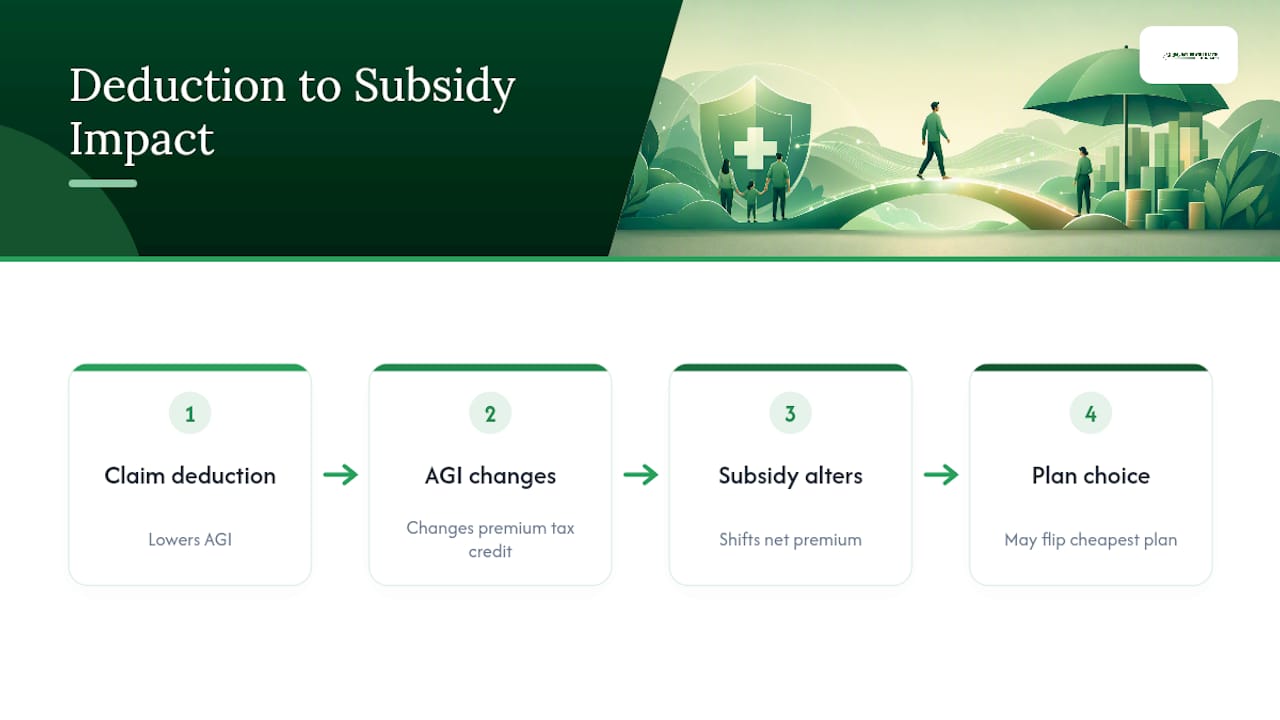
The conventional wisdom, “just pick the cheapest premium,” ignores how much the subsidy math can flip that calculation upside down. A Silver plan with a strong premium tax credit frequently beats a cheaper-looking Bronze plan once you factor in what you’re actually eligible to save.
If you take away one thing, prioritize getting your income estimate right before you touch plan comparisons. Every subsidy calculation, every deduction interaction, every dollar of real savings flows from that one number. Get it wrong and you’ll spend the year either overpaying or scrambling to repay credits through Form 8962. Get it right, and the rest of the decision gets a lot simpler.
— Bernie S
Get a Free, No-Pressure Plan Review
Running the subsidy math and the tax deduction side by side isn’t something you should have to figure out alone, especially when the numbers interact the way they do. Sobal Nationwide Health offers a free consultation that walks through your projected income, compares Marketplace subsidy scenarios against private underwritten options, and handles the enrollment paperwork so you’re not doing it solo at 11pm before a deadline.

If you’re ready to see what’s actually available to you, learn how health insurance works and what a personalized review looks like. Pull last year’s premium receipts and your most recent Schedule C before your call. It’ll speed up the whole process and give your broker a real starting point for comparing your options.
This article is general information, not a substitute for advice from a qualified financial advisor. Consult a qualified financial professional about your own circumstances before acting on anything here.
Sources
- Healthcare
- What are premium tax credits? — Tax Policy Center
- ACA Marketplace coverage among self‑employed and small‑business owners — U.S. Department of the Treasury
- Topic No. 502 Medical and Dental Expenses — IRS
