

If you spend more than roughly $150 to $200 a year on glasses, contacts, or eye exams, an individual vision plan will usually pay for itself. If you spend less, a discount vision program or paying cash out of pocket is often the smarter move. Run your own numbers before you buy anything, and remember that self-employed health insurance deductions may make either option cheaper than they first appear.
TL;DR:
- Vision plans typically cover one annual exam that can detect health issues like diabetes, and include allowances for lenses and frames, but exclude treatment for eye diseases.
- For self-employed individuals, buying a plan only makes sense if expected annual expenses exceed the combined premium and copays; contact wearers tend to break even faster.
- Out-of-network reimbursement rates are often lower than retail prices, so confirming in-network providers is essential to realize savings.
- Premiums range from $10 to $30 per month, with deductibility possible if premiums are paid with health accounts, but modeling total costs with copays and allowances remains crucial.
- When choosing a plan, verify provider network coverage first, compare allowances and copays, and consider flexibility in billing and cancellation terms to suit variable income.
Table of Contents
- What Does Vision Insurance for Self-Employed Workers Cover?
- Is Vision Insurance Worth It for the Self-Employed?
- How Do You Buy Vision Insurance Without an Employer?
- What Does Vision Insurance Cost, and Can You Deduct It?
- A Checklist for Choosing the Right Vision Plan
- Mistakes That Quietly Erase Your Savings
- How to Evaluate Your Personal Vision Health Risks Before Buying
- Managing Vision Premiums When Your Income Isn’t Steady
- Getting the Most Out of Your Benefits as a Self-Employed Buyer
- When Does Broker Advice Actually Save You Money?
- Get Help Choosing the Right Coverage
- Sources
- FAQ
What Does Vision Insurance for Self-Employed Workers Cover?
A standalone vision plan is built around one comprehensive eye exam per year, plus an allowance toward eyewear. That exam does more than update your prescription. It can also flag early signs of diabetes and high blood pressure, which makes it one of the few “small” checkups with outsized preventive value.
Beyond the exam, most plans include:
- A frame allowance, typically $100 to $200 toward a new pair
- Standard lens coverage, often with copays for coatings or progressives
- A contact lens allowance instead of the frame benefit (most plans make you choose one or the other each year)
- A discount on LASIK, rather than full coverage, since laser surgery is usually classified as elective
Vision plans exclude treatment for eye diseases like glaucoma or cataracts. That’s medical care, and it belongs on your regular health insurance, not a vision rider. Staying in-network also matters more than people expect: an out-of-network exam or purchase reimburses at a flat rate that rarely matches what your preferred retailer charges at full price.
Is Vision Insurance Worth It for the Self-Employed?
Vision insurance works like a prepaid discount plan for expenses you already know are coming. The way to test whether it’s worth it isn’t a gut feeling. It’s a simple break-even calculation using your own spending habits.
- Add up your expected annual costs: exam fee, plus glasses or contacts, plus any lens upgrades you know you’ll want.
- Compare that total against 12 months of premiums, which typically run $10 to $30 a month for an individual plan.
- If your expected spend clears the annual premium total, plus whatever copay remains after the allowance, the plan pays off.
Quick math: at $20 a month, you’re paying $240 a year. A $150 exam plus a $200 pair of glasses covered by a $150 allowance and a $40 copay puts your out-of-pocket need well above that premium. Contact wearers tend to clear break-even fastest. Contacts-heavy users spending $200 or more annually on supplies typically recover the premium with room to spare.
Every one of these numbers assumes you’re shopping in-network. Take the plan out-of-network and the math falls apart fast.
How Do You Buy Vision Insurance Without an Employer?
You don’t need a job to get vision coverage. Self-employed people have four real paths, each with tradeoffs worth knowing before you sign anything.
- Association or group plans. Freelancer unions, chambers of commerce, and some professional associations negotiate group rates that individuals can’t access alone. Worth checking if you belong to one already.
- Discount vision programs. These aren’t insurance at all. They’re membership programs that negotiate lower service prices, and they often beat insurance for people who only need an exam every year or two.
- Bundled coverage. Pairing vision with dental or a broader health plan can simplify billing, but check the provider directory and any waiting period before assuming it’s cheaper.
Pro Tip: Before enrolling anywhere, pull up the plan’s provider directory and search for your current eye doctor and optical retailer by name. If they’re not listed, your “savings” may evaporate the moment you use the benefit.
Once you’ve confirmed network access, run your break-even math, then confirm the exact start date before you cancel any existing coverage.
What Does Vision Insurance Cost, and Can You Deduct It?
Premiums for standalone plans commonly land between $10 and $30 per month, with the higher end usually reflecting richer allowances or family coverage rather than a bigger provider network. Adding dependents raises the premium, but the per-person cost often drops compared to buying separate individual plans.
What actually determines your out-of-pocket total isn’t the premium alone. It’s the combination of:
- Copay amounts for the exam and materials
- Whether your frame or contact purchase falls within the allowance or spills over into extra charges
- How often you use the benefit in a two-year cycle, since some plans stagger eyewear coverage
On taxes, self-employed people may be able to deduct health-related insurance premiums when filing, subject to IRS rules on the self-employed health insurance deduction. An HSA or FSA can also cover many vision expenses pretax, including exams, glasses, and contacts, though the rules differ by account type. Keep every receipt and your plan’s explanation of benefits in one folder. You’ll want that paper trail if a tax preparer asks how you calculated the deduction.
A Checklist for Choosing the Right Vision Plan
Comparing two or three quotes is easy to get wrong if you focus only on the monthly price. Work through this order instead:
- Check the provider network first. Search for your current optometrist and preferred optical retailer before comparing a single dollar figure.
- Compare allowances and copays, not just premiums. A $12 plan with a $60 allowance can cost more in practice than a $22 plan with a $150 allowance.
- Confirm the benefit cycle. Some plans renew eyewear benefits every 12 months; others stretch frames to a 24 month cycle while keeping the exam annual.
- Look for overlap or gaps. If you’re bundling vision with a broader health or dental plan, make sure the vision rider doesn’t duplicate a benefit you’re already paying for elsewhere.
- Read the waiting period and cancellation terms. Many individual plans allow immediate use of preventive benefits, but materials benefits sometimes carry a short delay.
- Set up your deduction tracking before your first claim. Note the enrollment date and premium amount in whatever bookkeeping system you already use for other business expenses.
Pro Tip: If you’re weighing month-to-month flexibility against an annual plan, remember that variable income makes flexibility worth almost as much as the sticker price. A plan you can pause during a slow quarter beats a locked-in annual contract that strains your cash flow.
Mistakes That Quietly Erase Your Savings
The gap between expected savings and real savings almost always comes down to a handful of avoidable errors.
- Assuming out-of-network reimbursement matches retail cost. It rarely does. A reimbursement cap far below your retailer’s cash price is the single most common reason a plan underperforms expectations.
- Skipping the provider directory check. Buying a plan before confirming your preferred retailer participates is how people end up paying full price anyway.
- Forgetting to model both contacts and backup glasses in the same year. If you wear contacts daily but also need a backup pair, that’s two materials benefits competing for one annual allowance.
- Never testing plans against your own spending. A simple spreadsheet with last year’s exam cost, eyewear purchase, and any contact lens supplies takes ten minutes and prevents most of the above.
How to Evaluate Your Personal Vision Health Risks Before Buying
Your medical history matters more here than most people assume. If you have diabetes, a family history of glaucoma, or you’re over 40, your eyes need more frequent, more thorough monitoring, and a vision plan’s preventive exam becomes more valuable simply because you’re more likely to use it every year without fail.
Start by asking yourself a few honest questions. How often have you actually changed your prescription in the last three years? Do you currently wear contacts, glasses, or both, and would you need both types if one broke? Is there a family history of any eye condition that a routine screening might catch early? Screening exams matter for another reason too: they can surface signs of diabetes or high blood pressure before those conditions show up anywhere else.
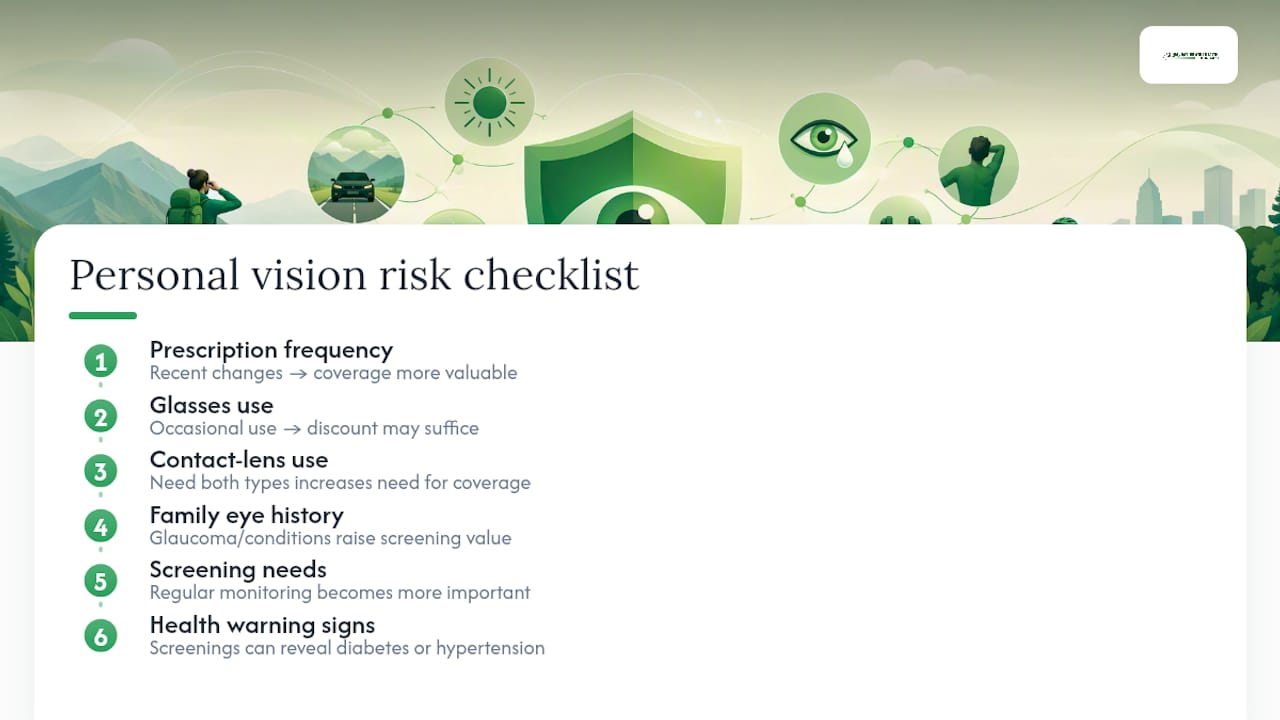
Screen time is worth factoring in as well. If your work is entirely computer based, which describes most self-employed consultants, designers, and writers, eye strain and dry eye symptoms tend to accelerate the need for updated lenses. That pushes your expected annual spend higher and shifts the break-even math in favor of buying a plan rather than paying cash.
If your risk factors are low, your prescription has been stable for years, and you only wear glasses occasionally, a discount program may serve you better than a full insurance plan. If any risk factor above applies to you, weight your break-even calculation toward buying coverage, even if the raw numbers look close to even.
Managing Vision Premiums When Your Income Isn’t Steady
Self-employed income rarely arrives in equal monthly installments, and a fixed vision premium doesn’t care whether your invoices got paid on time. The fix isn’t avoiding coverage. It’s structuring how you pay for it.
Set aside your vision premium as a fixed line item in whatever percentage-based savings system you already use for taxes or business expenses. Treating it as a non-negotiable withdrawal, the same way you’d treat rent, keeps it from becoming the bill you skip during a slow month.
Where your carrier allows it, choose month-to-month billing over an annual lump sum. Plan flexibility, meaning the ability to pause or adjust coverage without breaking a long-term contract, often matters as much as the premium itself when your income swings from month to month. An annual plan locks in savings if your income is stable, but it can strain cash flow during a dry stretch if you’re required to pay it all upfront.
If your income has a predictable seasonal pattern, so slower winters or a busy summer, time your enrollment to start right after a strong income month. That gives you a buffer before the next premium is due. And if you’re bundling vision with a broader health plan, ask whether the combined premium can be billed on a schedule that matches your invoicing cycle rather than a generic calendar month.
Getting the Most Out of Your Benefits as a Self-Employed Buyer
Using your vision benefit well starts before you ever sit in the exam chair. Call ahead, or check the provider’s website, to confirm your plan is accepted and ask what portion of the visit is covered outright versus what triggers a copay.
For eyewear, use your allowance strategically rather than automatically. If your allowance covers $150 toward frames and you find a pair at exactly that price, you pay nothing beyond the copay. Push past that number for designer frames, and every extra dollar comes straight out of your pocket. The same logic applies to lens upgrades. Anti-glare coating and progressive lenses are worth asking about upfront, since the difference between “included” and “add-on” is where surprise bills usually hide.

Keep your receipts and the plan’s explanation of benefits together in one folder, digital or physical, from day one. If you’re planning to claim a self-employed health insurance deduction, you’ll want that documentation ready at tax time rather than reconstructed from memory.
If you paid out-of-network and are filing for reimbursement, submit your claim promptly. Most carriers set a filing deadline, often 12 months from the date of service, and reimbursement rates for out-of-network care are usually a flat schedule rather than a percentage of what you actually paid.
When Does Broker Advice Actually Save You Money?
Break-even math handles a lot of the decision on its own, but a few situations make outside advice genuinely worth the phone call. Bundling vision with a broader health plan, covering a spouse and kids under different eligibility rules, or dealing with income that swings wildly month to month can all turn a simple comparison into something harder to model alone.
Some insurance brokers specialize in tailored coverage for self-employed individuals, families, and small businesses across multiple states, which matters most when the “right” plan isn’t obvious from a rate sheet alone. A quick signup offer comparison from health insurance research shows how much plan flexibility can vary between carriers, reinforcing that the fine print often matters more than the headline price.
If your break-even numbers land within a few dollars either way, or your income makes annual commitments risky, that’s the moment to request an enrollment review rather than guessing.
— Bernie S
Get Help Choosing the Right Coverage
Running your own break-even math gets you most of the way there, but bundling vision with a health plan, adding family members, or working with income that changes every month adds variables a spreadsheet won’t catch on its own. Some health insurance brokers work directly with self-employed individuals and small business owners across multiple states, offering personalized policy review across plan types, including private medically underwritten plans, ACA marketplace options, dental, vision, and supplemental coverage, without any sales pressure attached.
A consult typically means walking through your current spending, comparing plan types side by side, and getting enrollment support once you’ve picked the option that actually fits your income pattern. If you’d rather understand how health insurance works before talking to anyone, that’s a reasonable place to start too. When you’re ready to compare real options, reach out to Sobal Health to start the conversation.
Sources
- Can eye exams detect other health problems? — Traverse City Eye
- Standalone vision insurance: coverage, costs & enrollment — LegalClarity
- Is vision insurance worth it? How to decide — Decipher Healthcare
FAQ
When Can I Enroll in a Vision Plan as a Freelancer?
Most individual vision plans allow year-round enrollment and can start within one to two weeks of signing up, unlike major medical plans tied to open enrollment windows.
Can I Deduct Vision Insurance Premiums on My Taxes?
Self-employed filers may be able to deduct health-related insurance premiums, including vision, under IRS self-employed health insurance rules, though eligibility depends on your specific tax situation.
Are Discount Vision Plans Better Than Insurance?
For infrequent users, discount vision programs that negotiate lower cash prices can cost less than a monthly insurance premium, especially if you only need an exam every year or two.
Does Vision Insurance Cover LASIK?
Most vision plans offer a discount on LASIK rather than full coverage, since laser eye surgery is typically treated as an elective procedure rather than a covered medical benefit.
Can I Add Family Members to My Vision Plan?
Yes, most individual vision plans allow you to add a spouse and dependents, usually at a lower per-person rate than buying separate individual policies, though the combined premium rises with each person added.
