

The short version: both plans only pay for doctors in their network, but an HMO makes you pick a primary care doctor and get referrals, while an EPO usually lets you see in-network specialists directly. If you want a guide for the daily routine of care, an HMO is often the more structured choice. If you hate paperwork and already know your doctors are in the network, an EPO often feels easier.
I’m a licensed independent health insurance broker, and this is one of the questions I hear most. Let’s walk through it without the jargon.
TL;DR
- Referrals: HMOs generally require a primary care doctor (PCP) and a referral for specialists. EPOs generally don’t.
- Out-of-network care: Neither HMOs nor EPOs usually cover non-emergency care outside the network. A PPO is the plan type that offers partial out-of-network coverage.
- Cost: The plan label doesn’t set your price. Deductibles, copays and coinsurance vary widely inside each type, so compare the full plan design.
- Check before you commit: Confirm your doctors, hospital and prescriptions are in the network, and recheck when you book each appointment.
Table of Contents
- EPO vs HMO at a glance
- What an HMO actually asks of you
- What an EPO actually asks of you
- Which one costs less?
- Who tends to prefer an HMO
- Who tends to prefer an EPO
- The risk both plans share: the surprise bill
- Don’t forget the plan types around them
- Self-employed? Two extra things to check
- Our perspective
- How we can help you compare
- FAQ
- Sources
EPO vs HMO at a glance
Here is how the two compare on the points that matter most. The descriptions follow HealthCare.gov’s plan type guide and the California Department of Insurance comparison. I’ve added PPO as a reference point.
| Feature | HMO | EPO | PPO (for comparison) |
|---|---|---|---|
| Primary care doctor required | Usually yes | Usually no | No |
| Referral to see a specialist | Usually yes | Usually no | No |
| Non-emergency out-of-network care | Generally not covered | Generally not covered | Partly covered, at a higher cost to you |
| Emergencies | Covered | Covered | Covered |
| Service area limits | Often tied to where you live or work | Varies by plan | Varies by plan |
Think of it this way. An HMO is a guided tour: you have a lead doctor who points you to the right places. An EPO is a pass to a closed park: you can walk to any attraction inside without asking, but the exit gate is locked for anything outside.
What an HMO actually asks of you
A Health Maintenance Organization limits coverage to an integrated network of providers. According to HealthCare.gov, you usually choose a PCP, and that doctor refers you to specialists and other services. Emergencies are the exception.
HMOs often focus on prevention and coordinated care. That can be a real plus if you have a chronic condition, because one doctor sees the whole picture. CMS describes the choice between an HMO and an EPO as a trade-off between care coordination and administrative freedom.
The trade-offs:
- You need that referral before seeing a specialist, which adds a step and sometimes a wait.
- Coverage may depend on your home or work address falling inside the plan’s service area.
- If you travel often or split time between states, a local network can be a poor match.
What an EPO actually asks of you
An Exclusive Provider Organization covers care only from doctors, specialists and hospitals in its network, except in a medical emergency. HealthCare.gov’s glossary says as much. The upside is that most EPOs don’t require a PCP, and California’s Department of Insurance notes that most of the time you don’t need a referral to see a specialist.
That makes an EPO simple when things go well. You book the dermatologist or the orthopedist yourself. If you’re curious how referral rules play out in a specialist’s office, this explainer on dermatologist referral rules by plan shows how the plan decides.
The trade-offs:
- There is no safety valve for out-of-network care. If you step outside, you may pay the full bill.
- The network is often narrower than a PPO’s, so your favorite specialist may not be in it.
- Some people assume an EPO is a middle ground. It can be more restrictive than an HMO in one way: some HMOs may occasionally approve out-of-network care when a needed service isn’t available in the network, while an EPO generally won’t.
Which one costs less?
This is where the label can mislead you. Many guides say HMOs are typically cheaper than EPOs and EPOs cheaper than PPOs, and as a rule of thumb that’s often true for premiums. But the premium only gets you in the door. What you pay once you’re inside depends on three things:
- Deductible: what you pay before the plan starts sharing costs.
- Copay: a flat fee for a visit or prescription.
- Coinsurance: a percentage of the bill you pay after the deductible.
The California Department of Insurance points out that the design of deductibles, coinsurance and copays varies widely within each category. A low-premium HMO could cost you more over a year than a different plan if you use a lot of complex care. The out-of-pocket maximum is your financial safety net, so look at that number too.
If percentages versus flat fees confuse you, our piece on coinsurance vs copay walks through a worked example with real dollar amounts.
A quick way to compare two plans
- Estimate your visits: primary care, specialists, prescriptions, any planned procedures.
- Add up the yearly premium for each plan.
- Apply each plan’s deductible, copays and coinsurance to your expected care.
- Add the out-of-pocket maximum as your worst case.
- Compare the total for a normal year and for a bad year.
The plan with the lower premium isn’t always the lower-cost plan. Doing this math once can save you real money, and it takes about fifteen minutes with the plan’s Summary of Benefits and Coverage in front of you.
Who tends to prefer an HMO
An HMO often suits you if:
- You’re happy with a PCP who coordinates your care.
- Your doctors and hospital are already in the HMO’s network.
- You live and work inside the service area and don’t travel much for care.
- You manage an ongoing condition and want one person overseeing it.
- Keeping the premium low matters more than flexibility.
Who tends to prefer an EPO
An EPO often suits you if:
- You want to book specialists directly, with no referral.
- You’ve confirmed your preferred doctors are in the network.
- You rarely need care outside your home area.
- You want a lower premium than a PPO usually carries and can live without out-of-network coverage.
The risk both plans share: the surprise bill
The biggest downside of both is the same. If you see someone outside the network, you can be stuck with a large bill. CMS guidance on provider networks stresses checking the provider directory carefully.
Here’s the part people miss: networks change. A doctor listed today may not be in the network when your appointment comes around next month, as CMS notes in its basics guide. So before each visit:
- Call the doctor’s office and ask if they take your exact plan, not just the insurance company.
- Check the plan’s online directory.
- Ask about labs, imaging and anesthesiologists too, since they can bill separately.
- Write down the date and the name of who confirmed it.
We cover this in more detail in in-network vs. out-of-network care.
Don’t forget the plan types around them
EPO and HMO are two of several choices. A PPO lets you see out-of-network providers at a higher cost. A POS plan blends HMO-style referrals with some out-of-network coverage. If the locked gate of an EPO or HMO worries you, read our guides on EPO vs PPO, POS vs PPO and HMO vs PPO. If you travel or want any doctor, a nationwide PPO may be worth a closer look.
Self-employed? Two extra things to check
If you work for yourself, you pick your plan without an employer’s HR department. A few things matter more for you.
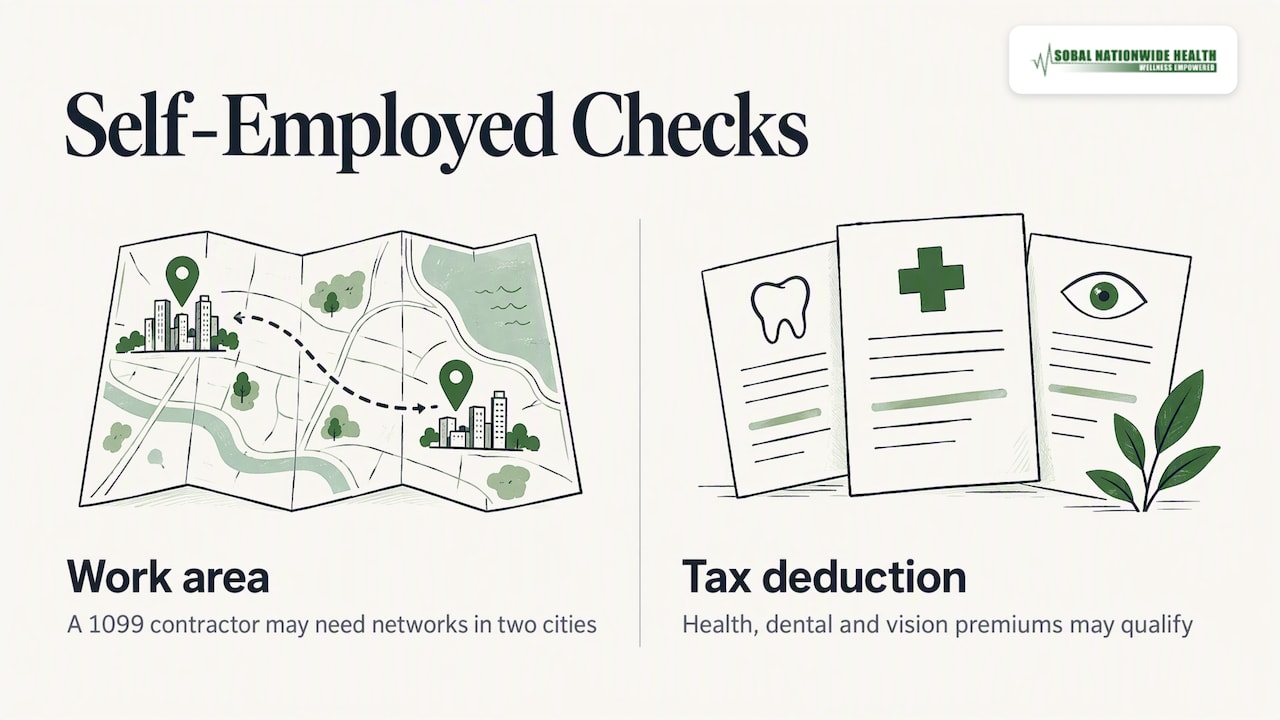
Where the plan sits. Your plan’s network and service area need to match where you really work and live. A 1099 contractor who takes clients in two cities needs a network that works in both.
The tax deduction. You may be able to deduct what you paid for health, dental and vision insurance on Schedule 1 (Form 1040), line 17, using Form 7206. The IRS instructions explain who qualifies, and how the policy is established under your business can affect that. The draft 2026 instructions describe the same rules. A tax professional can tell you how this applies to you.
Our perspective
We talk to self-employed people, freelancers and families every week, and the same pattern shows up. People pick an HMO or EPO for the low premium, then discover that their doctor isn’t in the network or that the deductible is far higher than they expected. The plan label was never the problem. They just never got the full picture.
Our approach is education first. We’re an independent brokerage working in 31 states, and we help people compare ACA marketplace plans alongside private medically underwritten plans, including portable and nationwide PPO options. We have English and Spanish-speaking brokers, and we don’t push you toward anything. If an HMO or EPO is the right fit for your doctors and budget, we’ll tell you.
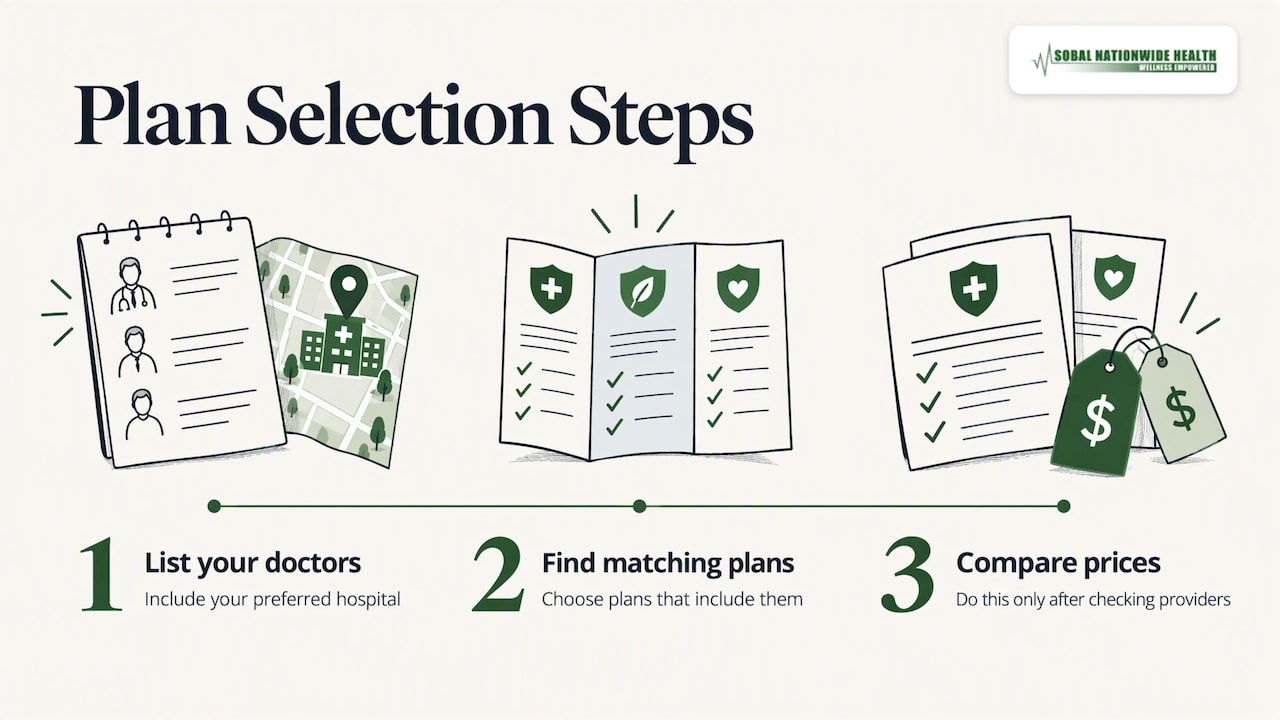
My honest advice is to start with your doctors, not the plan type. List who you see and which hospital you’d want. Then find plans that include them, and only then compare prices.
— Bernie S
How we can help you compare
If you’re stuck between plans, we’ll review them with you one on one. We help individuals and families through our personal and family insurance options, including medically underwritten health plans, dental and vision, and supplemental coverage. For owners with employees, see our business health insurance page. You can also start at sobalhealth.com to talk to a broker in English or Spanish.
FAQ
What is the main difference between an EPO and an HMO?
An HMO usually requires you to choose a primary care doctor and get a referral before seeing a specialist. An EPO usually doesn’t require either. Both generally cover only in-network care outside emergencies.
Is an EPO better than an HMO?
Neither is better for everyone. An EPO gives you more freedom to book specialists directly, while an HMO gives you structured, coordinated care that can help with chronic conditions. Choose based on your doctors, your travel habits and the total yearly cost.
Does an EPO cover out-of-network doctors?
Generally no, except in an emergency. HealthCare.gov says EPOs offer no coverage for out-of-network services outside emergencies. If you need that flexibility, look at a PPO.
Is an EPO cheaper than an HMO?
Often an EPO has a higher premium than an HMO and a lower one than a PPO, but that varies by plan. Your total cost also depends on the deductible, copays and coinsurance. Compare the full benefit summary, not just the monthly premium.
Can I switch if I pick the wrong one?
Usually only during open enrollment or after a qualifying life event, though rules vary by plan type and state. Ask a broker about your timing and options before you enroll.
Sources
- Health insurance plan and network types, HealthCare.gov
- Exclusive Provider Organization (EPO) glossary, HealthCare.gov
- Compare PPOs, EPOs, and HMOs, California Department of Insurance
- Types of Health Coverage, California Department of Insurance
- Health Plan Definitions, California Department of Insurance
- Health Insurance Basics, CMS
- What You Should Know About Provider Networks, CMS
- Instructions for Form 7206 (2025), IRS
- 2026 Instructions for Form 7206 (draft), IRS
