

If you need health insurance in Spanish, your fastest options are a Spanish-speaking broker or Healthcare.gov’s “Find Local Help” tool, which connects you with assisters who work in Spanish at no cost. Call a bilingual broker today or search the local-help directory for someone near you. Sobal Nationwide Health offers Spanish-speaking brokers who compare plans and handle enrollment for you, start to finish.
TL;DR:
- Spanish-speaking brokers can significantly reduce confusion by providing clear explanations of deductibles, out-of-pocket maximums, and provider networks in Spanish.
- Their availability varies by state, with licensed brokers working across 31 states and many offering side-by-side comparisons of private, marketplace, and group plans.
- Confirm that your broker or agent offers plan documents in Spanish and provides a Spanish customer service line before enrolling.
- Gathering essential documents such as ID, proof of income, and household info in advance speeds up enrollment and helps brokers or assisters provide faster help.
- Choosing a bilingual broker over a purely English-language process leads to better understanding, fewer errors, and potentially substantial cost savings.
Table of Contents
- Health Insurance in Spanish: What Are Your Plan Options?
- How Do You Choose the Right Spanish-Language Plan or Agent?
- What Documents Do You Need to Enroll in Spanish?
- How Sobal Health Supports Spanish-Speaking Clients
- Why Spanish-Language Help Actually Changes Outcomes
- Sources
Health Insurance in Spanish: What Are Your Plan Options?
Not every type of health coverage offers the same level of Spanish-language support, and knowing the difference saves you a lot of frustration. Let me walk you through the main categories, because picking the right one depends heavily on your work situation and household.
Private medically underwritten plans are individual policies you apply for directly, often through a broker, and your rate is based partly on your health history. These plans can come with lower premiums than marketplace options for people in good health, and a bilingual broker can walk you through the Spanish version of every question on the application. ACA marketplace plans are the government-run exchange plans most people associate with “Obamacare.” Healthcare.gov itself offers a Spanish-language version of its site, and many of the local assisters listed there speak Spanish fluently. Employer or group coverage is what you get through a job, and while the plan documents are sometimes only in English, HR departments at larger companies increasingly provide Spanish summaries. If you or a family member qualifies for Medicare or Medicaid, both programs publish Spanish-language handbooks and offer phone support in Spanish, though wait times and plan variety are more limited than with private coverage.
Here’s how the four options typically break down by who they serve best:
- Individuals in good health: often save the most with private medically underwritten plans.
- 1099 workers and freelancers: usually split between marketplace subsidies and private plans depending on income.
- Families: frequently need marketplace or employer coverage for pediatric and maternity benefits.
- Small-business owners: often look at group plans to cover employees, which come with their own comparison process.
Self-employed workers face a particularly tricky decision here, since 1099 income changes the subsidy math every year depending on how much you earned.
How Do You Choose the Right Spanish-Language Plan or Agent?
Choosing a plan without understanding the terms is like signing a lease without reading it. You wouldn’t do it, so don’t do it here either. Start by comparing four numbers side by side, no matter what language the paperwork is in: the premium (what you pay monthly, or la prima mensual), the deductible (el deducible, what you pay before insurance kicks in), the out-of-pocket maximum (el máximo de gastos de bolsillo, your financial safety net for the year), and the network of doctors (la red de proveedores).
Before you sign anything, confirm three things with the agent or carrier:
- Is there a Spanish-speaking customer service line you can call after enrollment?
- Are the actual plan documents, not just the sales brochure, available in Spanish?
- Can you search the provider directory in Spanish to find doctors near you?
When you get an agent on the phone, ask directly: “¿Puede explicarme esto en español?” and see how they respond. A good agent answers without hesitation and offers to send you written explanations of how the plan works. Watch for red flags: no Spanish documents available at all, vague or evasive answers about costs, or heavy pressure to sign before you’ve had time to think it over. None of that should happen with a legitimate broker.
Pro Tip: Ask the agent to send you a written breakdown of the deductible and out-of-pocket max in Spanish before you agree to anything. If they can’t produce it in writing, that tells you something about how they’ll handle you after enrollment.
If cost is your biggest concern, two paths are worth checking before you commit: marketplace subsidies based on your income, and medically underwritten private plans if you qualify based on health history. Both can lower your monthly bill significantly compared to a standard unsubsidized plan.
What Documents Do You Need to Enroll in Spanish?
Enrollment goes faster when you gather your paperwork first. Here’s what most applications ask for, with the Spanish terms you’ll see on the forms:
- Government-issued ID (identificación con foto)
- Proof of income, like pay stubs or tax returns (comprobante de ingresos)
- Social Security number or ITIN (número de Seguro Social o ITIN)
- Household information, including everyone who needs coverage (información del hogar)
Once your documents are ready, you have two main routes to actual human help in Spanish. The first is Healthcare.gov’s “Find Local Help” tool, which lets you search by zip code for in-person or virtual assisters, many of whom offer services in Spanish at no cost to you. The second is working with a bilingual broker, which makes more sense if you want someone comparing private and marketplace options side by side rather than walking you through marketplace enrollment alone.
A broker’s job during this process is straightforward: they pull quotes from multiple carriers, review every document with you in Spanish, submit your application, and follow up if anything gets flagged or delayed. That follow-up step matters more than people realize, since a missing document can hold up your coverage start date for weeks.
After you enroll, expect your ID card within one to two weeks, your first premium payment due before coverage begins, and the ability to update your plan or personal information anytime through your broker or the carrier’s member portal, with clear guidance on insurance billing and payment options to help you manage post-enrollment steps effectively.
How Sobal Health Supports Spanish-Speaking Clients
Here’s where the pieces come together. Sobal Nationwide Health works with Spanish-speaking brokers who handle everything from private medically underwritten plans to ACA marketplace enrollment, group coverage for small businesses, and add-ons like dental, vision, and supplemental accidental or critical illness insurance.

Sobal Health is licensed across 31 states, so whether you’re an individual shopping for your first plan or a small-business owner setting up group coverage, there’s a real chance a licensed broker is already working in your state. Client reviews cite meaningful savings after switching, with some households reporting reductions of up to $400 per month, often after moving from a high-premium marketplace plan into a medically underwritten private option.
Your first call typically covers your household size, income situation, and current coverage, if any. Bring the same documents listed above and your broker takes it from there, comparing plans and explaining every line item in Spanish. If you’re self-employed, check the self-employed coverage guide first, or if you’re a family, start with the family plan cost breakdown. Ready to talk to someone? Reach out through Sobal Health’s contact page and ask specifically for Spanish-language assistance.
Why Spanish-Language Help Actually Changes Outcomes
The biggest problem I see isn’t that Spanish speakers don’t understand insurance. It’s that most plan documents are written in English first and translated, badly, second. Terms like “coinsurance” and “prior authorization” get garbled in translation, and people end up guessing at what their plan actually covers until a surprise bill arrives.
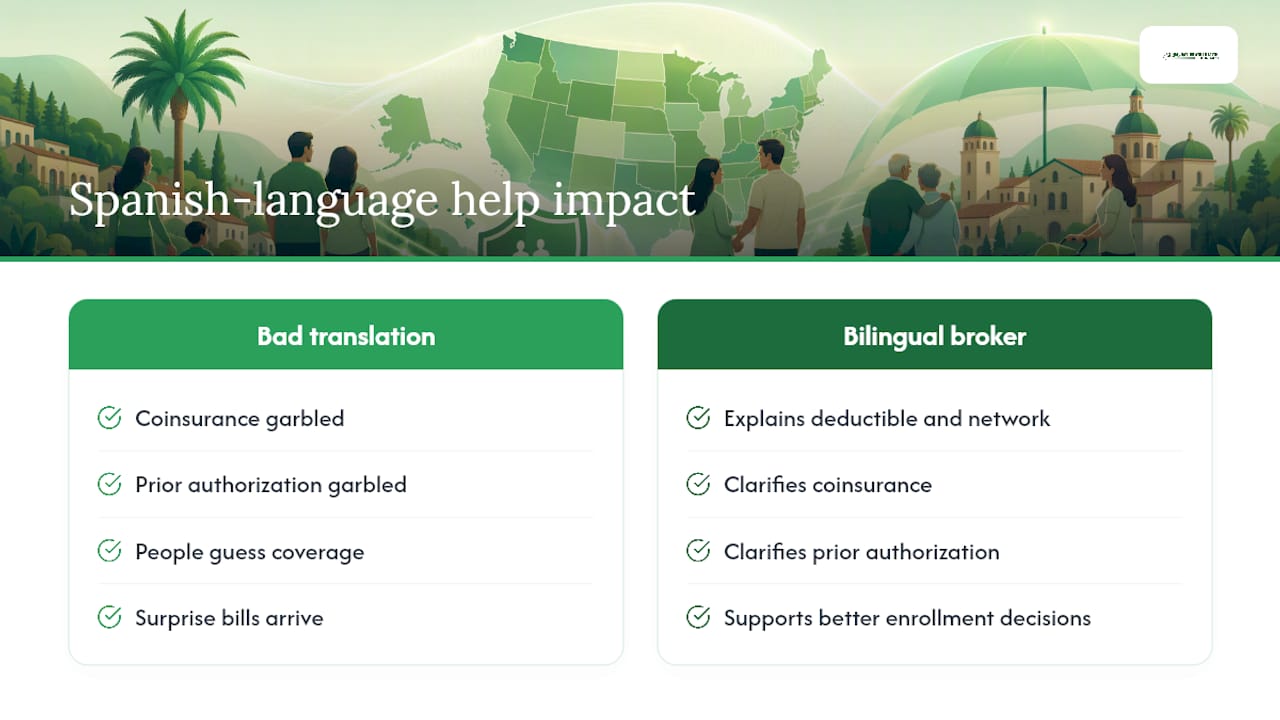
A bilingual broker changes that dynamic completely. When someone explains your deductible and network rules in your own language, from the start, you make better decisions and avoid the costly mistakes that come from signing something you didn’t fully understand. This isn’t a minor convenience. It’s the difference between a plan that works for your family and one that quietly fails you the first time you need it.
If you’re weighing your options right now, call a Spanish-speaking broker before you enroll anywhere else.
— Bernie S
