

If you are retiring before 65, your main routes to coverage are a Marketplace plan through a Special Enrollment Period, COBRA continuation, retiree coverage from your former employer, or a private medically underwritten plan, with Medicaid available if your income qualifies. The clock starts the moment your job-based coverage ends, so confirm your exact coverage end date and begin an application within 60 days to avoid a gap.
TL;DR:
- A Marketplace enrollment window lasts 60 days after job coverage ends, but voluntarily dropping COBRA generally does not create a new enrollment window.
- Medicare Part B enrollment stays open for eight months after employer coverage ends at 65 or later; applying before coverage ends helps prevent gaps.
- Marketplace subsidies depend on household income, while private underwriting may lower premiums for healthy retirees but can raise rates or exclude conditions.
- COBRA preserves your existing doctors, network, and prescriptions, but costs the full premium plus a 2% fee; compare total treatment costs before keeping it.
- Retiree plans may require Medicare Parts A and B at 65; delaying Part B can reduce benefits, so confirm enrollment rules with the former employer.
Table of Contents
- Coverage options explained: marketplace, COBRA, retiree plans, private plans, and Medicaid
- Enrollment timing, special enrollment periods, and coordinating your medicare sign-up
- Cost and subsidy considerations: how to estimate what you’ll pay
- If you have retiree health benefits: what to confirm with your benefits administrator
- Decision checklist: choose the right coverage until medicare
- Why a brokered, medically underwritten review is a useful next step
- Options for prescription drug coverage prior to medicare part D eligibility
- How to handle pre-existing conditions when selecting health insurance before medicare
- Navigating state-specific regulations and programs that may affect retiree coverage
- Understanding coverage gaps and exclusions in retiree health plans before medicare
- Author perspective and practical encouragement
- Sobal Health: how we help early retirees bridge coverage gaps
- FAQ
- Sources
Coverage options explained: marketplace, COBRA, retiree plans, private plans, and Medicaid
Once you give notice at work, you have five realistic paths to carry you to Medicare. Each works differently, and the right one depends on your health needs, your budget, and how close you are to 65.
Losing job-based coverage when you retire triggers a Special Enrollment Period on the Marketplace. You get 60 days from the date your coverage ends to enroll, and if you pick a plan before that date, coverage usually starts the first day of the following month. Marketplace plans also come with income-based subsidies, which can make them considerably cheaper than other options for retirees with modest post-work income.
COBRA lets you keep your exact employer plan, same doctors, same network, for a limited stretch, often up to 18 months. The tradeoff is cost: you pay the full premium your employer used to help cover, plus a 2% administrative fee, with no employer subsidy softening the blow. It is worth holding onto when your out-of-pocket costs under COBRA are meaningfully lower than anything else you can find, usually because you are mid-treatment or have a plan with an unusually generous network.
Retiree employer coverage, when your former employer still offers it, tends to be the most convenient option, but it comes with fine print about how it coordinates with Medicare once you turn 65 and limits on who else it covers.
Private medically underwritten plans ask about your health history before pricing your coverage. For retirees in good health, underwriting can produce lower premiums than an unsubsidized Marketplace plan, though applicants with chronic conditions may face higher rates or exclusions.
If your household income drops enough after retirement, Medicaid eligibility is worth checking. It has no annual enrollment window, coverage can begin right away, and it costs little to nothing if you qualify.
Quick rundown of what each option is built for:
- Marketplace SEP: subsidized coverage, new plan, 60-day window to enroll.
- COBRA: same plan you already have, full price, best for continuity of care.
- Retiree employer plan: convenient but needs Medicare coordination at 65.
- Private medically underwritten plan: potentially lower cost if you are healthy.
- Medicaid: immediate, low-cost coverage if your income qualifies.
Enrollment timing, special enrollment periods, and coordinating your medicare sign-up
Timing mistakes cause more coverage gaps than any other factor in this transition, so treat your calendar as seriously as your coverage choice.
Your Marketplace SEP gives you 60 days from the date job-based coverage ends to apply, and selecting a plan before the end of the prior month usually means coverage starts on the first of the next month. Wait too long, and you risk a gap with no coverage at all.
Separately, if you had employer coverage when you turned 65 or worked past 65, Medicare gives you an 8-month Special Enrollment Period for Part B that starts the month after your employment or employer coverage ends. Signing up the month before your coverage ends is the safest move, since it helps you avoid a gap between losing employer coverage and Medicare kicking in.
One detail trips up a lot of retirees: if you voluntarily cancel COBRA early, you typically do not qualify for a new Marketplace SEP, while an involuntary loss of coverage does. In plain terms, choosing to stop paying for COBRA on your own schedule can leave you stuck without a path back to subsidized coverage, so confirm your SEP status before you cancel anything.
Once your retirement date is firm, work through this sequence:
- Call your HR or benefits administrator to confirm your exact coverage end date in writing.
- Request COBRA election paperwork even if you think you will not use it, since it preserves your options.
- Start your Marketplace application the same week, before the 60-day SEP clock runs out.
- If you are within eight months of losing employer coverage and are 65 or older, contact Social Security to begin Medicare Part B enrollment.
- Keep copies of every coverage-end letter. You will need them as proof of SEP eligibility.
Pro Tip: Set a calendar reminder for the month before your employer coverage ends. Medicare Part B enrollment that month, rather than after, is what actually prevents a lapse.
Cost and subsidy considerations: how to estimate what you’ll pay
The sticker price on a plan rarely tells the whole story. What you actually pay depends on your income, your age, and which type of plan you choose.
Marketplace premiums are subsidized through premium tax credits based on your household income relative to the federal poverty line. The catch for many early retirees is the so-called subsidy cliff: once your income rises above the eligibility threshold, subsidies disappear and you pay full price. KFF’s analysis found that older Marketplace enrollees, ages 50 to 64, face the steepest premium increases if enhanced tax credits expire or shrink, since insurers charge older applicants more to begin with underage rating rules.
Older enrollees face the sharpest cost exposure: KFF’s research shows that retirees in the 50 to 64 age bracket are disproportionately affected by subsidy changes, since age rating already pushes their unsubsidized premiums higher than younger enrollees pay.
A few cost comparisons worth running before you decide:
- COBRA costs the full premium plus a 2% administrative fee, with no employer contribution.
- Marketplace plans can be far cheaper after subsidies, but only if your income falls under the eligibility threshold.
- Private medically underwritten plans may beat both if you are healthy, since insurers price based on your personal risk rather than a community-wide average.
- Retiree employer plans vary widely. Some are nearly free, others cost more than COBRA.
If your income lands you near or above the subsidy cliff, a private plan comparison against your unsubsidized Marketplace quote is worth doing before you commit.
If you have retiree health benefits: what to confirm with your benefits administrator
Retiree coverage sounds like the easy button, but it behaves differently once Medicare enters the picture, and the details matter more than most retirees expect.
Before you assume your retiree plan will simply continue as is, confirm these points directly with your former employer’s benefits team:
- Whether the retiree plan pays primary or secondary once you are eligible for Medicare.
- Whether the plan requires you to enroll in both Part A and Part B, and what happens to your benefits if you delay.
- How spousal coverage works and whether your spouse’s benefits change when you enroll in Medicare.
- Whether joining a Medicare plan changes your retiree benefits or cost-sharing maximums.
Many retiree plans act like a supplement once Medicare becomes primary, paying second on claims Medicare already covered in part. That also means delaying Part B enrollment, when your plan requires it, can leave you underinsured rather than simply saving you a premium.
One more deadline to know: you generally get a limited window, often six months after enrolling in Part B, to buy a Medigap policy with guaranteed issue. Miss it, and insurers can medically underwrite you or decline coverage altogether.
Decision checklist: choose the right coverage until medicare
With the mechanics covered, here is the order of operations we recommend to retirees working through this decision.
- Confirm your exact coverage end date with HR or your benefits administrator, in writing.
- Estimate your household income for the year to see where you land relative to subsidy thresholds.
- Compare the monthly premium plus likely out-of-pocket costs for COBRA, a Marketplace plan, and a private medically underwritten option.
- Confirm your SEP windows for both the Marketplace and Medicare Part B so you know your deadlines.
- Choose a plan, or start a broker review if you want a second set of eyes on the comparison.
A few decision triggers that tend to settle the choice quickly: keep COBRA if your cost-sharing under that plan is substantially lower than alternatives, even with the higher premium. Choose a Marketplace plan if your income qualifies you for a significant tax credit. Keep your retiree plan if it pays primary to Medicare and costs little. Lean toward a private medically underwritten plan if you are healthy and the Marketplace quote, unsubsidized, is hard to justify.
Pro Tip: Run the numbers before your coverage ends, not after. A side-by-side comparison takes less time than you think and can save hundreds of dollars a month.
The one action that moves everyone forward: contact your benefits administrator this week, and start either a Marketplace application or a broker consultation in parallel, so you are never choosing under deadline pressure.
Why a brokered, medically underwritten review is a useful next step
Medically underwritten plans price your coverage based on your personal health history rather than community averages, which can mean lower premiums if you are in good health. We focus on personalized plan comparisons rather than a one-size-fits-all pitch, and client reviews often report meaningful monthly savings. A broker review makes the most sense when you want underwritten options the public Marketplace does not display. Self-enrolling on the Marketplace works fine when your income already qualifies you for strong subsidies.
Options for prescription drug coverage prior to medicare part D eligibility
Medication costs do not pause just because you have not reached Medicare yet, so your drug coverage deserves its own check, separate from your medical plan choice.
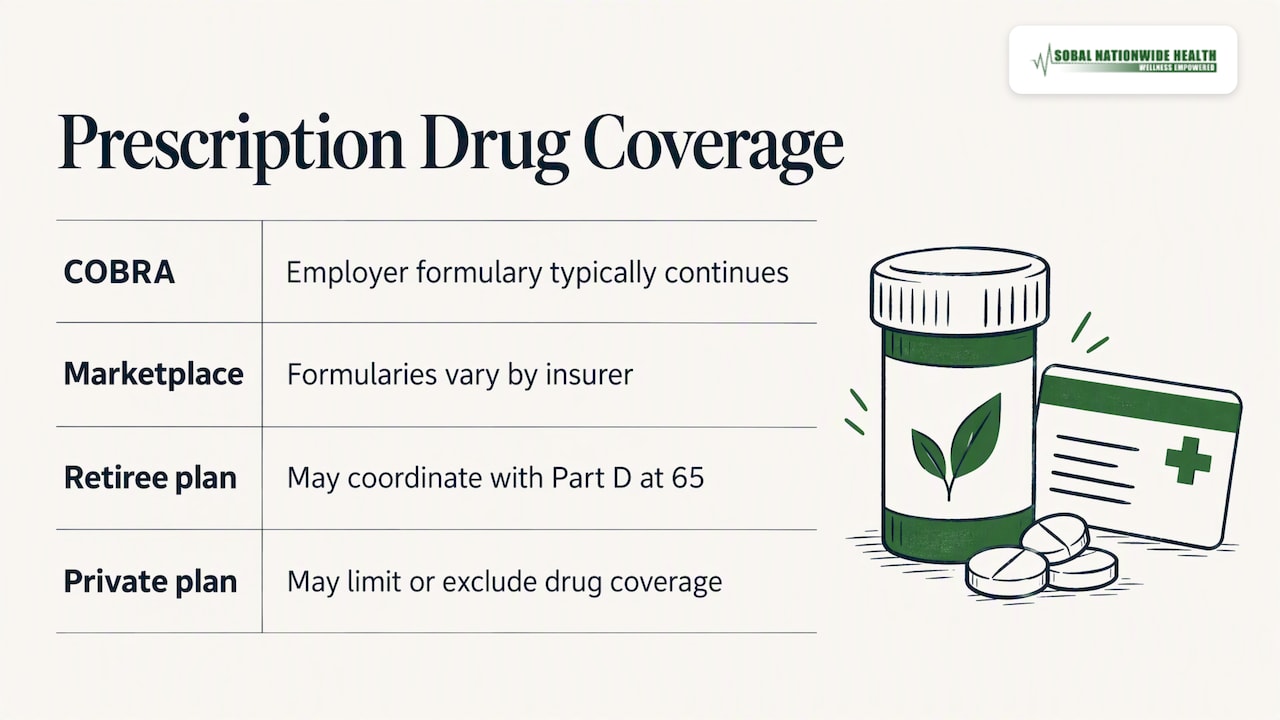
If you stay on COBRA, your prescription benefits typically continue exactly as they were under your employer plan, drug formulary and all, which is one reason some retirees keep COBRA through a course of ongoing treatment. Marketplace plans each carry their own drug formulary, and formularies vary significantly between insurers, so if you take maintenance medications, check the specific plan’s drug list before enrolling rather than assuming coverage carries over.
Retiree employer plans sometimes include drug coverage that coordinates with Medicare Part D once you turn 65, though the details depend entirely on your former employer’s plan design, which is another reason to confirm directly with your benefits administrator.
Private medically underwritten plans may offer more limited drug coverage, or none at all for certain conditions, depending on your health history and the insurer’s underwriting guidelines. If prescription costs are a major part of your monthly budget, weigh that tradeoff carefully against any premium savings before choosing an underwritten plan over a Marketplace option.
Whichever route you choose, confirm the specific formulary and your expected copays for your actual medications before you enroll, since the plan with the lowest premium is not always the cheapest once prescriptions are factored in.
How to handle pre-existing conditions when selecting health insurance before medicare
Your health history shapes which of these options actually works for you, so it is worth addressing directly rather than discovering the impact after you have already enrolled.
Marketplace plans cannot deny you coverage or charge you more because of a pre-existing condition. That protection makes the Marketplace a reliable fallback if you have ongoing health needs and want predictable premiums regardless of your medical history.
Private medically underwritten plans work differently. Insurers review your health history before quoting a price, and a significant pre-existing condition can mean a higher premium, a coverage exclusion for that specific condition, or in some cases a decline. For a healthy retiree, underwriting often produces savings. For someone managing a chronic condition, it can work against you, which is why a side-by-side comparison against a Marketplace quote matters before you commit either way.
COBRA and retiree employer coverage sidestep this issue entirely, since you are continuing a plan you already qualified for, with the same coverage for existing conditions you had while employed.
If you are unsure how a specific condition would be treated under a private plan, that is exactly the kind of question worth asking a licensed broker before you apply, since an application denial can complicate your options later.
Navigating state-specific regulations and programs that may affect retiree coverage
Health insurance rules are not uniform everywhere, and a program available to a retiree in one state may not exist for a retiree in another.
Medicaid eligibility thresholds, for example, vary by state, so the income level that qualifies you in one state may not apply across a state line. Some states also run their own Marketplace exchanges with additional state-funded subsidies on top of federal premium tax credits, which can change your actual out-of-pocket cost beyond what the federal subsidy calculator shows.
State insurance departments also regulate which private medically underwritten plans and short-term plans are sold within their borders, so availability and plan design can differ meaningfully depending on where you live. A plan that is common in one state may not be offered at all in another.
Given how much this varies, the most reliable step is confirming the specific rules for your state, either through your state’s Marketplace exchange if it runs one, or with a broker licensed in your state who can walk through the options actually available to you. Generic national advice is a reasonable starting point, but your final decision should be based on what is actually sold and subsidized where you live.
Understanding coverage gaps and exclusions in retiree health plans before medicare
Reading the fine print now saves you an unpleasant surprise later, particularly around what a retiree plan does and does not cover.
Retiree employer plans sometimes exclude or limit coverage for services that were standard under your active-employee plan, since many employers scale back retiree benefits deliberately to manage costs. Network restrictions are common too: a retiree plan may cover a narrower set of doctors and hospitals than you had while working, especially if you move out of the area the plan was designed for.
Private medically underwritten plans can carry exclusions tied directly to your health history, meaning a specific condition might be carved out of coverage entirely rather than just priced higher. It is worth asking directly whether any condition is excluded, rather than assuming a quoted premium means full coverage for everything.
COBRA, by contrast, continues your exact prior plan, so gaps are unlikely there, though the cost is the tradeoff.
Across every option, the practical move is the same: request the plan’s summary of benefits and coverage before enrolling, and specifically ask about exclusions related to any condition you currently manage. A quick question now is far easier than an appeal after a denied claim.
Author perspective and practical encouragement
The biggest mistakes we see are timing errors, not plan choice errors. Confirm your coverage end date, check your subsidy eligibility early, and if the numbers get confusing, get a licensed review before you enroll anywhere.
— Bernie S
Sobal Health: how we help early retirees bridge coverage gaps
We built our business around exactly this moment: the stretch between leaving a job and reaching Medicare, when the usual advice assumes you can only shop the public Marketplace. Our brokers compare your COBRA quote, your Marketplace options, and private medically underwritten plans side by side, so you can see the actual tradeoffs rather than guessing.

A consultation with us typically includes:
- A review of your current coverage and your exact end date.
- A cost comparison across COBRA, Marketplace, and private underwritten plans.
- Personalized plan recommendations based on your health history and budget, with no pressure to buy on the spot.
If you want a second opinion before your coverage lapses, start a personal insurance review with our team.
This article is general information, not a substitute for advice from a qualified financial advisor. Consult a qualified financial professional about your own circumstances before acting on anything here.
FAQ
How to get health insurance if you retire before Medicare?
You can enroll in a Marketplace plan through a Special Enrollment Period within 60 days of losing job-based coverage, continue your employer plan through COBRA, keep retiree coverage if your former employer offers it, or apply for a private medically underwritten plan. Checking Medicaid eligibility is also worth doing if your income drops after retirement.
If I have retiree health insurance, do I need Medicare Part B?
Many retiree plans require you to enroll in Medicare Part A and Part B once eligible, and delaying Part B when your plan requires it can reduce or eliminate your retiree benefits. Confirm the exact requirement with your benefits administrator before deciding to delay.
How much does health insurance cost if you retire before 65?
Costs vary widely based on income, age, and plan type: COBRA means paying the full premium plus a 2% administrative fee, while Marketplace plans can cost far less if you qualify for premium tax credits. Older enrollees face steeper unsubsidized premiums due to age rating, which makes a personal cost comparison important before choosing a plan.
What is the best health insurance for retirees before Medicare?
There is no single best option. It depends on your income, health, and whether you qualify for subsidies: Marketplace plans suit retirees who qualify for tax credits, COBRA suits those who want to keep existing providers, and private medically underwritten plans can suit healthy retirees seeking lower premiums outside the subsidized Marketplace.
Sources
- Working past 65 | Medicare
- If Enhanced ACA Tax Credits Expire, Older Marketplace Enrollees Face Steepest Premium Hikes | KFF
